
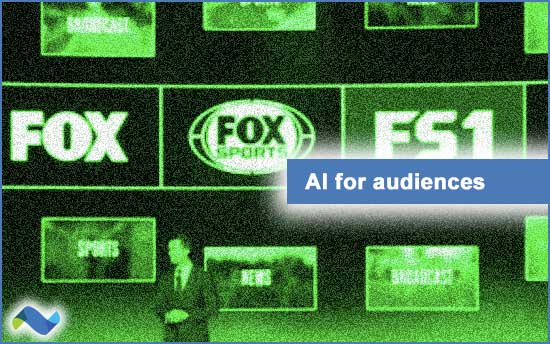
Fox’s TV Upfronts presentation in New York City on Monday included its new Fox Fan OS, which attempts to address interactivity with live sports lineup.
Adweek’s Mark Stenberg reported about the OS/platform:
“According to chief technology officer Melody Hildebrandt, the platform is an ‘agentic AI-native media operating system’ built on two connected platforms: Fox Fan Studio, which powers consumer experiences, and Fox AdStudio, which connects brands to those audiences.
Fox runs AI inference against every second of its raw video in real time, extracting topic, talent, mood, and vibes, before comparing those insights against performance data to understand what resonates with fans, Hildebrandt said.
AdStudio offers advertisers a converged audience graph, a contextual engine for scene-level targeting, and full-funnel measurement across more than 20 data partners, with the ability to plug directly into brands’ own AI agents.”
Read: “At Fox’s Upfront, the World Cup, Tubi, and AI Adtech Headline the Pitch” (May 12) – Adweek
More: FOX Advertising Launches FOX AdStudio, Unifying Audience Intelligence Across Its Premium Portfolio (April 26) – FOX
LLMs & CHATBOTS
Developments
- SAP Launches Unified AI, Automation Suite (May 12) – The Wall Street Journal (subscription)
- A smarter, more proactive Android with Gemini Intelligence (May 12) – Google’s The Keyword blog
- Threads tests a Meta AI integration that works similarly to Grok (May 12) – TechCrunch
CONNECTED TV
Q&A: Vibe enhances its CTV bidding model
In late April, self-serve CTV and streaming platform Vibe announced the launch of its new AI optimization model Keanu 3.0, which it describes as a “unified multi-head prediction model for CTV performance bidding.”
Vibe CEO Arthur Querou said of Keanu, “Rebuilt from the ground up. Already driving +12.4% ROI than its previous version. Not only is it a huge leap, it’s also a foundation that will enable us to move faster and deliver stronger optimizations in the future.”
Read: “Introducing Keanu 3.0” (April 7) – Vibe
Vibe VP of Product Arnaud Blanchard answered a selection of follow-up questions from tipsheet via email.
tipsheet: What makes Keanu 3.0 an AI system rather than a traditional optimization engine?
Arthur Blanchard: Traditional ad optimization is a rate card with math on top. Take a target CPA, estimate a conversion rate, submit a bid. The “intelligence” is the pacing logic keeping you on budget.
Keanu is a calibrated probabilistic prediction system. For every ad opportunity, the model outputs a predicted action-through rate (pATR): the actual probability that this specific impression will generate the advertiser’s target outcome, given this auction, this publisher, this user state, this ad pod. The bid is a direct function of that probability.
How should we think about Keanu in an agentic context?
Right now, Keanu is an automated decision system operating within a fixed decision space. It decides what to bid, at what price, on which impression. This limits the need for an operator—human or agentic—to manage a complex set of controls and allows them to focus on what is essential: setting goals, choosing budgets, and adjusting based on performance. By automating these tactical bidding choices, Keanu streamlines the execution layer while humans or higher-level agents maintain strategic oversight.
Additional questions include:
- Arthur described it as “rebuilt from the ground up.” What actually changed in Keanu 3.0?
- What is the model optimizing for exactly?
- What data feeds the feedback loop?
- Where does human control end and the model take over?
- Does this make CTV a prediction problem, and then, where does Keanu live?
Read: “Q&A: Vibe improves CTV bidding with AI and Keanu 3.0” (May 12) – tipsheet
TECH
The components of AI-enabled advertising
In a new essay, Mobile Dev Memo analyst Eric Seufert broke down what he sees as the four major layers of AI-enabled advertising:
- AI-based creative generation
- AI-enabled campaign optimization
- AI-enabled retrieval and ranking
- AI-enabled conversion optimization and measurement
Seufert argues that “chatbot ads” themselves are getting overemphasized in discussions around AI and advertising. How AI is changing systems underneath advertising is what matters such as those represented in the bulleted list.
He also revisits the rise of “black box” campaign products from major platforms including Meta Advantage+, Google Performance Max and Amazon Performance+, arguing that these systems increasingly maximize spend against ROAS constraints while reducing manual advertiser control.
One of Seufert’s broader points: retrieval and ranking systems (e.g. RecSys) may ultimately become the most important AI investment area because improvements benefit both recommendations and advertising simultaneously.
Read: “Components of AI-enabled advertising” (May 12) – Eric Seufert on Mobile Dev Memo (subscription)
Podcast: “The Prosperous Society, Part 1: The Primacy of Distribution” (February 24) – Eric Seufert on Mobile Dev Memo
From tipsheet: Important post that should age well as industry participants consider the advertising and marketing road ahead. Increasingly, AI is becoming the underlying operating system for advertising itself.
COMMERCE MEDIA
Retailers serve product feed ads in ChatGPT
Product feed ads are showing up in consumer conversations in ChatGPT, according to Digiday.
Digiday’s Krystal Scanlon reports:
“To be clear, the ad itself looks the same to the user. The so-called ‘product feed’ campaign will still appear in the same placement as any other ChatGPT ad — below the response, clearly labelled as sponsored. What’s new is what’s happening behind the scenes. Retailers connect their product catalog, set filters for which products are eligible and let the platform handle the rest, generating ads automatically from product names, images and attributes in the feed.”
Read: OpenAI makes it easier to run shopping ads in ChatGPT (May 12) – Digiday (subscription)
Retailer product feeds, including Shopify, have been making their way into ChatGPT conversations since last year when OpenAI envisioned an agentic commerce future which was reportedly mothballed in March. What’s different now is that retailers are paying for placement in the conversation.
The ‘organic’ (non-paid) product feed powering the LLM is still full steam ahead. See “Power product discovery in ChatGPT.”
From tipsheet: What’s old is new. ChatGPT commerce is starting to resemble search: organic discovery alongside sponsored product placement inside conversational interfaces.
AGENCIES
The agency opportunity in the age of AI
In Australian financial publication Financial Review, the transformation of the agency model due to AI gets a deeper look — and with participation from agency leaders.
As is common in stories like this, the traditional agency model is framed as a relic of the past.
Noting the automation of workflow, Jessica Tamsedge, chief executive of Dentsu Creative, says the “removal of friction is reshaping our industry” with “cash flow, commission and day rates all squeezed by AI and technology”.
Financial Review finds some light at the end of the tunnel for agencies:
“David Jones, chief executive of marketing technology group Brandtech, says the worst is yet to come for the large advertising agencies, but not for the talented workers in them.
‘AI is less than 1 per cent of how advertising is done, but 70 per cent of advertising will be done with no humans in the loop,” he says. “Agencies are less and less relevant. But in a world of GenAI, brand, creativity and human taste and judgment have never been more important.’”
Former WPP CEO Mark Read succinctly captures at least part of agencies’ future opportunity, “The big idea is still important, but it’s not where agencies make the money any more. It’s now how the idea is being transmitted.”
Related: “CMOs tread line between maths and magic” (April 27) – Financial Times (subscription)
Read: “‘Mad Men’ era over as AI takes over advertising” (May 12) – Financial Review
From tipsheet: In the AI era, part of the economic value may shift from the idea itself to the optimization systems transmitting it. But the idea — the thing people actually remember, feel and act on — still matters.
FINANCIALS
Strong ad revenue growth at Comcast, elsewhere
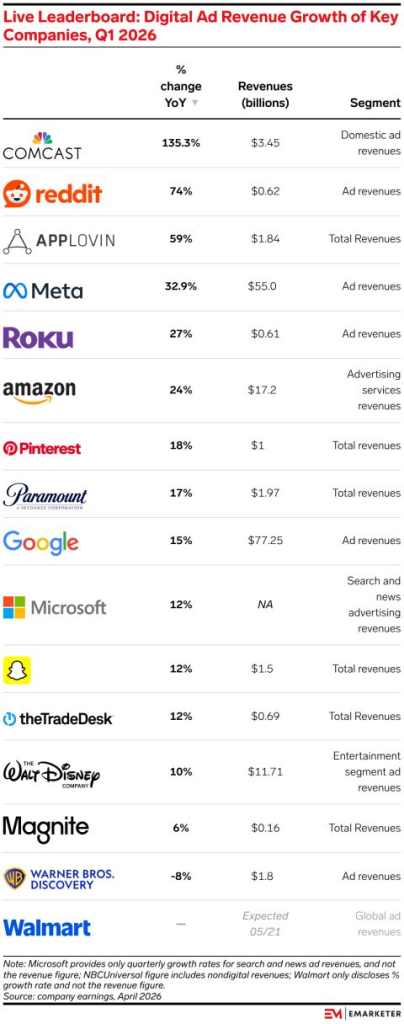
Emarketer compiled a list of ad-supported companies organized by the year-over-year growth rate of their advertising business as of Q1 2026.
Meta, Google and Amazon are enormous, of course — but Comcast won with 135% quarterly ads growth “driven by a strong sports lineup that included the Olympics and Super Bowl,” according to eMarketer analyst Marisa Jones. Read more. (May 11)
From tipsheet: Strong quarter for digital ads!
LLMs & CHATBOTS
OpenAI researchers on ChatGPT usage data
From data covering Q1 of 2026, OpenAI researchers took another look at consumer use of ChatGPT.
(In this study, the company excluded use of Codex, ChatGPT education and enterprise products. But, “B2B” data was released separately last week.)
The findings mostly avoid commerce signals. But you can extrapolate.
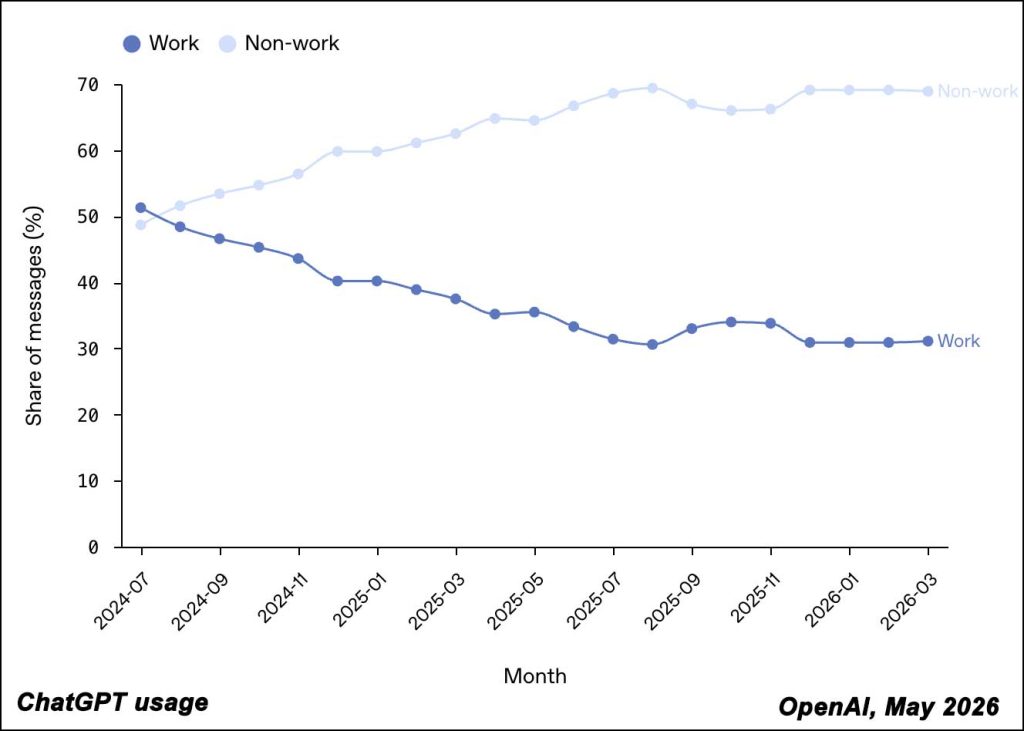
One of the most striking graphs shows consumers increasingly using ChatGPT for “non-work.”
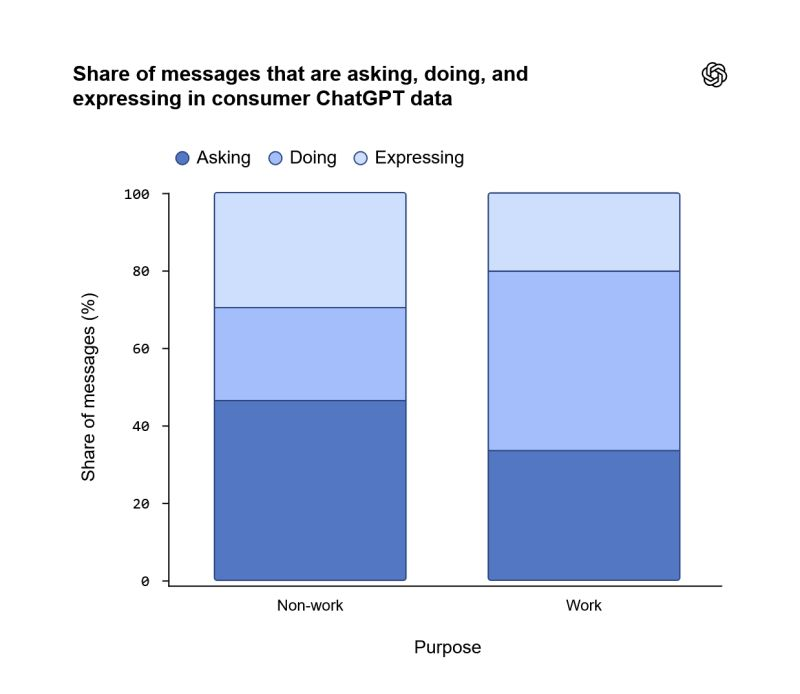
After reviewing the report, Stefano Puntoni, Wharton Professor of AI & Behavioral Science, picked one of his favorite graphs. He said on LinkedIn (May 12), “Work use is more about doing, while personal use is more about asking and expressing. But it’s a difference of degree more than kind. See graph.”
Read:
- Signals consumer data (May 11) – OpenAI
- Download data and methodology – OpenAI
- OpenAI B2B Signals (May 6) – OpenAI
Related: “Wikipedia and Reddit Now Drive Over 25% of ChatGPT Citations in the U.S., New 5W Research Finds — WSJ, NYT, and Bloomberg Do Not Appear in the Top 20” – press release
From tipsheet: From an ads/marketing perspective, one takeaway is that unlike Search — where queries revealed intent — conversational AI may reveal something deeper: mood, context and ongoing behavioral patterns. That could create a far deeper advertiser-consumer connection. It also could become a tripwire if privacy expectations aren’t respected.
PLATFORMS
Gemini enables prompts for reporting
“Google Ads is rolling out a new Dashboards feature that lets advertisers explore performance data using charts, graphs and tables, powered by Gemini. Users can customise views simply by typing prompts, with the dashboard updating in real time based on their queries.” (May 12) – Anu Adegbola, reporter, Search Engine Land
Read: Google Ads adds Gemini-powered dashboards for real-time insights (May 12) – Search Engine Land
More: “Tired of manual reporting? Introducing Dashboards built with Gemini capabilities.” (May 11) – Google Ads on X
SELL-SIDE
Agentic yield optimization case study
“The focus is always on realized yield, not theoretical floor protection.” – Swivel
Agentic yield optimization tech firm Swivel offered a new case study where Swivel agents outperformed OEM clients’ proprietary BI tech by 20-30%.
“The results told a clear story. The OEM’s models were overpricing inventory that buyers were willing to bid on at lower floors, sacrificing yield in defense of a price point the market had already moved past. When our logic adjusted those floors in response to live demand, bid volume increased and total revenue followed.”
Read: “CPM Optimizations Case Study” (May 12) – Swivel
AGENTS
OOH firm adds agentic strategy
“Excited to announce the launch of our MCP which allows partners to use AI agents and chatbots to discover, plan, and eventually purchase our advertising. We believe the right use of AI tools will make it easier to buy and sell OOH ads and supplement the work of our sales teams Nothing will ever replace the creativity, problem solving, and partnership skills of humans, but there are many opportunities to simplify the OOH buying process. We look forward to experimenting to see what works.” (May 11) – Chris Grosso, CEO, Intersection on LinkedIn
MARKETING
Salesforce on the Agentic Marketing Stack
Salesforce SVP Martin Kihn explained how his company’s Agentforce solution fits within what he calls the “Agentic Marketing Stack” and how it exists alongside traditional martech infrastructure.
He wrote on LinkedIn yesterday:
“The consensus now is that AI and Agents are ‘capabilities’ that are ‘embedded throughout.’
Saying something is everywhere seems to put it nowhere, in fact.
I think Agents are clearly additive – not destructive – and do add capabilities but need a parallel lane of their own.
So I divide my stack into three big regions:
- Agentic Marketing Stack
- Marketing Tech Stack
- Data Operations (or Data & Ops)”
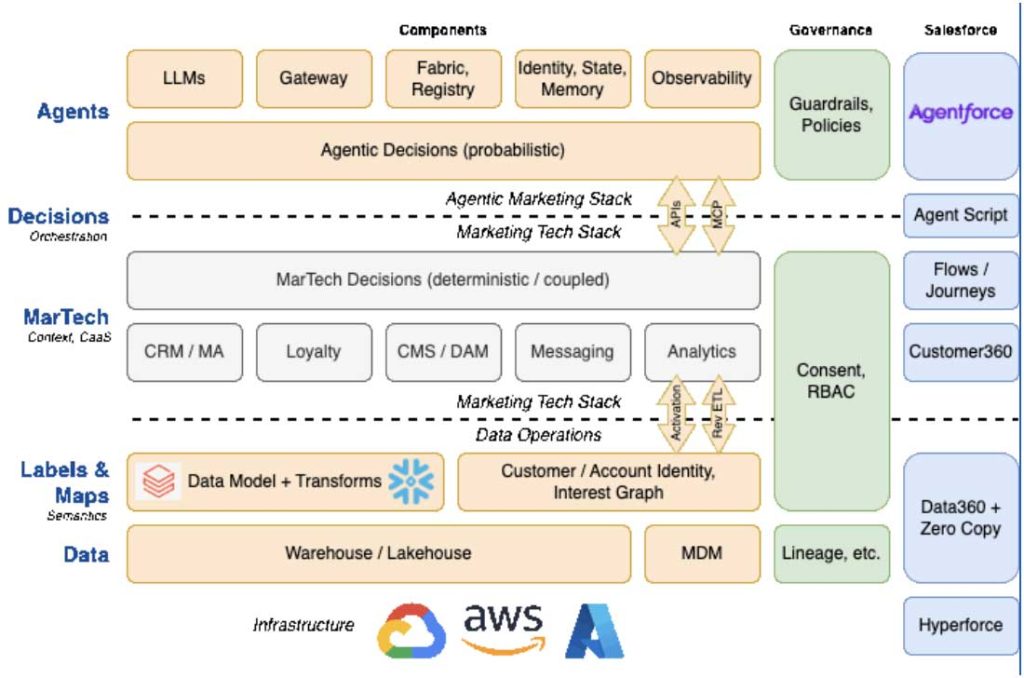
Read Kihn’s breakdown on LinkedIn. (May 12)
From tipsheet #1: Mr. Kihn is at the forefront of Salesforce’s effort to explain to both industry and Wall Street why CRM platforms will not be overtaken by AI. His thinking also reflects the broader SaaS industry’s effort to position agents as additive orchestration layers rather than replacements for existing software infrastructure.
From tipsheet #2: How long until Salesforce buys a GEO firm which is now called an Agentic Marketing Platform (AMP)?
EVENTS
Meta Performance Marketing Summit today
“Want the blueprint for next-level campaign performance? It’s happening May 13th (and 14th) at the Meta Performance Marketing Summit. Join us for an exclusive virtual experience where we’ll share the cutting-edge strategies and insights you need to drive unprecedented results.” (May 12) – Meta For Business on LinkedIn
Registration: Meta Performance Marketing Summit.
PEOPLE MOVES
Now hiring
- Former Skai executive Nich Weinheimer joins Google as Head of Commerce Media (May 12) – LinkedIn
- “I’m thrilled to be joining Christopher Paquette and the amazing team at DeepIntent, as the company’s new CMO.” (May 12) – Former Trade Desk CMO Ian Colley on LinkedIn
- Former ZeroClick executive Noah Gorsky has joined Adobe as VP, Advertising Cloud (May 12) – LinkedIn
MORE
- Viant Sees A Growth Wave Coming, But First Marketers Must Really Ditch Walled Garden Ad Tech (May 12) – AdExchanger
- YouTube Plays Matchmaker for Sponsors and Stars (May 12) – The New York Times (subscription)
- Study: “4 out of 10 top-performing Creators would not be renewed under standard attribution” (May 12) – Arthur Leopold, CEO, Agentio on LinkedIn
- Adthena Launches the First to Market ChatGPT Ads Intelligence Platform (May 11) – press release
- Life360 Q1 2026 earnings: “Record Q1 Advertising Revenue of $19.7 million.” (May 11) – press release