

Digiday reports that Google is testing a Search Console-based program that pays a small number of publishers when their content “significantly” contributes to AI-generated responses across Gemini, AI Overviews and AI Mode. Its reporting includes screenshots and documentation indicating that the pilot is currently open to only a small group of publishers.
Read: Google rolls out pay-per-value AI licensing program to publishers (Sept. 14) – Digiday
Search Engine Roundtable notes that references to the AI contribution pilot were first spotted in April.
Read: “Google Al Contribution Pilot – Paying Publishers For Use Of Content In AI” (Sept. 14) – Search Engine Roundtable
Google has not commented publicly on the reported pilot. But it comes as publishers question the value of making content available to AI crawlers when the resulting answers may not return referral traffic or revenue.
No company has yet established a durable compensation model for publisher content used in AI answers. Microsoft, Cloudflare, TollBit and others are in-market with approaches, while IAB Tech Lab is developing CoMP, its Content Monetization Protocol.
Related: Google introduced generative AI performance reporting in Search Console in June. See Google Developer blog.
From tipsheet: Google’s pilot acknowledges that AI answers depend on publisher content even when they do not return a publisher visit. The meaningful question is whether it becomes a transparent, material market for that content, with clear eligibility and pricing, or a limited payment program that does little to replace lost referral revenue.
PLATFORMS
Pinterest’s AI assistant is a shopping surface
At the Goldman Sachs Communacopia + Technology Conference in San Francisco last week, Pinterest CEO Bill Ready said 80% of queries to Pinterest’s AI assistant are commercial, compared with more than half of searches across the platform.
About 30% of Pinterest’s lower-funnel ad revenue now runs through Performance+, its AI-driven campaign platform. Together, the figures show Pinterest turning visual-intent data into both an AI shopping interface and a more automated performance-ad product.
Ready also said Pinterest’s tvScientific acquisition extends its advertising strategy into connected TV, where the company has seen a reported 60%-plus lift in purchases.
Read: “Pinterest CEO: AI Shopping Push Drives Gen Z Growth, Ad Gains” (Sept. 11) – MarketBeat
FINANCIALS
Adobe inserts GEO into enterprise workflow
Creative software platform company Adobe spoke more last week about its plans to sell Semrush’s SEO and GEO capabilities alongside its web content management, brand visibility and content supply products. Adobe acquired the firm last November for $1.9 billion.
CEO Shantanu Narayen told Wall Street analysts on Adobe’s fiscal Q3 earnings call:
“I think moving forward, the real selling motion is all around how do we combine SEO and GEO with all of our web content management, as well as those solutions. I think increasingly… the sales motion is all around the combined new offerings as it relates to what we are doing around Adobe Brand Visibility and what we are doing around content supply. I think we talked about how all of those are growing north of 20%, the must-wins. That is how we are going to market with those solutions.”
Leadership change: The head of Adobe’s customer experience unit, Anil Chakravarthy, is taking over as CEO on Dec. 1.
Read: “Adobe Hits 1 Billion Monthly Active Users, Raises Full-Year Outlook” (Sept. 11) – The Wall Street Journal (subscription)
More:
- Adobe Reports Record Q3 Results (Sept. 10) – Adobe (PDF)
- Adobe Inc. (ADBE) Q3 FY2026 earnings call transcript (Sept. 10) – Yahoo Finance
From tipsheet: Adobe is packaging GEO as an enterprise workflow: create the content, manage the site and measure whether a brand appears in AI-generated recommendations. The goal is to make visibility in the recommendation layer another managed marketing function alongside SEO and web experience.
CREATIVE
Microsoft rolls out provenance guidance
Microsoft is joining Google and Meta in giving advertisers guidance on how to disclose AI-generated or materially altered creative. Google and Meta have issued similar guidance in recent months.
After reviewing the new Microsoft rules, Search Engine Land advises readers: “Advertisers should also avoid stripping metadata or watermarks from AI assets and check disclosure requirements in every market where a campaign will appear.”
Read: Microsoft Advertising sets rules for AI-generated ads (Sept. 14) – Search Engine Land
More: AI-generated and synthetic content in advertising – Microsoft Advertising Help
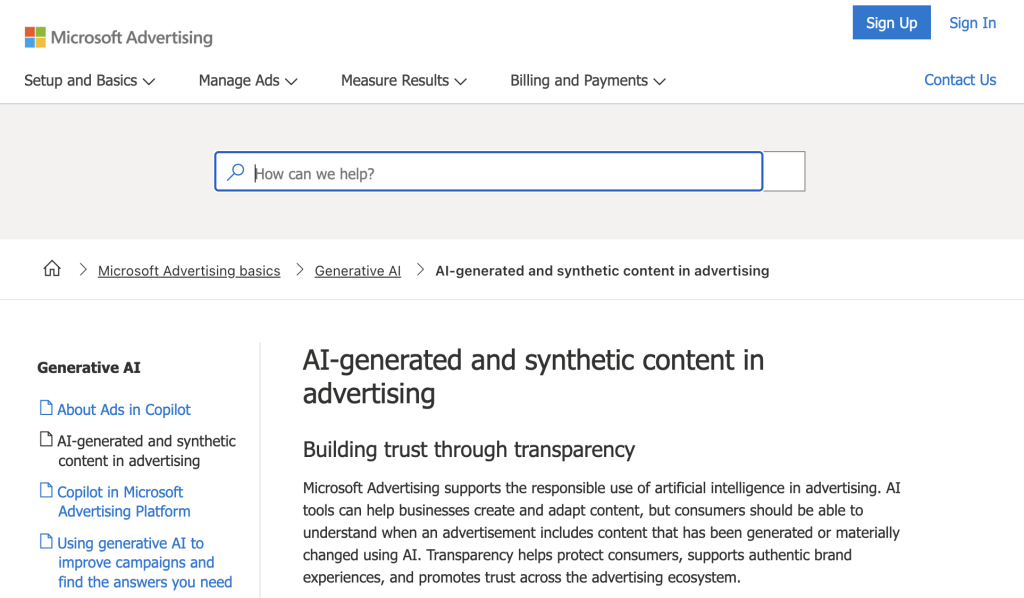
From tipsheet: Provenance is becoming part of the ad creative supply chain. As platforms ask advertisers to preserve metadata, labels and disclosure signals, agencies will need auditable processes for creative review across creators, brands and media platforms.
COMMERCE MEDIA
Snap turns Chat into a catalog
Snap is bringing Dynamic Product Ads to Sponsored Snaps, allowing advertisers to run AI-recommended catalog products inside Chat, Snapchat’s most-used surface.
Sponsored Snaps have been a Chat placement since 2024. The new “Commerce Power Pack” adds Snap’s Dynamic Product Ads, which use catalog and conversion signals to choose the products it thinks are most relevant to each user.
“Advertisers can now surface the most relevant products directly into where Snapchatters are connecting and making decisions every day.”
Snap separately introduced AI Sponsored Snaps in April, an alpha format that lets brands bring their own AI agents into Chat. This week’s announcement is different: Snap is making its existing Sponsored Snaps placement shoppable, using its recommendation models to select a product from a brand’s catalog that appears in the paid Chat ad.
Read: Spend smarter this holiday shopping season with the Commerce Power Pack (Sept. 10) – Snap
From tipsheet:
- Dynamic Product Ads (DPA) in Sponsored Snaps: likely the bigger near-term revenue product. They scale from an advertiser’s existing catalog feed and optimize toward purchases.
- AI Sponsored Snaps: potentially the more transformative format. A brand can turn a paid Chat placement into a customer conversation, if users choose to engage.
LLMs & CHATBOTS
Developments
- The API: “Introducing the Agents API” (Sept. 10) – OpenAI
- Reacting to the API: “Another data point in my ‘Why you probably shouldn’t be building your own agentic harness’ POV” (Sept. 11) – Matthew Schultz, Global CPO, Dentsu on LinkedIn
- Building harness: “This week we introduced the Salesforce Trusted Enterprise AI Harness.” (Sept. 11) – Marc Benioff, CEO, Salesforce on LinkedIn
From tipsheet: The underlying AI model may be interchangeable, but the layer that connects it to a company’s data, tools and controls may not be.
SELL-SIDE
Prebid wins. Now comes the fight.
On the AdTech AdTalk podcast, Gamera CEO and co-founder Gareth Glaser argued that the battle among publisher header bidding architectures is largely settled.
[50:30] “The Prebid battle is over. Prebid has won. It is the open source that everyone uses. I do not expect it to change.”
In Glaser’s view, the next contest is among the companies that manage Prebid for publishers. He pointed to public complaints about aggressive revenue guarantees, such as Freestar’s last week, as a sign that Prebid management firms are competing in a business with limited differentiation.
Glaser said a smaller set of firms could gain more leverage as the operational link between buyers and the mid- and long-tail open web.
Watch: “Consolidation & Aggression” (Sept. 11) – AdTech AdTalk podcast on YouTube
From tipsheet: For smaller publishers, monetization managers are becoming a sell-side control plane, shaping how supply is configured, qualified and packaged before it reaches buyers.
Related: Prebid names former chairman and Magnite product leader Garrett McGrath as president (Sept. 10) – AdExchanger
AGENTS
Inference cost monetization
A new advertising category
Amazon bringing advertisers into ChatGPT last week is another sign that advertising in AI is becoming infrastructure, not novelty.
For OpenAI and Amazon, the immediate story is new inventory for Amazon DSP and more revenue for ChatGPT Ads. The larger economic story is that as AI applications absorb more usage and agents take on longer, more expensive workflows, subscriptions and commerce may not cover the entire cost of computation. Advertising is becoming another financing mechanism.
That is the category companies such as Koah and Velocity are building toward: inference-cost monetization for AI applications.
- Koah CEO Nic Baird on the ad network for AI (Sept. 11) – tipsheet
- Podcast: Building ad tech for the chatbot era (with Tal Shoham) (July 8) – Mobile Dev Memo
AGENCIES
AI platform buying in 2030: Room to grow
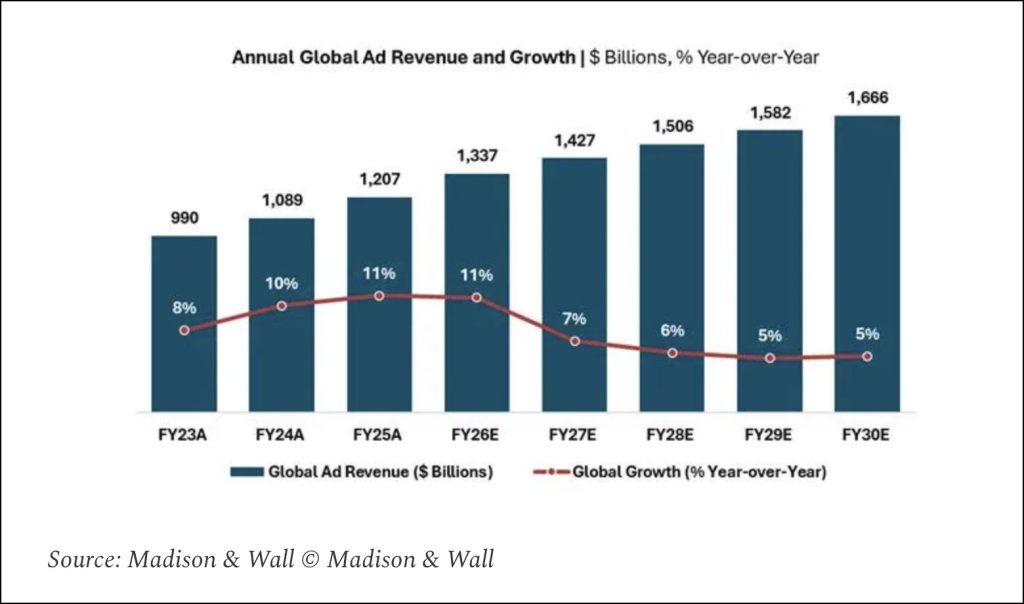
A new report from media research firm Madison & Wall predicts AI buying platforms will only manage 27% of U.S. ad spend by 2030.
Adweek covered the news on Friday and added:
“After becoming a $1 trillion industry for the first time in 2024, a new forecast from Madison & Wall shows that total global ad revenue will reach $1.3 trillion by the year’s end—an 11% increase year-over-year.
The growth, categorized by the report as ‘unusually rapid,’ is thanks to AI companies both creating tools that make ad buying more efficient while also becoming significant ad buyers themselves.”
Read: AI Buying Platforms Will Manage 27% of U.S. Ad Spend by 2030: Report (Sept. 11) – Adweek (subscription)
Still, Madison & Wall forecasts global ad revenue growth will slow to 7% next year and 5% by 2029–30. The firm attributes this year’s unusually rapid growth partly to AI companies becoming major advertisers and to AI buying tools improving efficiency. The forecast suggests AI is expanding the global ad market, but not creating a permanently faster global growth rate.
Read: “M&W SATURDAY SUMMARY: New Global Forecast! Details on Top 50 Markets + The M&W Podcast Episode #100!” (Sept. 12) – Madison & Wall on Substack
MORE
- Brand: ChatGPT Leaps To No. 5 Brand In Loyalty (Sept. 14) – MediaPost
- Musings: Meta’s AI opportunity, whatever the pace (Sept. 14) – Analyst Eric Seufert on Mobile Dev Memo (subscription)
- Agents: “Advertising to AI agents—everything brands need to know” (Sept. 10) – Ad Age (subscription)
- Feedback loop: Databricks CMO Rick Schultz on “infinity campaigns” and the data infrastructure behind continuous, agent-assisted marketing. (Sept. 3) – The Trade Desk’s The Current
- AI and publishers: “Ziff Davis CEO: if OpenAI can find $750 billion for data centers, it can find money for publishers, too” – Fortune on Yahoo Finance