
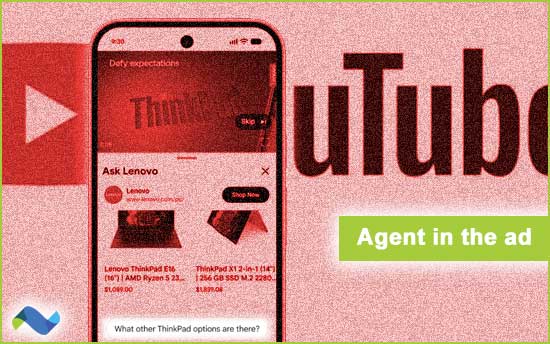
Google is launching a U.S. beta that embeds Business Agent within YouTube ads, allowing viewers to ask product questions and receive tailored guidance without leaving YouTube.
Trend: This week, tipsheet covered similar moves from Meta and OpenAI. Platforms are moving brands’ conversational agents into ads or the immediate path to conversion, turning the chatbot into part of the ad experience.
Google is also assembling the infrastructure around that experience. AI performance insights in Merchant Center is now available in Australia, Canada, India, New Zealand and the U.S. Retailers can measure their share of voice against competitors across AI Mode and AI Overviews and identify opportunities based on shopper intent, product attributes and stages of the shopping journey.
An expanded Universal Commerce Protocol integration hub is gradually rolling out in the U.S. It supports checkout on Google, cart transfers to merchant websites and enhanced checkout testing, with analytics coming later.
Google is encouraging retailers to submit conversational and video attributes and connect loyalty data to Merchant Center. During testing, conversational attributes supplied by Lululemon appeared in 50% of relevant AI Mode product recommendations, according to Google.
Read: Boost your holiday sales with these agentic commerce updates (Sept. 16) – Google
A Google spokesperson told tipsheet:
- Retailers cannot see the full conversational queries in which their products appear. Reporting instead includes share of voice against competitors and insights organized by shopper intent, product features and stages of the shopping journey. Google will evaluate additional reporting capabilities based on market and partner feedback.
- Shoppers cannot complete purchases through Business Agent within a YouTube ad. They are directed to the merchant’s website. Agent interactions register as standard clicks in Demand Gen reporting without double-counting the subsequent site visit, while resulting conversions appear through existing campaign tracking.
From tipsheet: Google is assembling the layers of an AI shopping funnel: product data shapes the recommendation, reporting measures recommendation visibility, Business Agent answers follow-up questions and UCP supports the transaction. The YouTube beta makes the ad conversational, but the purchase and its measurement remain conventional.
COMMERCE MEDIA
OpenAI confirms Sponsored Agents
In a rare blog post on advertising, OpenAI confirmed yesterday that it is testing Sponsored Agents, which allow people who click a ChatGPT ad to begin a separate, clearly labeled conversation with an advertiser’s agent.
“For users, this can make it easier to understand whether a product or service is the right fit. For businesses, it’s an opportunity to help interested customers explore their offerings through a personalized conversation. The conversation with a Sponsored Agent is distinct from ChatGPT’s independent answers and separate from the original conversation that the user started in ChatGPT.”
The format, now being tested with select U.S. advertisers, was first spotted September 10 by Juozas Kaziukėnas in a Wayfair ad. Read tipsheet.
OpenAI is also building distribution through marketing platform HubSpot and ecommerce platform Shopify. The HubSpot app already shows more than 400 installs. Advertisers can create campaigns using conversational “context hints,” buy on a CPM, CPC or optimized CPC basis and connect ad clicks to contacts, deals and ROI within HubSpot. U.S. Shopify merchants can launch campaigns from their product catalogs, with international availability scheduled to begin Sept. 23.
Eligible businesses can get started through the ChatGPT Ads for Shopify app or the ChatGPT Ads in HubSpot app.
CAPI is key
In a reply to a review for the Shopify app, OpenAI verified that “the app does automatically set up a Shopify server pixel, which is what we often describe as a server-to-server Conversion API (CAPI) integration.” That gives ChatGPT Ads a direct conversion signal from participating Shopify stores.
Read: Reimagining advertising with AI (Sept. 16) – OpenAI
From tipsheet: OpenAI is building both sides of an AI-native advertising platform: a conversational experience for consumers and catalog, activation and conversion infrastructure for advertisers. Google and Meta are, too.
LLMs & CHATBOTS
OpenAI’s ad build outruns infrastructure
OpenAI’s ad business was the subject of a feature article in The Wall Street Journal yesterday. That, in itself, may be the news. For advertising trade professionals, not much else was new.
The Journal reported that OpenAI’s technology, targeting and campaign operations have struggled to keep up with the speed of the rollout. Dave Dugan, OpenAI’s head of global ads solutions and a former Meta executive, said: “This is one of the fastest ad builds in history, from my experience.”
Rocket CMO Jonathan Mildenhall called its ChatGPT ads results “underwhelming” and wants “better targeting and a smoother transition between chats and ad content” before spending more. Other advertisers reported bugs, difficulty spending their budgets because of limited inventory and insufficient information about how people search on ChatGPT.
Read: Inside OpenAI’s Ad Rush (Sept. 16) – The Wall Street Journal (subscription)
On LinkedIn, Mindgruve’s Spencer Lian-Thornton, a former Amazon executive who is quoted by the WSJ, offered his perspective:
“This reminds me of some of the early days of the Amazon DSP — brands tried it, ‘didn’t work for me,’ but then waited years to go back. The pace of innovation here will only go faster.”
From tipsheet: Despite the criticism, OpenAI reported earlier this month that it had reached a $1 billion annualized ad revenue run rate after launching in February. Something is clearly working. OpenAI has delivered the basics at extraordinary speed.
PLATFORMS
OpenAI fills out its performance ad stack
Despite the growing pains reported by The Wall Street Journal, OpenAI is adding more of the targeting, optimization and measurement infrastructure expected of a performance advertising platform, according to a ChatGPT Ads advertiser update reviewed by tipsheet yesterday.
Conversion optimization with impression billing is now generally available and is OpenAI’s recommended model for maximizing performance. Campaigns are billed by impression but optimize toward conversions attributed to both ad clicks and ad views.
Advertisers can now select a 7-, 14- or 30-day click window and a 0- or 1-day view window. They can also target and analyze Android app, Android web, desktop web, iOS app and iOS web separately.
OpenAI is also introducing a way to score conversion setup quality:
- “Event Quality Score is now available in Ads Manager under Tools > Conversions. It gives eligible Pixel and Conversions API data sources a 1-10 setup quality score, assesses user data coverage, and provides actionable recommendations to help improve conversion event implementation.”
See an example dashboard:
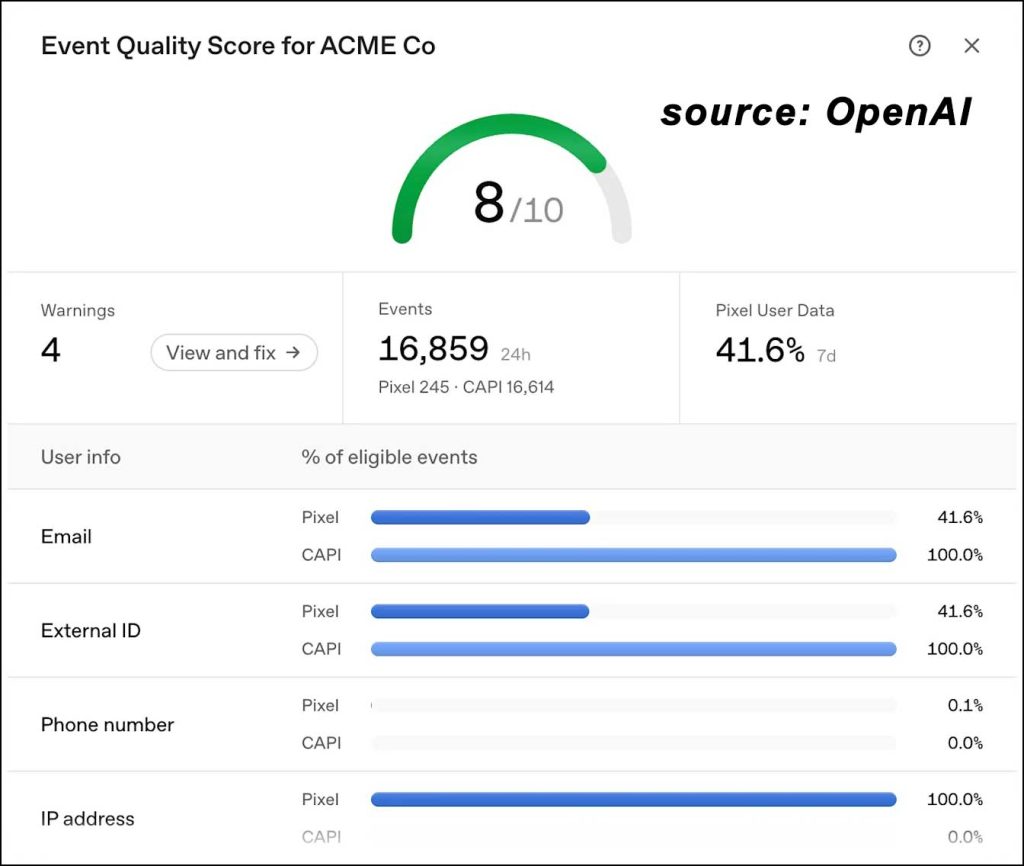
From tipsheet: These updates show OpenAI assembling the less visible machinery needed to optimize and measure ChatGPT Ads. Event Quality Score makes the learning loop visible: OpenAI is grading advertisers on the identity and conversion signals they provide through Pixel and CAPI, then directing them to improve those inputs.
AGENTS
New products for agentic workflows
- Inventory: Magnite Advances Agentic Vision as Major Media Owners, Buyers and Technology Players Leverage Orchestration Layer (Sept. 16) – Magnite
- B2B marketing: “Demandbase Launches Mojo, the B2B Marketing Agent that Learns from Every Campaign” (Sept. 15) – Demandbase
- Analysis: Keynes Launches kAI, a New AI-Powered Analysis Layer Within Keynes’ Kortex Platform (Sept. 15) – Keynes
COMMERCE MEDIA
The omnichannel duel
- “Walmart CEO John Furner is turning the retailer’s 5,200 U.S. stores into an unstoppable AI engine” (Sept. 15) – Fast Company
- “Amazon’s next move could reshape how America shops — all over again” (Sept. 16) – Business Insider
GOVERNANCE
Reviewing programmatic practices
On LinkedIn, Gary Guarnaccia, Bayer’s head of programmatic and ad tech, begins:
“Have you ever criticized Programmatic? …”
The IAB Tech Lab’s Programmatic Governance Council released its first deliverable, a proposed set of practices for how buyers and sellers should use existing standards in programmatic transactions.
The council includes representatives from brands, publishers and buy- and sell-side ad tech companies. Guarnaccia urged advertisers in particular to review and comment on the proposal, saying their participation is “crucial.”
Read his plea. (Sept. 16)
Read: Programmatic Standard Practices (Sept. 16) – IAB Tech Lab
LLMs & CHATBOTS
Developments
- Claude Cowork and chat are now one Claude (Sept. 16) – Anthropic
- Mistral and Mozilla are bringing open, private and multilingual AI to your web browser (Sept. 16) – Mistral
- Apple is developing AI servers (Sept. 16) – The Information (subscription)
MORE
- Breaking: “Google ad tech antitrust ruling was just unsealed. I’m going to read and post highlights in the thread below…” (Sept. 16) – Marketecture’s Ari Paparo on X
- Targeting crawlers: “Have it both ways: stay discoverable in search while disallowing AI training” (Sept. 15) – Cloudflare blog
- Balancing ads: “How Reuters’ dynamic paywall is boosting subscriptions and ads” (Sept. 16) – Digiday (subscription)
- Provenance: “Governor Newsom signs new law to protect workers, require disclosures on AI-generated advertising” (Sept. 16) – Gov[dot]CA
- Verticalization: “33Across Rebrands as WealthStage” (Sept. 16) – press release