
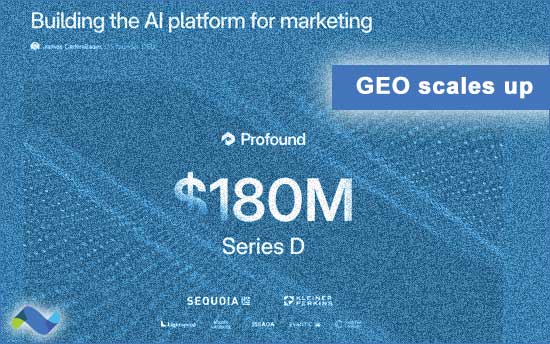
AI search platform Profound has raised a $180 million Series D at a $1.8 billion valuation, co-led by venture capital “blue bloods” Sequoia Capital and Kleiner Perkins.
Back in February, Profound raised $96 million at a $1 billion valuation for its Series C.
The startup is expanding beyond measuring brands’ visibility in AI answers. Its AI Marketer product identifies opportunities and, with approval, can create, publish and evaluate marketing using company and individual context.
Co-founder and CEO James Cadwallader explains the premise on LinkedIn:
“The agent is now the customer. It scans hundreds of thousands of sources to form an opinion of your brand, and it wants all content current and specific.
Winning in AI Search means being everywhere, all at once. It’s an inhuman amount of work, and the only way to do it is with agents.”
Read more. (Sept. 15)
The company says more than 2,500 brands, including one-third of the Fortune 100, use Profound.
Read: Building the AI platform for marketing (Sept. 15) – James Cadwallader, CEO on Profound’s blog
From tipsheet: Profound believes the next stage of the generative engine optimization (GEO) market is closing the loop between measurement and execution. It is trying to become the application layer through which marketers govern that work across organic and paid channels.
PLATFORMS
Meta bundles business agents into subscriptions
Yesterday, Meta introduced Meta One, a subscription service that combines expanded AI usage with features for individuals, creators and businesses across Instagram, Facebook and WhatsApp.
Tools for creators, businesses
Business plans offer more access to Meta Business Agent (launched in June) for WhatsApp customer responses. Higher tiers add scheduling, links in organic posts and Reels, analytics and team access. Meta describes its Expert and Max tiers as supporting “teams managing at scale,” suggesting enterprise opportunity, too.
Meta plans additional agent skills for marketing, operations and content optimization. An upcoming Edits assistant will analyze Instagram insights and help brainstorm ideas.
Read: “Introducing Meta One: A Subscription Service With More Features and AI to Create, Connect, and Stand Out” – Meta (Sept. 15)
From tipsheet: Meta wants to capture more of the software budgets of businesses that already buy its advertising. Its agents could also connect customer interactions, content creation and campaign performance inside one feedback loop. A question to watch, starting with the terms of service: How much of that activity can inform Meta’s ad systems?
LLMs & CHATBOTS
The ‘Chat with us’ conversational ad
ChatGPT has begun testing a “Chat with us” ad that moves shoppers from an AI answer into a branded conversation without leaving the platform.
The first publicly spotted example came from Wayfair. After asking ChatGPT for “the best picture frame with gold leaves,” entrepreneur Juozas Kaziukėnas received a Wayfair ad inviting him to try its shopping assistant. Clicking the call to action opened a branded Wayfair chat with a prefilled prompt.
See it or view below. (Sept. 10)
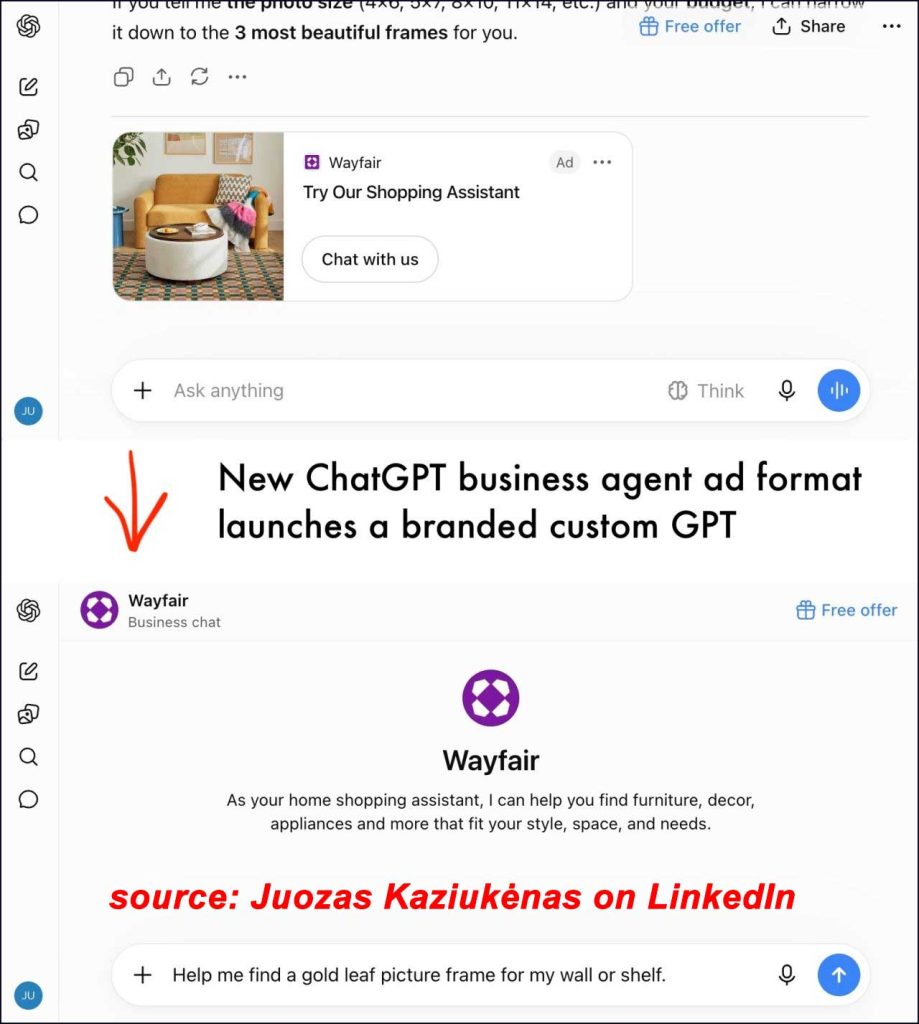
Ad Age senior editor Garett Sloane reviewed Kaziukėnas’ screen recording and wrote on LinkedIn: “ChatGPT has said it would offer the ability to enter into conversations with branded chatbots on the platform, and now they start popping up.” Read more. (Sept. 14)
Read: ChatGPT ads bring brands into conversations with consumers (Sept. 14) – Ad Age (subscription)
From tipsheet: The ad turns the click into a conversation, but keeps the customer inside ChatGPT instead of sending traffic to the brand’s website. Conversational ads also give OpenAI a new incentive to extend interactions, complicating its earlier focus on retention rather than time spent.
MEASUREMENT
Chrome measures publishers’ ad load
Google Chrome introduced a new set of metrics yesterday for its Chrome User Experience Report (CrUX). Product manager Alex Cone explained that the metrics are “designed to describe websites’ ad loads as real users encounter them.”
Intended to help improve the user experience, the metrics include:
- “Ad Count: The average number of ads in the viewport
- Ad Density: The average fraction of the viewport area occupied by ads.
- Ad Weight (Network Usage): The resources consumed by ads measured in bytes.
- Ad Weight (CPU Usage): The resources consumed by ads measured in milliseconds.”
Read: “New ad metrics in Chrome User Experience Report” – Alex Cone, Group Product Manager, Google, on the Chrome for Developers blog
From tipsheet: Chrome is turning the ad experience itself into measurable supply metadata. If buyers incorporate these signals into valuation and bidding, publishers could face a clearer economic incentive to reduce intrusive and resource-heavy advertising.
MEASUREMENT
Case study: Amazon insights → DSP changes
AI media manager Gigi and agency Code3 used Amazon Marketing Cloud (AMC) to direct Nordic Naturals’ Amazon DSP campaigns.
Amazon says “every signal translat[ed] directly into a campaign parameter change—from frequency thresholds and attribution windows to audience builds and Amazon DSP Performance+ goal types.”
AMC showed that live sports drove the most new-to-brand acquisition and that audience overlays were hurting performance. The team removed the overlays, reset frequency and attribution parameters and used Amazon Publisher Cloud to establish a programmatic guaranteed deal. Nordic Naturals’ Amazon revenue grew 33%, three times its goal.
Read: Gigi and Code3 help Nordic Naturals grow revenue 33% with AMC-driven live sports strategy (Sept. 15) – Amazon Ads
From tipsheet: The AI/advertising intersection is the feedback loop: AMC produces the evidence; Gigi translates it into operating instructions for Amazon DSP. AI’s value is compressing the distance between measurement and campaign execution.
PLATFORMS
AppLovin: The first inning hasn’t started
AppLovin veteran Rafael Vivas on X yesterday:
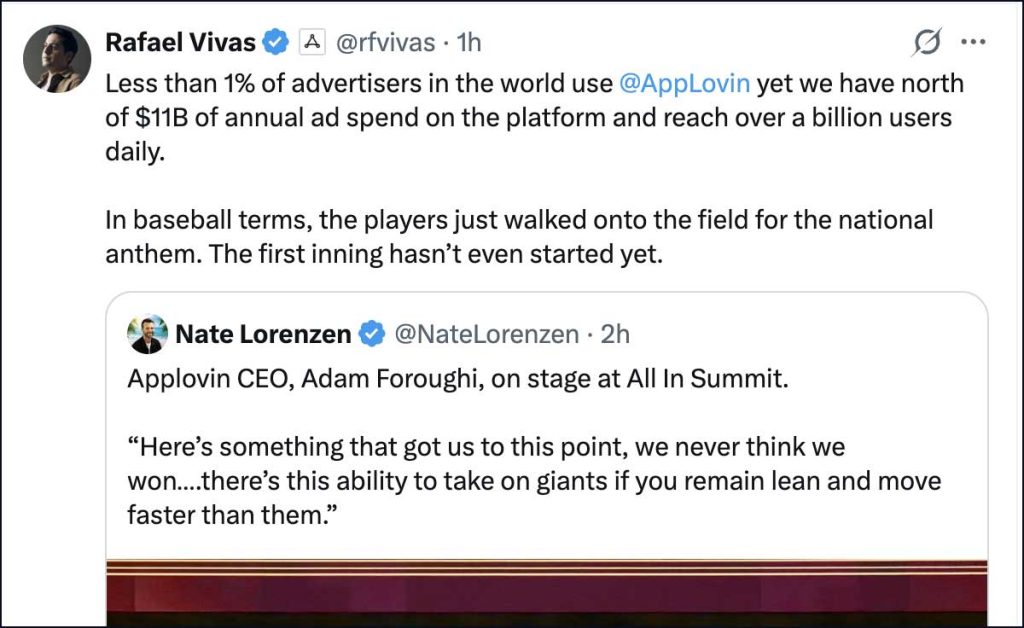
The post comes as AppLovin’s strategy and its AI-enabled ad platform Axon face renewed investor scrutiny following the company’s slightly weaker-than-expected second-quarter performance.
From tipsheet: AppLovin remains conspicuously on the offensive, a sharp change from its posture just a year ago.
AGENCIES
Creative agency makes a tech product
Creative agency R/GA is launching BRDNA Sequencer, a platform-agnostic AI workflow tool that translates a company’s brand guidelines, messaging and visual assets into instructions AI agents can understand.
The system connects with Claude, Figma and other AI tools to generate editable emails and social assets according to the company’s brand rules. Initially offered as a service to R/GA clients, BRDNA packages the agency’s creative expertise as reusable software. Video is planned.
“The reality is, all companies use different tech stacks, and all are using different tools, so how do you make sure that you’re creating a tool that lives within any environment?” said former Googler and R/GA’s new Global Chief Business Officer Sadie Thoma.
Read: R/GA’s new tool helps brands embrace the hyper-personalized future of advertising (Sept. 15) – Fast Company
From tipsheet: The moat may not be the software. It may be the workflow dependency. Once a client builds its brand system and creative production around BRDNA, changing agencies starts to look like changing infrastructure. SaaS returns!
TECH
Debates
- What sets agents apart? “Anyone can ship an agent now. Building something that stands out takes these ingredients: proprietary data, a clear product strategy, the infrastructure to execute, and independent measurement. Miss any of those and all you built is the same product as everyone else. Most of those will fail because the organization that built it is missing at least one…” (Sept. 15) – Tim Vanderhook, CEO, Viant on LinkedIn
- Human attention gains leverage: “In a world funded by those desiring to influence human consumption, it only makes sense that those who can continue to maintain direct human interactions will have leverage. Who knows, maybe high-engagement media channels with limited agentic mediation — live events, television, film, audio and reading — will drive more advertising value going forward, not less.” (Sept. 14) – Dave Morgan, CEO, Simulmedia on MediaPost
LLMs & CHATBOTS
Developments
- Introducing Gemini 3.8 Live and 3.8 Live Extended Thinking (Sept. 15) – Google
- Koa, a new CRM reasoning model to power your digital workforce (Sept. 15) – Salesforce
- OpenAI, Anthropic, Google have been in talks on AI safety for weeks (Sept. 15) – TechCrunch
PEOPLE MOVES
Now hiring
- “I’m excited to share that I’ve joined PebblePost as CEO.” (Sept. 15) – Former Magnite CPO Adam Soroca on LinkedIn
- “We are excited to welcome two exceptional leaders to the Teads team: Alex Underwood as Managing Director, North America, and Alena Morris as Senior Vice President, Client Solutions & Strategic Products.” – Teads on LinkedIn
MORE
- Marketing orchestration: Auxia gives marketing agents brand context (Sept. 15) – AdExchanger
- Retail: Yahoo DSP brings purchase-based campaign optimization to Canada (Sept. 15) – Media in Canada
- New strategic: “Mediaocean AI Ventures Launches to Scale the Next Generation of AI Startups Across Advertising” (Sept. 15) – Mediaocean
- OpenAI is a brand, too: “Inside OpenAI’s agency strategy—how it is choosing creative partners” (Sept. 14) – Ad Age (subscription)
- AI/ads job board: “MADJobs is here to help you get hired, fast with the world’s largest job board built specifically for advertising and marketing.” (Sept. 15) – Marketecture on X