
Advertising trade group IAB is helping build the measurement infrastructure for AI marketing.
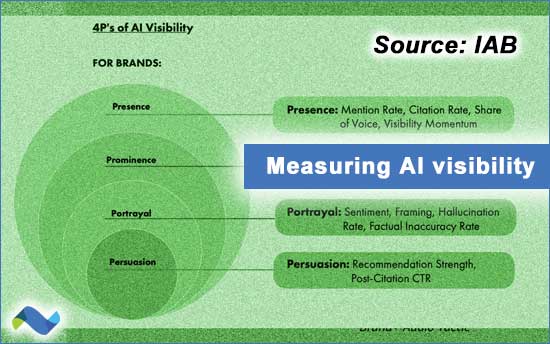
Yesterday, Caroline Giegerich, IAB’s VP of AI & Marketing Innovation, announced the IAB’s “Measuring Visibility in the AI Era” framework, which addresses both advertiser and publisher interests.
-
Download the framework (August 3) – IAB (PDF)
Emphasizing that the IAB is not creating a measurement product, Giegerich said on LinkedIn that the framework begins with the “4 P’s”:
- Presence: Are you mentioned?
- Prominence: Where do you appear?
- Portrayal: Is the model describing you positively or negatively?
- Persuasion: Does it actually influence behavior?
Additional framework elements include:
- “Directional vs. Decision-Grade Measurement: Is the data useful for watching a trend OR rigorous enough to inform budget and strategy?”
- “Provider Disclosure Standards: What measurement companies should disclose about their platforms, prompts, data collection, methodology, and historical baselines.”
She adds, “IAB is not building a measurement product or rating the companies that do. We’re defining what good measurement looks like so that brands, publishers, agencies, and measurement providers can operate from common ground.”
Read more on LinkedIn. (August 3)
More: “Measuring Visibility in the AI Era” (August 3) – IAB
From tipsheet: AI visibility is becoming a measurable marketing discipline, and advertisers and publishers will demand common standards for evaluating vendor methodologies. Frameworks like this provide a foundation for measuring AI recommendations if advertising expands into AI agents.
Related: “See Branded and Non-Branded AI Queries in the Clarity Citations Dashboard” (August 3) – Microsoft Clarity blog
LLMs & CHATBOTS
Developments
- Alibaba unveils its largest AI model yet, DeepSeek’s latest model is ultra-low cost (August 3) – Reuters
- White House to Host AI Companies on Tuesday to Review AI Framework (August 3) – The Information (subscription)
- Visa to Buy Fraud Defense AI Platform BioCatch in $2.4 Billion Deal (August 3) – The Wall Street Journal (subscription)
LLMs & CHATBOTS
AI recommendations meet paid media
For marketers, AI optimization is becoming both an organic and a paid media discipline.
Ad Age’s Garett Sloane writes:
-
“At Japan Airlines, it’s getting more challenging to acquire new customers. Website traffic is down since AI search diverts consumers from direct visits. Also, the makeup of consumers who visit the site has changed—they are more loyal customers, arriving later in their research, already informed and further along toward a purchase decision, according to Minako Kent, VP of global brand marketing at Japan Airlines.”
Read: How Japan Airlines will track its new ChatGPT ad strategy (August 3) – Ad Age
The Brandtech Group’s Jellyfish is supporting Japan Airlines’ initiative through the agency’s new AI Ads Optimization product and Share of Model platform.
Jellyfish says the product “brings AI visibility and AI media optimization together, helping brands identify opportunities across AI platforms and turn those insights into smarter campaign optimization.” Read more on LinkedIn. (August 3)
More: “Jellyfish Launches AI Ads Optimization in Share of Model” (August 3) – Jellyfish
From tipsheet: Brands are beginning to optimize AI recommendation share with a combination of generative engine optimization and paid media informed by AI visibility. Jellyfish says its latest Share of Model update “extends beyond the existing Google Ads integration for Performance Max to generate media optimizations with AI insights for ChatGPT, TikTok, DV360, YouTube and Reddit.”
GEO startups like Profound (Ads Studio) and Evertune (ChatGPT Ads Manager) have also expanded into paid media, suggesting some AI optimization platforms are combining organic visibility and advertising.
To be clear: This isn’t just SEO + SEM. It’s a new marketing layer built around influencing how AI models understand, recommend and advertise brands. And that’s before ads for agents at scale enter the picture.
SELL-SIDE
AI agents create new curation opportunity
AI agents are beginning to give publishers a new way to activate and monetize first-party data.
AdExchanger’s Anthony Vargas reports that publishers are beginning to use agentic workflows to generate campaign-specific audience segments on demand, reducing the manual work traditionally handled by ad operations and sales teams.
One example is the integration between PubMatic and Optable, first announced in March, which connects publisher audience creation with buyer-side AI agents. Publishers are now beginning to put those capabilities to work.
Co-CEO Indy Khabra of gaming media company Livewire tells AdExchanger:
“A lot of the AI narrative is very much demand-oriented. But I think you’re going to see more conversations balancing the demand and the activation side with the supply side going forward. Speaking of demand, agentic approaches are helping publishers tap incremental revenue streams.”
Read: AI Agents Are Giving Publishers A New Way To Monetize Their Data (August 3) – AdExchanger
From tipsheet: AI agents let publisher data become responsive rather than static. Publishers can move beyond relying on prebuilt audience segments and generate campaign-specific audiences in response to buyer prompts, making first-party data easier for buyers to discover and for publishers to activate.
LLMs & CHATBOTS
OpenAI builds marketplace capabilities
OpenAI has added two new advertising roles that provide another window into how its ad business is evolving.
From the OpenAI Careers website:
-
Data Scientist, Ads Demand focuses on marketplace health. The role “will build the measurement and insight foundation for understanding demand health and advertiser value across the marketplace. You will partner closely with Ads Sales leadership and Ads Product leadership — along with Marketing Science and product and sales teams — to diagnose advertiser performance, define benchmarks, identify growth opportunities, and turn advertiser feedback into product priorities. Your work will shape demand strategy, improve advertiser outcomes, and help OpenAI build for its most valuable advertisers.” More.
-
Data Scientist, SMB Ads Growth listing says the role “will architect the analytics function end-to-end—driving strategy across targeting, funnel optimization, and performance forecasting. You will work directly with the SMB Ads Marketing team and your insights will be the primary catalyst for high-stakes decisions across marketing, product, and sales engineering.” So, no pressure. More.
From tipsheet: OpenAI is hiring around the economics of an advertising marketplace rather than simply the mechanics of selling ads. Together, these roles suggest the company is building the data science needed to run a marketplace at scale.
LLMs & CHATBOTS
eMarketer: How people use AI
From eMarketer analyst Nate Elliott on LinkedIn yesterday: “… our new eMarketer survey and framework doesn’t lead with platform or feature adoption. Instead, it leads with the human motivations that drive people to use AI in the first place”:
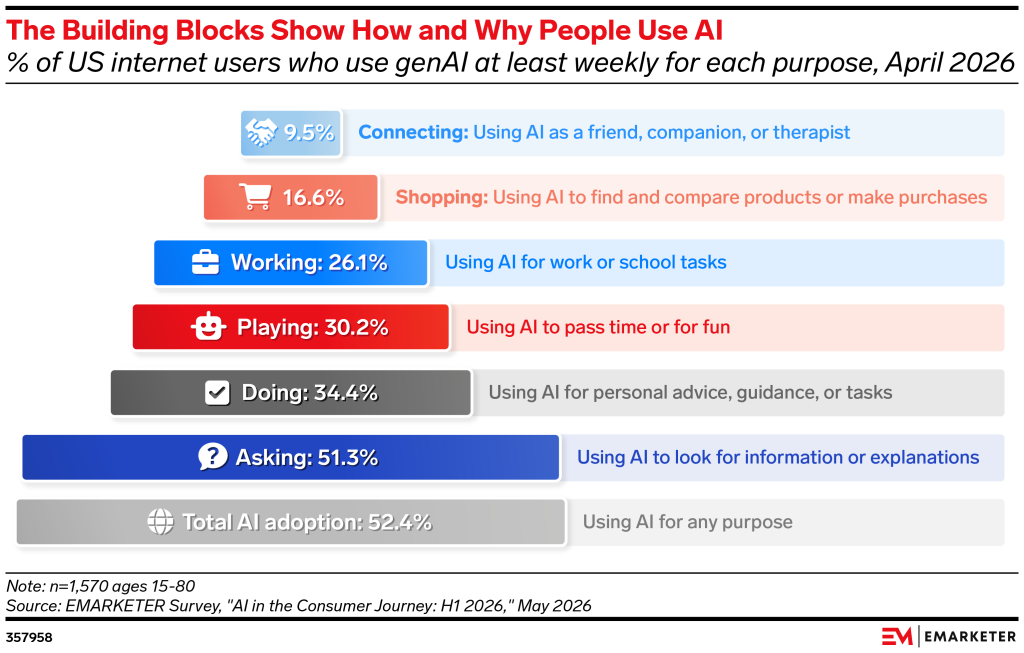
He concludes, “The pattern is clear: Problem solving and personal utility drive the vast majority of AI usage. Shiny technology might create trial, but human motivation drives lasting habits.”
Read more. (August 3)
More: “Our AI Consumer Survey Reveals the Building Blocks of AI Adoption” (August 3) – Nate Elliott on eMarketer
From tipsheet: Solve recurring problems. Secure recurring revenue.
MORE
- Google Ads API pilot: Secure API Access to your Manager Accounts (August 3) – Google Ads Developer blog
- Meta Earnings, Meta’s Timing Problems, The Financial Tail (August 3) – Ben Thompson on Stratechery
- Agentic CRM with Databricks and Braze (July 27) – Massive Rocket
- The latest lures holding companies are using to grow principal media (August 3) – Digiday (subscription)
- Outfront Taps UM Vet Griffiths As Chief Data Officer (August 3) – MediaPost