

Following Mobian CEO Jonah Goodhart’s announcement last week that Time had launched Mobian’s Agent Ads, OpenAds co-founders Michael Bishop and Steven Liss offered an extended discussion on X about where advertising for AI agents could be headed.
Bishop identified three hurdles: frontier AI labs could eventually treat ads for agents like search spam; publisher integrations may prove difficult without infrastructure providers such as Cloudflare; and brands still need to be convinced that nonhuman attention has economic value.
From Bishop on ads for agents:
- “The adversarial dynamic it invites with the frontier labs and agent-harness-producers is a mirror of black-hat search cloaking. OAI / Anthropic are not currently policing website content to extract out sponsored content, but this is a minor cost and annoyance for them.”
- “Scaling publisher integrations will be a tall order, when the ask is to overwrite site content, especially if you’re doing so at the CDN layer. Have spoken with Cloudflare a bit about this, and they’re aware of the possible opportunity of being an ‘ad server’ as well.”
- “Selling brands on the prospect that nonhuman attention has economic value–this, [Mobian CEO Jonah Goodhart] is probably the best person in the world to do. Still a barrier that has to be overcome, but what I would call the most obviously tractable one with only time and effort…”
Liss argued the key distinction is between useful commercial information and attempts to manipulate AI systems, or what he called “aligned” advertising and prompt injection.
From Liss:
“The aligned version of ads for agents is sponsored data that surfaces info and offers from the deep web that the AI would not have found otherwise… The misaligned version (that will also happen) is Internet scale prompt injection attacks.
Google/Anthropic/OpenAI’s main reason to allow this is to avoid getting blocked entirely by publishers. Pubs need an economic model to replace lost search traffic, and pay-per-scrape and data licensing isn’t cutting it.”
Read more from Bishop (July 30) and from Liss (July 31) on X.
From tipsheet: The debate is already shifting from whether AI agents can receive advertising to how an advertising infrastructure for AI agents gets built. Publisher economics, AI platform incentives, standards and measurement may ultimately determine who captures value in the emerging market.
LLMs & CHATBOTS
Developments
- Ten advances in mathematics and theoretical computer science (August 1) – OpenAI
- Jensen Huang says ‘a lot’ of six-figure jobs in plumbing and construction will soon be unlocked because someone needs to build new AI centers (August 1) – Fortune
- Safer and more transparent AI (August 2) – European Commission
PLATFORMS
Buyer Direct as a Google ‘trial balloon’
On the latest Marketecture Podcast, Ari Paparo and Aperiam Ventures’ Eric Franchi discussed Google’s emerging Buyer Direct product.
The product, which allows agencies to book digital media directly in Google Ad Manager (GAM), Google’s publisher ad server, was first highlighted by Gamera CEO Garrett Glaser. (tipsheet, July 28)
Paparo, the primary author of the Video Ad Serving Template (VAST) standard and author of Yield, sees Buyer Direct as both a logical product evolution and a potential legal flashpoint.
At around the 39-minute mark, he speculates Buyer Direct could be Google’s way of testing regulators’ reaction while antitrust remedies are still being determined:
-
“So I wonder how much of this is a trial balloon from Google to see what happens and or they may have had this under development for quite some time and they just got tired waiting for the remedies to come in and they just said, screw it, we’ll launch it. And ‘worst case scenario, the judge makes us put it away.’”
Paparo argues Google may characterize Buyer Direct as an order processing system rather than an exchange, but questions whether that distinction would survive scrutiny given the court’s monopoly findings.
He concludes: “The next shoe to drop hasn’t dropped yet on this.”
Listen: “Episode 184: Ben Edelman Will Send You to Affiliate Jail” (July 31) – Marketecture Podcast
From tipsheet: With the remedies decision still pending, Buyer Direct may offer an early indication of how aggressively Google is willing to extend Google Ad Manager before the court defines the boundaries. Whether or not it is a trial balloon, Google appears to be moving ahead. Google executive Paul Gubbins recently highlighted a case study with WPP and Prisma Media. (tipsheet, July 29)
Related: Google ad tech monopoly trial: “United States v. Google LLC (1:23-cv-00108)” – Court Listener
LLMs & CHATBOTS
Bazaarvoice making reviews AI-readable
Customer reviews are potentially powerful signals for AI, but JavaScript can inhibit some crawlers’ ability to process them.
Bazaarvoice CEO Joe Davis says his company’s Authentic Discovery API is helping to structure reviews for AI. He explained:
“Across all the clients that implemented the API, there was a 40% median increase in AI-driven referral traffic to their sites.
Here’s the part I find most interesting: the content driving these results wasn’t created for AI. It was reviews and other UGC that brands had invested in for human shoppers. But by implementing the Authentic Discovery API and making that content visible to AI too, that investment is now doing double duty.”
Read more on LinkedIn. (July 30)
A product page explains how it works: “This structured content can be added to the initial HTML of a product page, allowing search and AI crawlers to access it without relying on JavaScript execution.”
Read: Make UGC discoverable with Authentic Discovery API (April 1) – Bazaarvoice updates
From tipsheet: Existing customer reviews are becoming AI infrastructure. Rather than creating new AI-specific content, Bazaarvoice is making years of UGC machine-readable by embedding structured review data directly into product pages for AI crawlers.
FINANCIALS
eMarketer: Ad spend keeps growing
On Saturday, Vladimir Hanzlik, Chief Content Officer at eMarketer, said:
“Every time EMARKETER releases new ad spend figures, I’m struck by how much faster advertising is growing than the rest of the economy. This hasn’t always been the case. From 2009 to 2015, US ad spend grew at almost exactly the same rate as US GDP. But since 2015, US ad spend has really pulled away, growing by 135% vs. just 68% for US GDP in the ten years from 2015 to 2025…”
Read more on LinkedIn. (August 1)
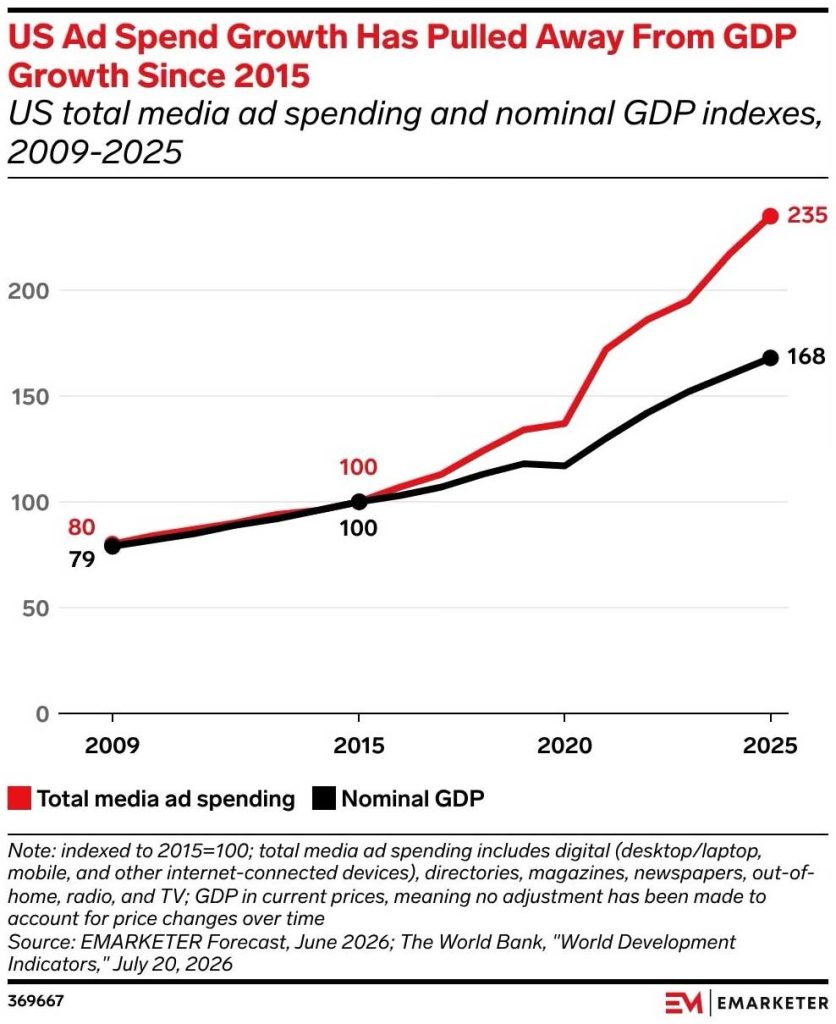
From tipsheet: Advertising is becoming a larger share of the economy. AI may make advertising so efficient that ad spend continues growing faster than GDP.
Related: June Ad Market Re-Accelerates Thanks To World Cup Spending (July 31) – MediaPost
AGENCIES
The AI leverage metric: revenue per employee
CEO Mark Penn used Stagwell’s latest earnings call to argue that AI is reshuffling the agency holding company landscape.
After reporting 6% net revenue growth, Penn pointed to major wins including IBM, Hershey’s and Haier, and said Stagwell is doubling its new business team following a 45% increase in new business.
Speaking to Adweek, Penn contrasted Stagwell’s strategy with larger rivals focused on restructuring: “Most of our competitors are figuring out how to lay off the next 1,000 people, and we’re still looking at the next 1,000 people that we’re going to hire.”
Penn says Stagwell is increasingly pursuing digital transformation engagements that combine consulting, engineering, software, creativity and AI.
Read:
- Stagwell Doubles New Business Team as Holdco Competition Heats Up, Says CEO Mark Penn (July 31) – Adweek
- Stagwell reports results for the three and six months ended June 30, 2026 (July 30) – Stagwell (PDF)
The transformation trend: WPP last month repositioned its WPP Enterprise Solutions group around AI transformation. Read tipsheet. (July 2)
From tipsheet: Stagwell remains much smaller than Publicis, Omnicom and WPP by revenue and headcount. But on a revenue-per-employee basis, it appears to outperform the larger holding companies by some estimates. If AI increases the leverage of knowledge work, revenue per employee may become one of the most important metrics alongside organic growth and margins.
PLATFORMS
YouTube’s new pitch for podcast ads
Google is explicitly positioning YouTube as an audio platform, not just a video platform.
The language is deliberate in a new help section first spotted by Search Engine Land: “Reach users with an audio optimised ad when users are on audio surfaces and in listening-first states on both YouTube and YouTube Music.”
Read:
- Create YouTube audio ads – Google Ads Help
- Google publishes its first dedicated guide for YouTube audio ads (July 31) – Search Engine Land
From tipsheet: By making podcast inventory accessible through familiar YouTube buying tools, Google strengthens YouTube’s pitch to podcasters seeking scalable advertising beyond traditional host-read sponsorships.
Meanwhile: Advertisers tell AI: “Create a YouTube audio campaign targeting podcast listeners.”
TECH
Retrieval becomes an agent capability
Salesforce SVP of Strategy Martin Kihn argues that retrieval-augmented generation (RAG) is evolving from a fixed pipeline into an agent capability. Rather than retrieving information before every prompt, agents decide when to retrieve data, which retrieval method to use and whether additional context is needed before taking action.
In Kihn’s view, enterprise differentiation shifts away from retrieval techniques alone and toward identity, governance and actions layered on top of enterprise data.
Read more on LinkedIn. (July 30)
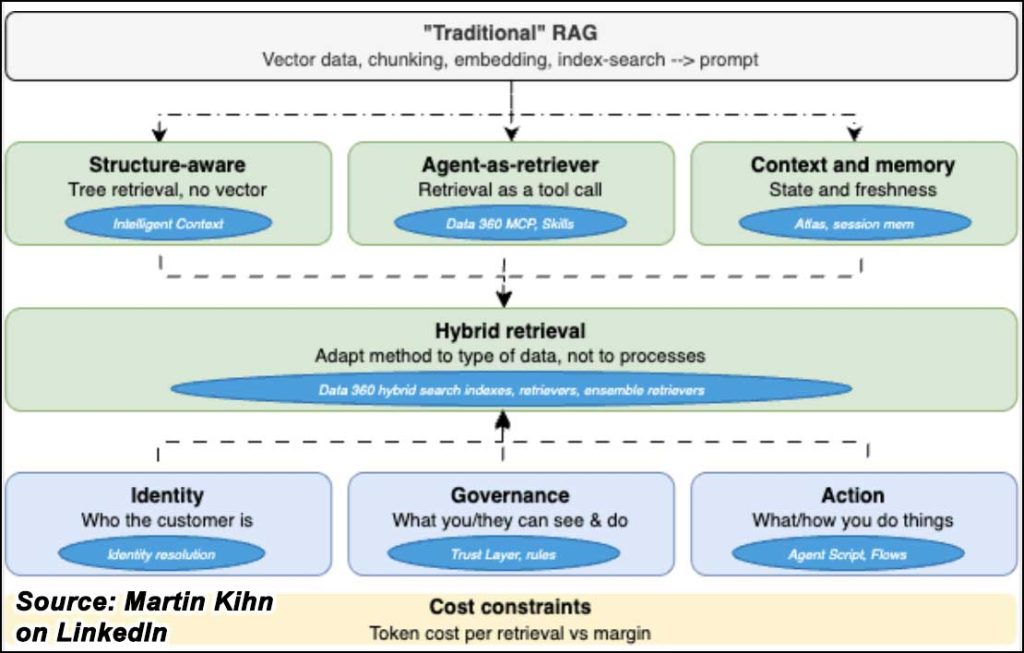
From tipsheet: Retrieval may become just another tool call as AI agents become more capable. Competitive advantage comes from the enterprise context surrounding the model: proprietary data, identity, governance and the ability to safely take action. That’s Salesforce’s broader strategic pitch.
FINANCIALS
Big week for earnings reports
- Snap – Monday, August 3
- Pinterest – Tuesday, August 4
- People, Inc. – Tuesday, August 4
- MNTN – Tuesday, August 4
- SpaceX – Tuesday, August 4
- AppLovin – Wednesday, August 5
- Criteo – Wednesday, August 5
- LiveRamp – Wednesday, August 5
- Taboola – Wednesday, August 5
- Magnite – Wednesday, August 5
- Shopify – Wednesday, August 5
- Fox – Thursday, August 6
- Unity – Thursday, August 6
- Roku – Thursday, August 6
- PubMatic – Thursday, August 6
- WPP – Thursday, August 6
- The Trade Desk – Thursday, August 6
- DoubleVerify – Thursday, August 6
From tipsheet: Nearly every company reporting this week now has an AI narrative. Watch for evidence that AI is changing financial results rather than simply generating demos. Can AppLovin extend its momentum into ecommerce? Does Pinterest discuss CTV opportunities following the tvScientific acquisition? Is Shopify seeing measurable traffic from AI shopping assistants like ChatGPT? And what do companies across adtech say about AI’s impact on productivity, targeting and revenue growth?
Related: “Reddit Q2 2026 earnings: 64% ad revenue growth, US DAUq sequential decline” (July 31) – Analyst Eric Seufert on Mobile Dev Memo (subscription)
MORE
- GPIDs and building trust infrastructure (July 31) – AdTech AdTalk podcast on YouTube
- Agentic AI automates advertising campaigns (August 1) – Axios (subscription)
- “AI-generated content will no longer be eligible for distribution on Spotlight” (July 31) – Snap
- Opinion: “Netflix’s Trade Desk Deal Won’t Fix Its Tune-In Problem” (July 28) – Dave Morgan, CEO, Simulmedia on Simulmedia
- Opinion: “Verification Is What Makes Agentic Workflows Trustworthy” (July 28) – Ryan Gauss, Director, PubMatic on LinkedIn