
Data collaboration platform LiveRamp is expanding its OpenAI partnership from conversion measurement (June 10) into audience targeting (Sept. 28), enabling brands to activate first-party audiences in ChatGPT Ads using RampID.
The Information’s Alix Coutures first reported the expansion on Monday. LiveRamp says the integration is available in 11 markets, allowing advertisers to use CRM, loyalty and other first-party data to reach customers and prospects or suppress audiences they don’t want to reach.
The integration is already live with multiple clients, LiveRamp’s Matthew Hogg, who works on AI and partnerships, said on LinkedIn Wednesday.
Advertisers can also upload customer lists directly through OpenAI’s Ads Manager, where matched audiences can influence campaign eligibility and bids.
Read: “Bringing the Power of RampID Globally to Custom Audiences in ChatGPT Ads” (Sept. 28) – LiveRamp
More: “LiveRamp Expands OpenAI Deal With First-Party Data Targeting” (Oct. 1) – Search Engine Journal
From tipsheet: So advertisers can bring familiar programmatic audience controls into ChatGPT Ads? Yes. And conversation privacy doesn’t mean conversations are disconnected from advertising. A platform can combine conversational intent with a matched customer audience to select an ad without giving the advertiser access to the underlying chat.
Matching serves two purposes:
- Measurement: Connecting conversions to earlier ad interactions.
- Audience targeting: Identifying audience members for targeting, suppression and bidding.
What remains unclear: LiveRamp’s announcement doesn’t explain what individual-level matching or attribution information flows back to the company.
Conversational intent adds a new signal to familiar identity infrastructure. So… what can brands learn from that combination?
Thought bubble #1 – ChatGPT and shopper conversations: OpenAI’s Sponsored Agents already let users start separate conversations with businesses. Could the needs shoppers express in those exchanges become customer signals for future advertising and measurement? What can brands retain and connect to their customer data, with the shopper’s permission?
Thought bubble #2 – RMNs and shopper conversations: Could a retailer unlock better advertising performance by letting shoppers explicitly share relevant assistant conversations with brands? A brand could learn not just that someone is in-market, but their intended use, budget and objections, then connect those needs to customer data to tailor advice and offers. Shopping may provide a natural setting for that exchange: users share what they need in return for more useful product guidance.
DATA
AppLovin vs. Unity
AppLovin has taken Unity to court over how its rival collects and uses advertising data.
Update (Oct. 1): A San Francisco Superior Court judge denied AppLovin’s application for a temporary restraining order and an order to show cause regarding a preliminary injunction, according to the court docket. The docket entry does not explain the court’s reasoning.
The story:
- Mobile ad giants AppLovin and Unity locked in legal dispute over data collection (Sept. 29) – Digiday
- Digiday’s Ronan Shields reports that Unity calls AppLovin’s lawsuit an attempt to slow competition and says Ad Quality, its ad-monitoring tool, “isn’t the driver of our improved performance.”
The courts:
- AppLovin’s application for a temporary restraining order: AppLovin vs. Unity (Sept. 29) – Superior Court of California – San Francisco County
- Paragraph 39 from AppLovin CTO Giovanni Ge’s declaration: “Even if individual fields are not confidential standing alone, AppLovin maintains the compiled record as confidential, and its value lies in the combination not being known to AppLovin’s competitors.” (Translation: AppLovin argues that one piece of data may reveal little, but many pieces linked together can reveal how it makes decisions.)
Social media:
- “Applovin is claiming that Unity somehow copies their data they collect, the auction info like bids and win price, and then looks at the actual ads themselves to basically reverse engineer their ad targeting system to allegedly use for the Unity ad platform.” (Sept. 29) – Jeromy Sonne on X
- “[Applovin doesn’t] want to tie up resources with this. [AppLovin CTO Giovanni Ge’s] time is better spent on product, but for the sake of the entire ecosystem, they must enforce the rules and uphold the integrity of the auction and data collection.” (Sept. 30) – Dom Davies on X
History:
- AppLovin offers to buy video game software maker Unity in $17.5 bln deal (2022) – Reuters
Markets:
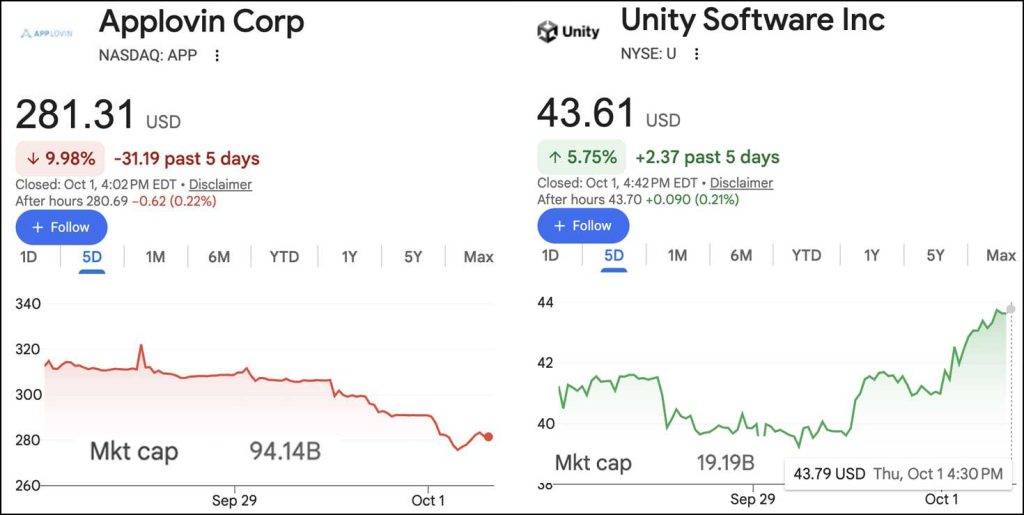
Five-day stock performance through market close, Oct. 1. Source: Google Finance.
From tipsheet: LiveRamp’s story is about bringing customer data into an ad platform. This one is about what a rival can learn from the data coming out. Shared ad ecosystem, competing AI models and contested data rights. Boom!
LLMs & CHATBOTS
Developments
- Claude for Government is now generally available (Oct. 1) – Anthropic
- Amazon unveils a free, fast, open source Jev killer: Strands Decider 2B makes decisions in fractions of a second (Oct. 1) – VentureBeat
- Gemini 4 Argon: our next era of frontier intelligence (Sept. 30) – Google
MORE
- Next week: “Advertising Week NY 2026: 10 execs on what they want to hear about AI” (Sept. 30) – The Current, a The Trade Desk publication
- Measurement guides AI: Amazon Ads’ Paula Despins explains how attribution helps advertisers steer AI and check its forecasts against actual sales (Oct. 1) – AdExchanger
- Provenance: “Swedish Company Uses A.I. Likeness of Greta Garbo in Ad” (Oct. 1) – The New York Times (subscription)
- Sell-side economics: “Publishers clear major hurdle in Google ad-tech antitrust fight” (Sept. 30) – Editor & Publisher
- Brands and AI: Study says Google AI Overviews appeared for 80% of tracked branded queries, up from 26% (Oct. 1) – Search Engine Land