
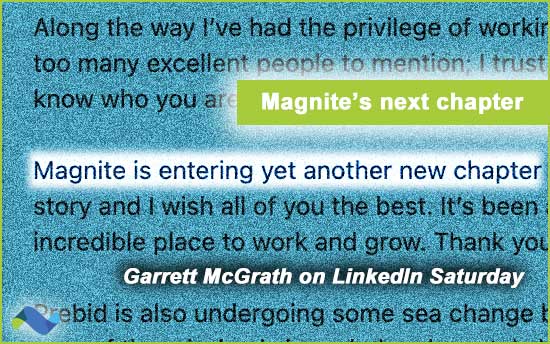
Former Magnite SVP of Product Management Garrett McGrath reflected on his nearly nine years at sell-side platform Rubicon Project — which became Magnite after Rubicon and Telaria merged — in a LinkedIn post following his recent departure from the company.
After recounting the company’s evolution through privacy changes, identity initiatives, curation, acquisitions and Prebid, McGrath concluded:
“Magnite is entering yet another new chapter in its story and I wish all of you the best. It’s been an incredible place to work and grow. Thank you.
Prebid is also undergoing some sea change but the core of the mission is iron clad and crystal clear. For the Board and the membership, thank you for everything you do. Keep doing it.”
Read his entire post. (May 30)
The comment comes amid a broader leadership transition at Magnite as tipsheet noted Friday.
From tipsheet: McGrath did not elaborate on what the company’s next chapter entails. However, the remark is notable given his long tenure and central role in many of Magnite’s product and industry initiatives. The comment comes as investors and industry participants look for clues about Magnite’s strategic direction amid a broader leadership transition and its expansion into CTV, curation and AI-related opportunities.
LLMs & CHATBOTS
Developments
- “The Billionaire Coding Genius Making the Tough Decisions at OpenAI” (May 29) – The Wall Street Journal (subscription)
- “Chip Ganassi Racing × OpenAI” (May 20) – part of an OpenAI docuseries
- In review: Mistral AI and its inaugural conference last week in Paris (May 28) – VentureBeat
TECH
Use cases: Search and programmatic
Two AI-related case studies that dropped recently:
- “5 brands driving growth on the AI Search frontier” (May 2026) – Think with Google
- “Unity’s Audience Hub: how 256 million gamers finally reached brand advertisers” (May 28) – PPC Land
More: “Unity + Optable Case Study: From Gaming Engine to Programmatic Powerhouse” (May 28) – Optable
From tipsheet: Search and programmatic advertising appear to be converging around the same idea: AI systems are becoming better at finding valuable signals than humans are at defining them. Google’s AI Max uses semantic understanding to reach new search demand, while Unity’s Audience Hub combines Vector AI audience modeling with Optable’s privacy-safe data collaboration infrastructure to activate gaming audiences across the open web.
MEASUREMENT
AppsFlyer: Incrementality gains momentum
Speaking on the ADSN podcast hosted by Universal Ads’ James Borow and Daniel Druger, AppsFlyer President Brian Quinn argued that the industry’s shift toward incrementality measurement could reshape how marketers evaluate media performance.
His company, which positions itself as a “Modern Marketing Cloud,” says its SDK has been adopted by more than 11,000 media sources worldwide.
He noted that major platforms, including Meta, have increasingly embraced incrementality testing, which attempts to measure the business impact of advertising by comparing exposed and unexposed audiences rather than relying solely on attribution models.
Quinn suggested the shift may benefit channels that have historically been under-attributed.
“TV is a good example. I think we’ve been under-attributed massively over the years. We weren’t a big enough part of your media plan to force you to change how you measure. But now that everyone’s being pushed towards incrementality, it actually is helping TV.”
… TV moves toward performance.
CFOs embrace incrementality
He also argued that incrementality is becoming more accepted by finance teams as marketers seek measurement frameworks that connect more directly to business outcomes.
“It becomes a really important always-on testing environment that reinforces learning. (…) You see more and more CFOs recognizing that incrementality, modeling and experimentation are critical.”
“Nobody talks about this, but a lot of times, marketing innovation dies when the CMO has to go and present to the CFO. CFOs want to see consistency, quarter over quarter, year over year. They don’t want to see tests and new marketing vocabulary and things that actually can’t back out into enterprise value and unit economics, things that have been tested and true.
And you see more and more CFOs recognizing that incrementality and that kind of modeling, that kind of experimentation, is critical.”
Listen: “‘Why Marketing, Product and Measurement are Collapsing,’ featuring Brian Quinn, AppsFlyer” (May 28) – ADSN on Apple Podcasts App
From tipsheet: Incrementality may prove to be one of the most important trends in advertising measurement over the next decade.
Historically, many open-web channels have been measured through attribution systems that favored platforms with stronger identity signals and closed-loop reporting. Incrementality shifts the question from “who gets credit?” to “what actually caused business outcomes?”
If that framework continues gaining acceptance among CFOs and finance teams, it could help marketers justify investment across a broader mix of media, including connected TV and other channels that may have been under-attributed by traditional measurement approaches.
SELL-SIDE
Amazon: Signals, shopping and AI
Amazon Publisher Services announced several new capabilities at its annual summit last week, including:
- An expanded version of Signal IQ that helps publishers measure the impact of OpenRTB bidstream signals on advertiser demand;
- Shopping Insights for web and mobile inventory
- Publisher Supply AI
- New shoppable ad formats for mobile and connected TV.
Read: “Amazon Publisher Services Unveils New Capabilities at Annual Summit” (May 29) – APS’ Scott Siegler on Amazon Publisher Services
More: Amazon Has New Tools To Help Publishers Prove Which Bidstream Signals Drive Demand (May 29) – AdExchanger
From tipsheet: The common thread across these announcements is that Amazon is helping publishers understand not just what inventory they have, but what it’s worth. The company is connecting publisher inventory more directly to shopping intent, advertiser demand and transactions. In that model, intelligence becomes as important as inventory.
PLATFORMS
Meta beyond ads: subscriptions, AI, cloud services?
Nearly 98% of Meta’s revenue still comes from advertising, making AI subscriptions and potential cloud services among the company’s most ambitious diversification efforts to date.
Read: “Meta has struggled at selling anything other than ads. Will AI be different?” (May 29) – CNBC
COMMERCE MEDIA
Reaction: Walmart shopper graph
On X, W Media Research analyst Karsten Weide published an analysis of last week’s Walmart shopper graph announcement which has implications for retail media.
He saw an important shift where datasets are becoming portable. Weide explained:
“Walmart Connect is making its audience data and closed-loop sales measurement available inside Yahoo DSP, initially across VIZIO CTV inventory, with Magnite providing the supply-side technology for audience activation. In plain English, advertisers can now use Walmart shopper data, buy premium VIZIO CTV inventory through Yahoo, and measure results against actual Walmart sales — without living inside Walmart’s own buying environment.
Everybody Wins
Yahoo gets the most obvious victory. Few DSPs can offer direct access to one of the world’s largest retail media datasets tied to actual purchase outcomes. Walmart’s shopper graph instantly makes Yahoo DSP more relevant to agencies and brands seeking alternatives to Google, Amazon and The Trade Desk.
Walmart benefits because on-site retail media growth eventually hits a ceiling. To keep growing, Walmart must export its data and inventory into the broader internet — while preserving what makes retail media valuable in the first place: sales attribution.
Magnite also wins: SSPs were once viewed as dumb pipes. Increasingly they are becoming intelligence layers. Positioning itself as the infrastructure where retailer data, audience decisioning and measurement happen close to the impression is a far more defensible business than simply auctioning inventory.”
Read more from Karsten Weide on X. (May 29)
Bayer retail media marketer Ryan Verklin responded in the comments to Weide:
“I do agree with your sentiment this is big news for Walmart. First time they deviated from the Amazon playbook. One thing I would point out is all the RMNs you called out in your last paragraph audiences are already available in The Trade Desk.”
Read Verklin on X. (May 29)
From tipsheet: A notable shift is Walmart extending shopper graph, activation and measurement capabilities deeper into the open web through partners such as Yahoo DSP, Magnite and The Trade Desk.
Looking ahead, if retailer signals increasingly flow through the supply path, SSPs could evolve from auction infrastructure into intelligence and measurement layers that sit closer to both media execution and business outcomes. For DSPs, the opportunity may be less about access to audiences and more about access to retailer-derived measurement signals that can be used to optimize campaigns against sales outcomes.
LLMs & CHATBOTS
New ad category proposed: conversational intent
On the Marketecture podcast, Aperiam’s Eric Franchi referenced new data from Similarweb CEO Harel Amir which suggested that ChatGPT ads are performing well.
The CEO also suggested the emergence of a new ad category: “conversational intent” versus the “intent” of Google Search.
Read the data: “OpenAI is building a new kind of ad machine. Early data suggests Google should worry” (May 27) – Business Insider
Franchi explained on the podcast:
- Pure intent: “Airline tickets to Chicago from Newark…I’m thinking about taking a trip.”
- Conversational intent: “Like anticipating a need versus a user expressing a need.”
He asked for thoughts from Marketecture’s Ari Paparo and Hightouch co-CEO Tejas Manohar, a guest on the show:
Ari Paparo: “Conversational intent is interesting because my thought on this is that the longer context is primarily valuable because it gives you more sense of where the consumer is in the funnel. Whereas if you go to Google and you type in “airline fares to Detroit,” there’s no way to know if you’re right about to book it or if you’re ‘maybe I’ll go to Detroit. I wonder how much it costs?’ (…)
Whereas in the conversation, you can actually tell. You could just say, ‘what are the best fares? Are there any fares on Saturday?’ You could start drilling down and now you know you’re at the bottom of the funnel. That could open up some exciting opportunities for advertisers.”
Tejas Manohar: “Theoretically, it could be a lot more incremental of a channel if OpenAI gives you the right primitives to leverage it. I’m super bullish on ads.”
Manohar also said that his AI-enabled CDP startup is in the early stages of a partnership with OpenAI.
Listen: “Episode 175: Tejas Manohar, co-CEO of Hightouch, on the Company’s Giant Fundraise, Agentic Ads, and LiveRamp” (May 29) – Marketecture
From the Similarweb CEO
Meanwhile on LinkedIn, Similarweb’s Amir connected the findings to his company’s product direction:
-
“The mental model of ‘buying keywords’ served the industry for two decades. I don’t think it’s enough anymore. This is exactly where we’re heading with our ad intelligence product at Similarweb: giving advertisers the visibility they need to understand intent drift and reach consumers at the right point in the funnel, inside ChatGPT and the conversational AI platforms that follow.” Read more on LinkedIn. (May 28)
From tipsheet: Conversational intent may also be thought of as intent visibility. As Paparo noted, conversations provide additional context about where consumers sit in the funnel. Search sees the query. Conversational AI sees the conversation that led to it.
LLMs & CHATBOTS
Job opening: OpenAI formalizes GTM sourcing
“Strategic Sourcing Leader, Go-to-Market” – OpenAI Careers
From tipsheet: The senior procurement role suggests OpenAI is formalizing sourcing and vendor-management processes across marketing, partnerships and other go-to-market functions.
TECH
Heimlich: Private models vs. pooled intelligence
On the AdTech AdTalk podcast, Chalice Co-founder and CEO Adam Heimlich argued that advertiser-owned models — systems trained on an individual brand’s outcomes rather than pooled industry data — may eventually outperform platform-owned optimization systems.
In speaking with his co-host, Gamera’s Gareth Glaser, Heimlich illustrated the point using Coke and Pepsi. While both sell soft drinks, the objective may be persuading Coke drinkers to switch to Pepsi or vice versa.
[52:20]
Adam Heimlich: “The per advertiser model starts slower and compounds better.”
Gareth Glaser: “Right. It’s an investment in itself. It gets better and better the more you spend on it.”
Adam Heimlich: “But to the platform point of view, it’s like, ‘Start slow, we can’t do that. We need it to perform.’”
Gareth Glaser: “Yeah. It’s got to perform the second they set it up or they’re going to turn it off.”
Adam Heimlich: “So, where that’s headed is that the brands eventually will realize, ‘Why am I working with this platform? I have what I need in my data and I need to bring it to market as like a model based off a private valuation.’”
Garth Glaser: “I get it… The idea is that if you have enough money to spend on a customized model for you, the outcomes are so distinct that there is no reason to use data from elsewhere. Where this gets really interesting is also this model needs a consolidated delivery mechanism so that it’s not an ETL nightmare to try and marry up the different systems that are delivering all over the place and consolidate the data for it to look at its outcomes across all of its media.”
Adam Heimlich: “And that’s why I’m screaming about modularity and ARTF shared compute environments. Like this is the infra where private valuations are going to be dropped.”
Chalice is built around the same thesis.
Listen: “Let’s Get Encyclical” (May 29) – Adtech Adtalk on YouTube
From tipsheet: As AI becomes more widely available, the advantage may shift from access to intelligence to ownership of it. Proprietary data, measurement and feedback loops are one way to get there.
MORE
- Publishers quietly cut ‘six-figure’ deals via Snowflake’s AI licensing platform (May 29) – Digiday (subscription)
- Google appears to be testing new branded search controls in AI Max campaigns (May 29) – Search Engine Land
- ‘The Wild West’: IAB Tech Lab’s CEO on agentic misconceptions and the future of agencies – The Trade Desk’s The Current
- Axios Bets That AI Can Make Local News Pay, One Market at a Time (May 29) – Axios
- CNN sues Perplexity over alleged AI copyright theft (May 28) – CNN