
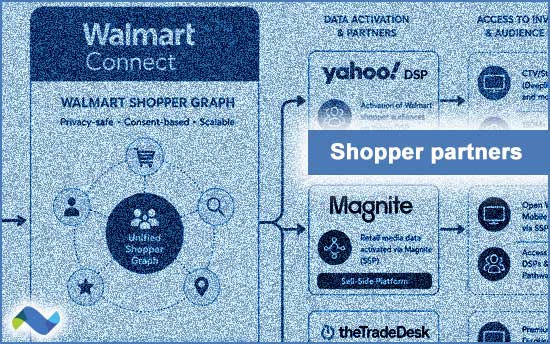
Walmart Connect announced expanded access to its first-party shopper data across multiple advertising platforms.
The company’s Media Partnerships lead Jared Lefkowitz explained on LinkedIn:
-
“We’re continuing to expand how Walmart’s first-party data can be activated across the ecosystem — making it easier for advertisers to connect real retail signals directly to media decisions, planning and measurement. This is just the beginning of what’s possible.”
Read: “Expanding access to Walmart first-party data across leading platforms” (May 28) – Walmart Connect
Ad Age’s Garrett Sloane reported that Walmart shoppers are now reachable through sell-side platform (SSP) Magnite and Yahoo DSP alongside The Trade Desk’s curated marketplace.
Sloane previewed his piece on LinkedIn yesterday:
“Walmart gave its first major indication of where it wants to take its ad tech after exclusivity with The Trade Desk expired last year. The retailer named Magnite as an SSP partner, which also gives it access to more DSPs, outside the Walmart DSP.
Here is what we know:
- Walmart wants to get closer to the supply side with this integration, pumping its retail media data through Magnite. This is an increasingly common strategy.
- Yahoo is the first DSP to get the go-ahead for activation through Magnite, but there are more DSPs and connected TV pathways available through the SSP.
- Walmart’s bespoke Trade Desk DSP also has a new curated marketplace creating a new direct pathway to the inventory through ‘Content Select.’”
Read more on LinkedIn. (May 28)
Yahoo DSP emphasized on LinkedIn: “150 million Walmart shoppers are now reachable through Yahoo DSP. Beginning today, select Yahoo DSP advertisers can reach high-intent Walmart audiences across VIZIO CTV inventory via the Yahoo DSP, with closed-loop measurement that connects ad exposure to real Walmart sales.” Read it.
Back in April, Magnite announced its partnership with Walmart Connect. Read the release. (April 28)
Read: “Walmart names Yahoo and Magnite as partners in its ad tech tuneup” (May 28) – Ad Age (subscription)
From tipsheet: Walmart is positioning its shopper graph as infrastructure for programmatic advertising across both demand and sell-side platforms. By connecting retail purchase data, CTV inventory and closed-loop measurement across partners like Magnite, Yahoo DSP and The Trade Desk, Walmart is moving closer to the systems that influence how media dollars are allocated and optimized.
LLMs & CHATBOTS
Developments
-
- Introducing Claude Opus (May 28) – Anthropic
- Geordie Raises $30M to Help Enterprises Securely Adopt Agentic AI at Scale – press release
- Anthropic bests OpenAI in valuation race, hitting $965B with Series H (May 28) – PitchBook
CONNECTED TV
Building the Universal Ads TV machine
Quoting from a Digiday article, Universal Ads GM James Borow wrote yesterday on LinkedIn:
“If you want to ship fast, innovate, and fundamentally change how the TV ads ecosystem works, there is nowhere else to be:
‘Last week, Universal Ads released an MCP (Model Context Protocol) extension, following a similar policy change from Meta. Earlier this month, it inked a partnership with commerce media firm Koddi that allowed small business advertisers to use retail data to target audiences using Fox Corporation, NBCUniversal and Paramount inventory. The week prior, it added linear inventory to the Universal Ads self-service platform, allowing SMB advertisers to run commercials (some made using AI tools) against broadcast TV. Last week, it finalized a deal with Adjust, AppsFlyer, Branch, Kochava, and Singular to allow brands to run campaigns on its CTV inventory that track mobile app users installing an app after they’ve seen an ad.’”
Read more on LinkedIn. (May 28)
Read: Universal Ads must pass the pizza test if it’s to steal ad dollars from social (May 28) – Digiday (subscription)
From tipsheet: Universal Ads’ recent announcements all point in the same direction: making television programmable. MCP exposes inventory to AI systems, retail media data improves audience selection and app-install measurement creates a clearer optimization signal. Together, they move CTV closer to the closed-loop optimization models that helped make Meta and Google so powerful.
MEASUREMENT
Measured brings incrementality data to MCP
Measurement startup Measured became the latest company to announce a Model Context Protocol (MCP) server. Marketers can use their preferred AI tools to access Measured’s cross-channel incrementality data, potentially bringing causal measurement signals more directly into media-buying and optimization workflows.
Measured’s MCP draws from what the company describes as an incrementality intelligence database “built from 30,000+ experiments across 200+ brands.” It includes:
- “Incrementality Intelligence Database: Recent tests of causal measurement data across channels, brands, and categories”
- “Omnichannel Measurement: Performance visibility across all major platforms in one place”
- “Optimization Insights: Marginal return and incremental growth potential data to guide budget allocation”
Read: “Measured Launches MCP Server, Bringing Marketing Performance Data into ChatGPT, Claude and Other AI Platforms” (May 28) – press release
CEO and Co-Founder Trevor Testwuide told AdExchanger’s Allison Schiff, “The magic of AI doesn’t happen when you dump a massive data set into an LLM and say, ‘tell me the insight’ – that’s actually when you run into a lot of these issues. (…) The contextual layer is incredibly important here.” Read more. (May 28)
Demo: See a video demo from Measured VP of Growth Will Post on LinkedIn.
From tipsheet: The advertising stack is becoming more modular. MCP servers potentially allow measurement systems, optimization engines and AI agents to interoperate more directly — even as platforms continue building closed-loop environments around their own data and tooling.
LLMs & CHATBOTS
Report: OpenAI moves toward outcome-based ads
Joe Kaziukėnas, an entrepreneur who has closely tracked the rollout of ChatGPT’s self-serve ads product on LinkedIn, said yesterday that ChatGPT ads now support conversion-optimized buying and CPA-style pricing.
He wrote:
“OpenAI now has conversion-optimized ads, where the advertisers only pay if the user buys something after clicking an ad. This will be live for all advertisers in early June. (…)
Two months ago, I built a tracker for OpenAI ads features. The pace of change has been relentless. Over those same two months, since OpenAI abandoned Instant Checkout and Walmart critiqued it in public, ChatGPT added practically zero new features for shopping (I have a tracker for that, too). Meanwhile, ads are getting new stuff every day.”
Read more. (May 28)
From tipsheet: OpenAI appears to be moving quickly up the performance advertising stack. In less than four months, ChatGPT ads have progressed from impression-based buying to click-based buying, conversion tracking and now outcome-based pricing. The company appears to be building toward a future where advertisers can buy outcomes rather than attention.
SEARCH
Google highlighting sources in AI Search
Sources matter.
Google Search Product Manager Duncan Osborn announced updates to AI Mode and AI Overviews on Wednesday as the company reintroduces source visibility, attribution and trust signals into AI search.
Osborn said users will now be able to bring Preferred Sources directly into AI experiences while Google expands features highlighting original reporting, creator perspectives and highly cited content.
He added, “When you come to Search, you’re looking for information you can trust from the sources, websites and creators you value most…”
Read: New ways to find your favorite sources and original content in AI Search (May 27) – Google The Keyword blog
More: Google AI Overviews & AI Mode gain preferred sources, plus new perspectives carousel and highly cited labels (May 27) – Search Engine Land
From tipsheet: One challenge for AI search is that the answer often becomes more prominent than the source. Google’s latest updates suggest the company is looking for ways to preserve attribution, trust and publisher visibility while continuing to push users toward AI-generated experiences.
TECH
Eric Seufert’s “prosperous society”
In a new interview with Ben Thompson on Stratechery, Mobile Dev Memo founder and digital advertising analyst Eric Seufert argued that AI may dramatically increase the importance of advertising and recommendation systems as economic coordination mechanisms.
His argument: AI-driven abundance increases the value of distribution. (Seufert said he was writing a book about it but decided to drop it as a four-part podcast series on Mobile Dev Memo.)
He explained to Thompson that AI-driven content and product creation could shift the bottleneck from supply toward distribution and matching, ultimately leading to what he called a “prosperous society”:
(transcript lightly edited)
Eric Seufert: “…My point is when you get the explosion of output that AI is allowing for, you shift the binding constraint to distribution, because you’ve got this massive pool of stuff to pull from.”
Ben Thompson: “[…So when] you have an explosion of supply, the problem becomes how do you sort through this? How do you actually find what you want?”
Eric Seufert: “Exactly, and so the distribution becomes the principal allocation mechanism, but these allocation mechanisms with digital ads are very good and very efficient. So you’re shifting a big chunk of the economy to these systems that are very efficient and very workable — and that’s good — that automatically creates growth, that automatically creates value.”
Read or listen: “An Interview with Eric Seufert About Models and Ads, and AI’s Upside for Humanity” (May 28) – Stratechery (subscription)
More: Seufert also discusses completing his Masters in Applied Computation at Harvard University this week (congrats!) and a related thesis exploring how marketers might use platform outputs to navigate increasingly opaque advertising systems.
From tipsheet: If AI creates abundance, distribution becomes the bottleneck. The systems that help people discover what they actually want may create enormous economic value.
EVENTS
IAB Tech Lab Summit: AAMP on AWS
From IAB’s Tech Lab Summit in New York City:
-
“Killer demo at IAB Tech Lab Summit as Amazon Web Services (AWS) Stephanie Layser deploys the Tech Lab AAMP framework on AWS. Fully functioning AAMP buyer and seller agentic workflows in less than 10 minutes! And customizable! No engineers, no deep technical expertise required. Simple!” – Anthony Katsur, CEO, IAB Tech Lab on LinkedIn (May 28)
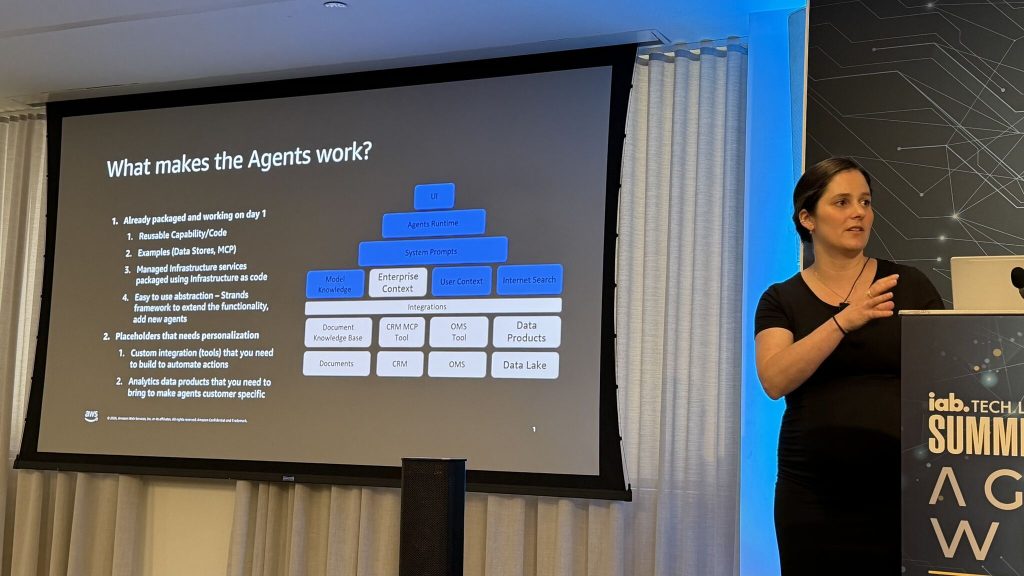 Stephanie Layser, AWS at IAB Tech Lab Summit (May 28)
More: AAMP (Agentic Advertising Management Protocols) (Updated April 23) – IAB Tech Lab
The demonstration comes as industry participants debate whether agentic infrastructure can help the open web close the gap with walled gardens.
In another post, advisor Nathan Woodman of Proof in Data wrote on LinkedIn:
“There’s a reason every walled garden — Meta, YouTube, TikTok, Amazon — runs ads through learned embeddings, and the open web mostly does not. It isn’t because the open web doesn’t know the technique. It’s because the open web has never had a place to run the math at bid time.”
He argued that frameworks such as AAMP and ARTF could provide the infrastructure needed to combine identity, audience and contextual signals using modern ranking systems.
Related: A Guide to the New, Wide World of Agentic Advertising and Commerce Protocols (May 28) – Adweek
From tipsheet: One way to think about AAMP and ARTF is that they attempt to give the open web something the major platforms have long enjoyed: a shared environment where models, signals and decisioning systems can operate closer to the transaction itself. The goal is not simply interoperability. It’s creating the technical layer required for AI-native advertising systems to compete on performance — something closer to the closed-loop environments that have powered the walled gardens for years.
SELL-SIDE
Prebid, Magnite leadership shifts
Sell-side open-source standards body Prebid announced that it would soon appoint a new chairperson following the departure of Garrett McGrath from sell-side platform Magnite, where he was SVP of Product Management.
Prebid President Mike Racic wrote in an email this week: “Prebid’s bylaws are designed to ensure our leadership reflects the active participation of our membership. In accordance with those rules, Garrett McGrath’s term as Chairperson concluded on Friday, May 15, following his departure from a member company. The Board has named Joel Meyer as interim Chairperson for the next 90 days as we determine the long-term leadership structure.”
Meyer is CTO of sell-side platform OpenX.
Racic also announced that he will be leaving pending the hire of a new President for Prebid.
Magnite is in the process of turning over much of its executive layer following the recently announced departures of the CFO, CPO, CMO, CSO and Garrett McGrath, all disclosed around May 15.
The turnover appears to reflect a planned leadership transition following years of M&A integration work tied to the Rubicon Project—Telaria merger and Magnite’s acquisitions of SpotX and SpringServe.
Magnite’s current leadership team is listed here.
From tipsheet: The leadership transition at Prebid and Magnite comes as sell-side ad tech attempts to redefine its role in a more agentic advertising ecosystem. Earlier this year, Prebid took over stewardship and development of the AdCP sell-side agent codebase as part of a broader push toward agent-to-agent media buying and selling across the open web.
On its recent earnings call, Magnite similarly argued that AI systems may increase demand for infrastructure “rails” and systems-of-record rather than bypass them entirely. Walmart’s new partnership with Magnite may reflect the same thesis: that infrastructure and coordination layers become more valuable as retail media signals, CTV inventory and AI-driven buying systems converge.
That could elevate the strategic importance of interoperability and coordination layers like Prebid as advertising shifts from human-operated software toward machine-to-machine systems.
MORE
- Adform and Adsquare launch Agentic Real-Time Framework (ARTF) integration (May 28) – press release
- Opinion: “Why Agentic Measurement Will Reprice The Ad Market” (May 28) – Evgeny Popov on AdExchanger
- Why iSpot is Confident that AI Will Revolutionize TV Ads – Eventually (May 28) – Mike Shields on his “Next in Media” Substack
- B2B: Why your buyers have already decided before you know they exist (May 28) – The Drum
- Global firms use AI at Indian hubs to bring more ad work in-house (May 28) – Reuters