
Manus announced a new desktop version of its cloud-based AI agent called “My Computer.”
TL;DR — the Manus AI agent works locally on the device.
A blog post went into the weeds:
“When Manus can leverage every command line tool on your machine, from Python and Node.js to Swift and Xcode, the potential for complex automation and development becomes immense.
One of our colleagues challenged Manus to build a real-time meeting translation and subtitle application in Swift, entirely on his Mac. The entire process, from project creation and coding to debugging and packaging, was handled through terminal commands.
Twenty minutes later: a fully working Mac app. No Xcode opened. No code written manually.”
Read: “Introducing My Computer: When Manus Meets Your Desktop” (March 16) – Manus
It’s available for macOS and Windows right now.
Visit: “Give Manus My Computer Now” – Manus
From tipsheet #1: Reminder — this is Meta’s Manus (acquired less than 90 days ago) which is already helping Meta with advertising workflow tools.
Having AI agent workflows happen locally (on the user’s device) rather than in the cloud is the same future predicted for Apple. (Ben Thompson, Stratechery, June 2024) “Working locally” aligns with Apple’s privacy positioning and hardware strategy.
Working locally would also seem to be a key element of ads of the future.
From tipsheet #2: Ben Thompson said in an unrelated Stratechery update yesterday, “That’s how big of a deal actually functional agents are: you can see them coming and yet still be amazed when they arrive — and, as one must say with everything related to AI, in a form that is the worst they will ever be.” (“Agents Over Bubbles” – March 16)
One could say that about advertising and marketing tech today, too.
LLMs & CHATBOTS
Developments
- “This news [Reuters] came out a little earlier than we planned; we’re excited to be building a deployment arm and will share more details soon. Companies have a ton of urgency to deploy AI…” (March 16) – OpenAI CEO of Applications Fidji Simo on X
- Adobe and Nvidia Announce Strategic Partnership to Deliver the Next Generation of Firefly Models and Creative, Marketing and Agentic Workflows (March 16) – Adobe
- Nvidia GTC 2026: CEO Jensen Huang sees $1 trillion in orders for Blackwell and Vera Rubin through ’27 (March 16) – CNBC
TECH
The “I am building” trend
- “I am currently building Markus, an AI agent GTM orchestrator.” (March 16) – Nate Woodman, Proof in data (former Havas/Iponweb executive) on LinkedIn
- “I’m building a tool via Claude that analyzes your Amazon DSP inventory supply report, gives detailed overviews of the ad experience for each site/app, and provides a score and blocklist recommendation.” (March 16) – Justin Dellinger (former Amazon Ads executive) on LinkedIn
Related:
- “Could AI create a one-person unicorn? Sam Altman thinks so—and Silicon Valley sees the technology ‘waiting for us’” (February 2024) – Fortune on Yahoo
- “Anthropic CEO Dario Amodei Predicts the First Billion-Dollar Solopreneur by 2026” (March 2025) – Inc
From tipsheet: In addition to Messers. Altman and Amodei, the venture capital world is waiting for the first one-person unicorn, too.
New iterations of AI tools like Anthropic’s Claude are allowing entrepreneurs with deep domain experience to explore their ideas with little overhead.
PROTOCOLS
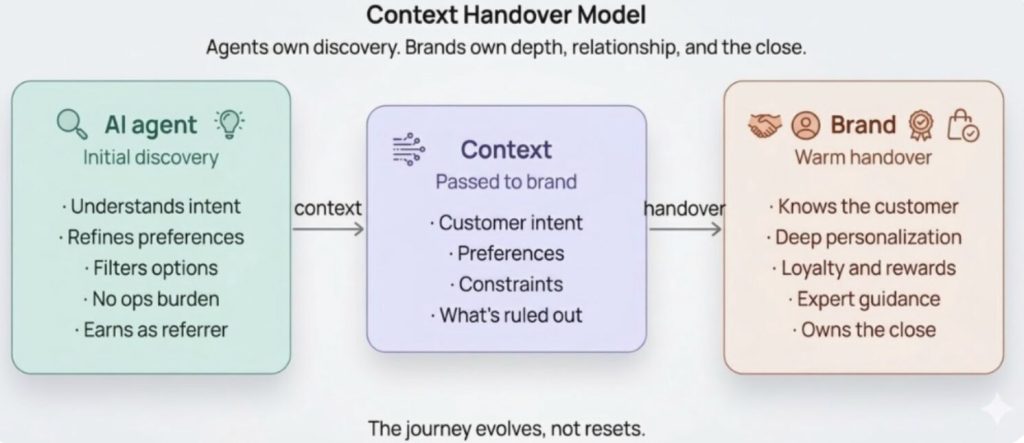
Context Handover Model
Building on last week’s news regarding Amazon’s successful court action against AI company Perplexity, Albertsons Group VP Jahin Pahuja explored the role of brands in the agentic world.
Mr. Pahuja described what he saw as a “Context Handover Model” which ultimately gets passed to brands (see graphic below):
“A WSJ piece out [last] week captures the tension well. Amazon is locking the door to protect ad revenue. Early native AI checkouts were overcorrections. Walmart is now threading their own intelligence, Sparky, into the ChatGPT ecosystem.
The future isn’t agents replacing brands. It’s agents handing off the baton, so the customer who started with a blank slate ends up with exactly the right gift, from a brand that knows how to close.
The real race now? Building the protocol that makes that handover invisible. And it’s far from clear who owns that standard, the agents, the retailers, or someone building quietly in between.”
Read LinkedIn. (March 15)
From tipsheet: Proponents of Agentic Real-Time Framework (ARTF) and Ad Context Protocol (AdCP) will happily pick up Pahuja’s protocol “gauntlet”.
The mushy ‘human zone’ of Brand would only seem to get more valuable as AI capabilities are commoditized over time. It’s why retail media isn’t going away. Brand matters as long as humans are involved in the buying process. And even if a human isn’t involved (and an agent is), brand may still matter.
B2B MARKETING
LinkedIn turns to LLMs
LinkedIn announced last week that it would begin using a single Large Language Model (LLM) to provide recommendations in the user feed.
To date, LinkedIn’s much-maligned algorithm has often delivered posts weeks after they are published to the frustration of many users.
Search Engine Land’s Danny Goodwin parsed the announcement:
“LinkedIn replaced several separate discovery systems with a single LLM-powered retrieval model…
Previously, feed candidates came from multiple sources, including network activity, trending posts, collaborative filtering, and topic-based systems.
The new approach uses LLM-generated embeddings to understand what posts are about and how they connect to your professional interests.
Now, LinkedIn can link related topics even when they use different terminology. For example, engagement with posts about small modular reactors could surface content about electrical grid infrastructure or renewable energy.”
Read more on Search Engine Land. (March 16)
More: “Updates to The LinkedIn Feed Focusing on Authentic, Relevant Conversations” (March 12) – LinkedIn
Related: Google Shares More Information On Googlebot Crawl Limits (March 16) – Search Engine Journal
SELL-SIDE
Yahoo CEO on chatbots, web publishers
On the most recent episode of The Verge’s Decoder podcast, Yahoo CEO Jim Lanzone discussed his multi-faceted company’s future — which includes the company’s new Scout chatbot.
He made the case that the Scout is open-web-publisher-friendly (lightly edited):
“Our chatbot looks a lot more like traditional search, and it is more paragraph-driven.
It’s not a chatbot that’s trying to act as if it’s a person and be your friend. (…) we’re hoping that — not just for us, but for other chatbot engines in the future — that the Scout model becomes more of the user interface for these things.
[Open web] publishers deserve it. We’re not going to have the content to consume and be able to give great answers if publishers aren’t healthy.
I really actually think Google would have wound up with that interface, one much more similar to what we did, if they’d been first out of the gate.”
Read: Yahoo CEO Jim Lanzone on reviving the web’s homepage (March 16) – Decoder on The Verge
Listen: Decoder podcast on Apple Podcasts app
Related: “Kat Downs Mulder: Inside Yahoo’s AI Strategy for the Future of News” (March 13) – Newsroom Robots on Apple Podcasts app
CONNECTED TV
CTV startup fights ‘silent retargeting’
New CTV ad platform startup Adgentic — whose pitch is “Advertise on TV. With Agentic AI” — says it’s looking to overcome industry measurement malfeasance on behalf of SMB advertising clients who seek a better way to understand the performance of CTV ad spend.
Adgentic recently announced a $3.25 million seed round of funding. More here from last week.
CEO and co-founder Ben Brenner has been busy making his startup’s case, and yesterday, his third LinkedIn post in a series (here’s #1 and #2) addressed an issue he called “silent retargeting”.
Brenner wrote yesterday:
“‘Silent Retargeting’ is a DEFAULT TACTIC in performance CTV, because vendors know your north star is ROAS or CAC, and because they know this would be one of the hardest things for you to prove.
The only way for you to know if it’s happening is by digging through log-level data (which the vendor won’t give you access to) or forcing a proper incrementality test (to be covered later).
This is one of the dirtiest secrets in performance CTV.
Everyone is chasing ROAS. And retargeting your site visitors is the easiest hack in the book.”
Read more on LinkedIn. (March 16)
Related: “Agentic AI, if it does anything, reduces platform control. This is by definition. It is the key feature. When you adopt Agentic AI, you stop going to SaaS platforms. The knowledge in your SaaS platforms comes to you. You forget they even have a UI. You never use it anymore. You never log in. Your agent stays logged in.” (March 16) – Adam Heimlich, Founder and CEO, Chalice AI on LinkedIn
MEASUREMENT
Opinion: Ad measurement for LLMs is next
With the launch of ads in OpenAI’s ChatGPT, Madeleine Boudreau of analytics platform Pixalate, made the case on LinkedIn for a coming wave of measurement needed for LLMs. She argued that click-through rate (CTR) data from an early-stage ChatGPT ads pilot is not the answer.
Ms. Boudreau wrote on LinkedIn:
“The next 12 months matter more than people realize. The measurement layer always follows the ad network. This isn’t a prediction. It’s just what happens. And the measurement layer, when built well, tends to become more valuable than the network itself. It’s the thing that tells everyone else whether the network is working. It’s where the real defensibility lives.
That layer doesn’t exist yet for LLMs.
The brands that start building their own understanding now will have an advantage that’s hard to replicate later…”
Read: “ChatGPT Ads Just Launched. The Dashboard Is a CSV.” (March 16) – Madeleine Boudreau, Director of Client Engagement, Pixalate on LinkedIn
From tipsheet: Pixalate, obviously, sees opportunity in a new ad-measurement product that intersects with generative engine optimization (GEO).
It will also be interesting to see if GEO/AEO firms integrate ads measurement.
For example, GEO firm Evertune would seem well-positioned for the challenge. The startup has already launched an AI retargeting product. Also, co-founder Brian Stempeck is the former CSO of demand-side platform The Trade Desk (a current Evertune AI retargeting partner).
TECH
‘Identity in an Agentic World’
Identity firm ID5 published a new whitepaper with the tantalizing title of “Identity in an Agentic World”.
ID5 marketer Paul Knegten teased a few takeaways on LinkedIn — identity’s future is still unclear when it comes to agents:
- “Lots of focus on workflow/replacing programmatic w/ Agentic; this ignores the main advertising disruption coming inside LLMs
- Some moves (TTD, Criteo) being made inside the LLMs – unclear what this will mean for identity
- This might not look like the closed ecosystems of Google and Meta — because of the fragmentation in LLMs
- Solving for identity is not a technical problem but a business one; interoperability is key”
Read LinkedIn. (March 13)
More: “Identity in an Agentic World” – ID5 (PII required)
SELL-SIDE
White-labeling the chatbot
Digital ad platform for financial publishers, Dianomi, announced a new partnership yesterday with Dappier, which offers a white-label monetization solution for AI chatbots.
A press release explained:
“Unlike horizontal AI platforms that often pull users away from publisher sites, this
collaboration by Dianomi and Dappier is designed to keep financial discovery and
monetisation within the publisher ecosystem. Agentic native advertising is integrated directly into the conversational experience, creating a new revenue opportunity for both publishers and financial brands.
Read more on Investing[dot]com. (March 16)
Dianomi trades on the London Stock Exchange and has a market cap of ~$6 million USD.
From tipsheet: As long as data/content can be “ring-fenced,” why wouldn’t open web publishers use their own data and content to create a bespoke chatbot for its users and layer in monetization?
Taboola’s Deeper Dive is already in-market and Amazon is “testing the waters” with its chatbot ad network strategy.
In parallel to a publisher’s chatbot strategy (using a white-labeled chatbot such as Dappier’s), there is also no reason a publisher couldn’t continue to monetize via licensing, too.
The yield management would be entirely new, that’s for sure. More ad tech!
Of course, Google and OpenAI are the “elephants” in the chatbot ad network “room.” —i.e. AdSense meets the chatbot.
PEOPLE MOVES
Now hiring
-
“I couldn’t be more excited to join the Seedtag team, as SVP Demand Activation.” (March 16) – Sofia Rabellino on LinkedIn
MORE
- Deep Brands’ Deep Indian Kitchen Drives Efficient Growth and Customer Trial Through Instacart Ads Integration with The Trade Desk (March 16) – Instacart blog
- Are CAPIs The Next Phase Of Performance TV? (March 13) – AdExchanger
- CMOs Are Driving Growth, So Why Aren’t More Becoming CEOs? (March 16) – Adweek
- Why Duration-Based Ad Measurement Matters for Streaming TV Publishers (undated) – Index Exchange
- Out-of-home is moving closer to the moment of purchase (March 13) – The Drum