
Last year, Meta laid out an ambition to let businesses set an advertising goal and budget, then have AI handle the rest. Today’s Muse for Small Business announcement brings a conversational interface closer to that vision.
Meta is introducing Muse for Small Business, adding connectors that let its AI agent draw on a company’s Facebook Pages, Instagram professional account analytics and Meta ad accounts, as well as tools including Shopify, Klaviyo, Stripe and QuickBooks.
In response to a question from tipsheet, Meta confirmed that a business owner can ask Muse to set up a product-sales campaign using Advantage+ audiences, informed by relevant context from connected accounts.
The company says nothing publishes, sends or spends without the user’s approval.
Meta says about a third of Muse’s early adopters have a business or creator presence on its platforms, though it hasn’t said how many are using the agent for advertising.
The company offers five Muse use cases:
- “Understand and grow my business – Prompt to try: ‘Analyze this year’s sales, campaigns, and social and make me a growth plan to meet my business goals for next year.’”
- “Save time and manage my operations – Prompt to try: ‘I’m underwater. What do I need to pay attention to from my email, calendar, news, etc? Can you take any of it off my plate?”
- “Create content and ads to acquire new customers – Prompt to try: ‘How do I improve my ads and content? Can you analyze what’s working or not, and draft a campaign for next week? Make sure to look at what’s trending.’”
- “Manage cash flow and inventory – Prompt to try: ‘How was my business’s financial performance this month? Find any expenses that look off.’”
- “Communicate with customers – Because Muse is always working for you, it will also come to you with ideas and solutions, like proactively flagging emails that need a response and writing your first drafts. And you can also head to the Ideas tab for even more ways to put Muse to work for you.”
Read: “The Future Is for Everyone: Muse for Small Business” (Sept. 29) — Meta
From tipsheet: Muse gives Meta’s ad automation a conversational front end, with business data available before a campaign is set up. The next step is the feedback loop: can Muse use results to recommend or make changes to a running campaign?
PLATFORMS
Meta makes enterprise AI a new business pillar
Meta’s AI ambitions now extend to selling businesses their own tools.
Meta CEO Mark Zuckerberg in a statement yesterday:
“We believe superintelligence will create significant new opportunities for all people and businesses. Meta already serves billions of people at scale and helps hundreds of millions of businesses reach customers. Today we are starting the next major pillar of our business, Meta Enterprise Platform, to help businesses use AI to grow and transform in new ways as well.”
Muse agent, Meta Business Agent, Muse API, Muse Code and other AI tools make up the new platform. Zuckerberg said that Chirantan “CJ” Desai, formerly CEO of MongoDB, will lead the effort as chief enterprise platform officer, reporting directly to him.
Read: “Launching Meta Enterprise Platform” (Sept. 28) — Meta
Reaction: Venture investor M.G. Siegler pointed back to his December argument that Meta’s Manus acquisition could give it a foothold in enterprise sales, with other offerings to follow. China later forced the deal to be unwound, but Meta’s enterprise ambitions have now become more explicit.
From tipsheet: Meta built its ad business on a feedback loop: Consumer activity helps it improve targeting and performance, drawing in more advertisers and generating more signals. Enterprise AI could give Meta a second loop, as business customers use its agents and show the company which tasks they handle well. The announcement doesn’t say what Meta could learn from that use or how it will make money from it.
LLMs & CHATBOTS
Anthropic believes in ads — for policymakers
Anthropic briefly posted on its Careers website—and then removed—a job for a paid-media strategist on its Policy Campaigns team.
The Digital Campaigns Strategist, Policy role appeared Sept. 24. McCoy’s job-board tracker website recorded it as open for two days and confirmed its Greenhouse listing was returning a 404 by Sept. 27. The position was based in San Francisco or Washington, D.C., with a salary of $265,000 to $295,000.
See a copy of the listing on McCoy’s website. (Screenshot available here.)
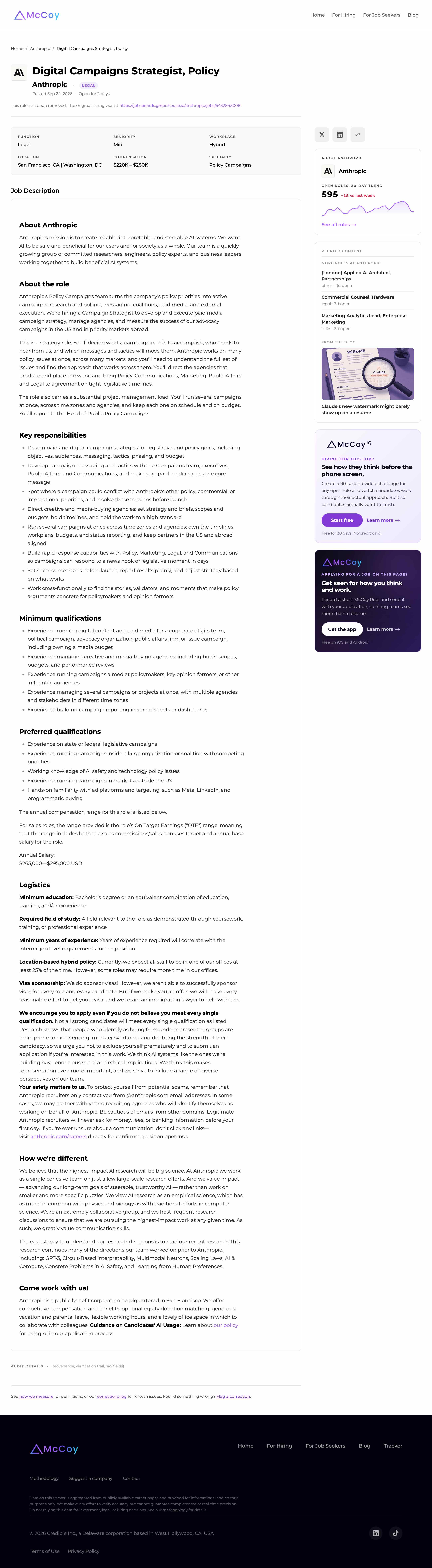
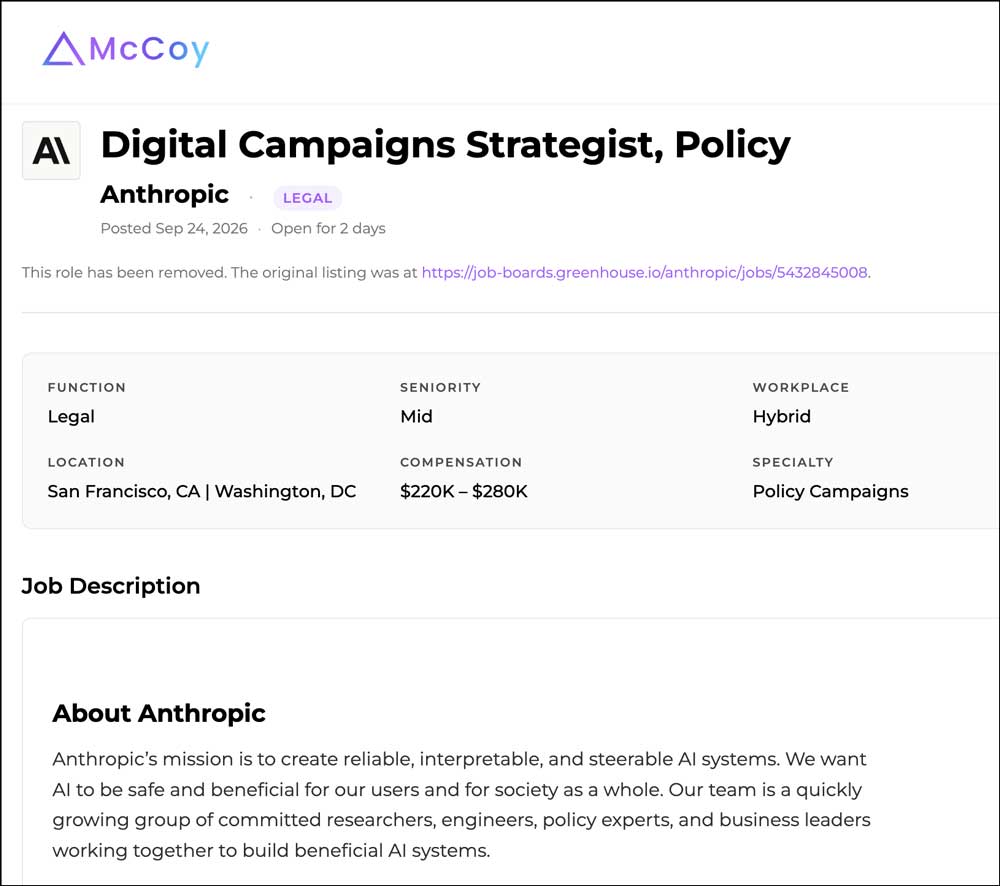
The job description was unusually direct about Anthropic’s plans: “Anthropic’s Policy Campaigns team turns the company’s policy priorities into active campaigns: research and polling, messaging, coalitions, paid media, and external execution.”
The strategy of ads
The role appeared well-suited to a programmatic pro at a media agency. The strategist would “develop and execute paid media campaign strategy, manage agencies, and measure the success of our advocacy campaigns in the US and in priority markets abroad.”
Moreover, Anthropic wanted someone to decide “who needs to hear from us” and which “messages and tactics will move them.” The responsibilities included designing paid and digital campaigns around legislative and policy goals, including the audiences, messaging, tactics, timing and budgets.
And Anthropic planned to buy the media through outside agencies. The strategist would “direct creative and media-buying agencies” and was expected to have experience owning a media budget. Anthropic also wanted “hands-on familiarity with ad platforms and targeting,” specifically naming Meta, LinkedIn and programmatic buying.
Another responsibility was building a rapid-response capability so Anthropic could react to a “news hook or legislative moment in days.” The target audiences included policymakers, key opinion formers and other influential audiences.
The role would report to Anthropic’s Head of Public Policy Campaigns and coordinate Policy, Communications, Marketing, Public Affairs and Legal. It was also responsible for setting success measures before campaigns launched and changing strategy based on the results.
From tipsheet: Anthropic has been emphatic that advertising doesn’t belong inside Claude, but that doesn’t mean Anthropic doesn’t believe in ads. This posting shows just how seriously it is thinking about paid media when the audience it wants to reach is policymakers rather than Claude users.
AGENTS
Jev enters the auction conversation
The ad tech conversation around Jev continued yesterday. We covered emerging industry reaction in Monday’s edition.
Swivel CEO Joseph Hirsch chimed in on Jev’s “decisioning” significance:
“Until now, ‘agentic’ has mostly meant an LLM in the loop. LLMs are brilliant at language, but they’re slow, expensive, and not built to make ten thousand pricing decisions a second. So agents got stuck doing the paperwork around the transaction instead of the transaction itself.
A decisioning model changes that. The LLM can still handle the conversation, the planning, and the negotiation. But the actual call (what’s this worth, should I buy it, what should I charge) moves to a layer built for exactly that: fast, cheap, structured, and auditable.”
Read more on LinkedIn. (Sept. 28)
From tipsheet: The pitch is that a model built for fast, structured decisions could sit inside the auction, pricing and evaluating each impression while LLMs handle planning and negotiation. The test is whether it improves on the bidding and pricing systems already making those decisions.
PLATFORMS
What/why: Salesforce’s Koa
Reviewing Mark Benioff’s recent Dreamforce announcements, Salesforce SVP Strategy Martin Kihn explains Koa, the company’s new CRM reasoning model for Agentforce, and why Salesforce built a model for sales, service and marketing workflows.
Kihn writes:
“What is KOA?
tl;dr in my words: it’s a faster lower-resource-using way to do common CRM type tasks. Its value is reliability, governance, data control, lower cost (presumably)
Now, what it’s not:
- A foundation model. It’s not a competitor to Claude or OpenAI or Gemini in its scope
- A replacement for anything. It’s another model choice added to Agentforce…”
Read more on LinkedIn. (Sept. 29)
LLMs & CHATBOTS
Developments
- Claude Sonnet 5.5 (Sept. 28) – Anthropic
- NVIDIA Open Agent Safety Platform: A Reference for Continuous In-Silicon Agent Monitoring (Sept. 28) – Nvidia
- How Pew Research Center is – and is not – using AI in our work (Sept. 28) – Pew Research
PEOPLE MOVES
Now hiring
- Snap: “This month I started at Snap on the Ads team, leading product for ad inventory. I chose it for the chance to go deeper on a problem I care about, with a team I liked from the first conversation. I’m excited to get to work.” (Sept. 27) – Amandeep Aggarwal on LinkedIn
- WPP Media: “Bringing media, clients, and technology closer together is how we turn those opportunities into better outcomes for clients. That’s why I’m thrilled Laura Ryan is joining us at WPP Media as Chief Media Officer from IPG/Orion Worldwide.” (Sept. 28) – Brian Lesser, CEO, WPP Media on LinkedIn
Related: “‘Not hiring’ entry-level talent: Industry acknowledges runaway crisis brought on by introducing AI to the workforce” (Sept. 28) – Digiday (subscription)
MORE
- App Store squeeze: “The App Store discoverability squeeze (part 2)” – Analyst Eric Seufert on Mobile Dev Memo (subscription)
- Open web prospects: “Who will stand up for the open web?” (Sept. 28) – AdExchanger
- Muse competitor? “Introducing Manus 2.0” (Sept. 28) – Manus
- AdCP governance: “Agentic advertising trade group debuts board amid broader industry adoption” (Sept. 28) – Marketing Brew