
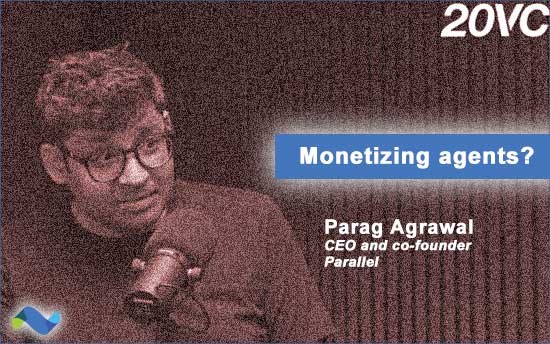
Parallel CEO and co-founder Parag Agrawal (former CEO of Twitter) makes his startup’s pitch on the 20VC podcast with Harry Stebbings.
The core pitch hasn’t changed much since he explained it to Stratechery’s Ben Thompson back in May.
Agrawal begins: “Parallel is the Google for agents. So agents need to search the web to do anything they do for you.” But how does the content get paid for?
“We’re effectively building an AdSense for agents showing up to read your content,” says Agrawal. (28:09) “We like to pay content owners the marginal contribution that they added to an agent doing work.” (33:05)
The approach borrows from the logic of causal measurement: Agrawal describes comparing an agent’s result with and without a source’s data to determine its contribution. If that information enables an equally good answer with less spending on AI inference, the content owner could receive a share of that value.
Parallel’s larger bet is that agents will use the web 1,000 times more than humans, creating enough demand to support a new business model.
The startup said in May that more than 100,000 developers used its platform. In the 20VC interview, Agrawal reiterates a broad customer list across legal, sales, insurance and other fields. But he offers no revenue or search-volume figure to show how large the business has become.
Listen: “Five Predictions for a World of Agents | The Ads Business Model Will Die | Biggest Lessons from Working with Elon Musk at Twitter with Parag Agrawal” (Sept. 26) – 20VC on YouTube
Related: Full Parallel API suite is now available on Google Cloud Marketplace (Aug. 25) – Parallel blog
From tipsheet: Parallel wants to sit between agents and the web, measuring what publisher content contributes to an agent’s work and determining what to pay for it. That gives it a role much like an ad network’s, with content value in place of ad impressions. Will publishers accept Parallel as both the measurer and the payer?
AGENTS
Ad tech finds a possible use for Jev
“I think System One models will change ad tech more than generative LLMs have. The first of those models is now public: a company called TypeSafe released one this month named Jev.” – Siva Jagadeesan, Yahoo VP of consumer monetization
TypeSafe describes Jev as a model designed to make structured decisions: Give it a brief or creative and a question with fixed answer choices, and it returns an answer with a probability. Its launch has drawn swift attention. TypeSafe announced a $40 million seed round this month and is already in talks to raise more than $1 billion at a valuation above $10 billion, The Information reports.
Last week, tipsheet flagged AWS ad tech product leader Sergio Serra’s observation that Jev’s fast, probabilistic decisions look familiar to anyone who has built an ad bidder. Now Jagadeesan argues that its first ad tech applications may sit around the auction: creative review, RFP matching and brand suitability.
“A protocol can say ‘here is the brief’ and ‘here are the products.’ It cannot decide which product fits the brief,” Jagadeesan writes. He proposes using probability scores to clear routine cases and send uncertain ones to a person.
Jagadeesan has yet to see Jev used for RFP matching in production. The next test is whether its scores prove reliable on ad tech data.
Read: “Ad tech has a decision layer, and Jev is the first model built for it” (Sept. 26) – Siva Jagadeesan on LinkedIn
Jagadeesan’s article preview post on LinkedIn is here.
MEASUREMENT
Lifesight adds to open-source measurement trend
Lifesight, a marketing measurement platform that combines marketing mix modeling, incrementality testing and attribution, has open-sourced its demand forecasting tool, Horizon, AdExchanger’s Allison Schiff reports.
Horizon works alongside marketing mix models, combining forecasts from multiple models to help marketers anticipate demand.
Noting the open-source MMM trend—such as Google’s Meridian—the article points to three reasons behind Lifesight’s approach:
- Trust: Customers and prospects can inspect the methodology and benchmarks.
- Adoption: Publishing the tools makes research available for practitioners to use and build on.
- Commercial differentiation: Lifesight competes on helping brands apply the models to business decisions.
Lifesight co-founder and chief product officer Rajeev Nair explains: “There’s no need for any of this to be a black box… The true value is in making it easy for brands to orchestrate, calibrate and then make decisions.”
Read: Why This Marketing Measurement Company Just Open-Sourced Its Forecasting Engine (Sept. 25) – AdExchanger
More: Lifesight’s inclusion in Forrester’s “The Marketing Measurement And Optimization Platforms Landscape, Q3 2026” (Sept. 24) – Co-founder and CEO Tobin Thomas on LinkedIn
From tipsheet: Open-sourcing the forecasting engine can help build demand for commercial tools that work alongside it. AI agents are part of Lifesight’s pitch: CEO Tobin Thomas describes its offering on LinkedIn as “Causal measurement, with AI agents that act on it.” The commercial bet: marketers can access the models freely, then pay for tools that help turn their outputs into decisions.
AGENCIES
Mark Read’s new AI event for marketers
Former WPP CEO Mark Read has ventured into the world of events with a new conference targeting marketers, agencies and startups.
Called “Prompt,” the company describes itself on LinkedIn:
“Prompt is a global invitation-only event series that brings together founders and leaders from AI companies with senior executives from creative, media, and marketing industries to discuss the future. Launched in London in 2026, events are planned in NYC, LA, Berlin, Cannes and more.”
Read: “Mark Read’s next act—running an AI conference for marketers, agencies and startups” (Sept. 25) – Ad Age (subscription)
The next event will be Tuesday, October 6, 2026, in New York City.
From tipsheet: Read’s next act puts him between marketers looking for AI partners and startups looking for customers. Prompt’s value will depend on whether his relationships and judgment produce useful introductions that attendees would otherwise miss.
FINANCIALS
Over the weekend: Sequoia on AI transformation
Sequoia venture partner Pat Grady offers a 15-minute look at the speed of AI adoption across industries and the companies serving them. It’s broader than ad tech, though GDPR makes a brief appearance.
View the 15-minute video. (Sept. 26)
PLATFORMS
Peeking inside PMax
- “Microsoft Ads API adds deeper search reporting and more PMax controls” (Sept. 25) – Search Engine Land
- “Google Ads API v25.2 adds competitive benchmarks and PMax upgrades” (Sept. 25) – Search Engine Land
Microsoft now lets advertisers exclude devices from PMax campaigns, while Google lets them set tracking parameters at the asset-group level. Microsoft also connects search terms, headlines and landing pages in one report.
From tipsheet: Automated buying puts more decisions inside the platforms and these API updates point to the continuing demand for ways to inspect performance and steer campaigns through outside tools.
TECH
Criteo puts its engineering work on display
Criteo launched tech[dot]criteo[dot]com, a new central destination for updates from its technical teams. The site brings together technical articles and links to Criteo’s AI Lab and open-source projects, with plans to add more event coverage, talks and perspectives from its employees.
In an accompanying editorial, CTO Diarmuid Gill offers a look at Criteo’s own adoption of coding agents. He explains:
“We have built an AI Registry of all the available tools, agents, and skills at our developers’ disposal. These include our CodeReview AI, migration and debt-removal agents, security review agents, and Beehive, our internally built framework which orchestrates Slack-invoked coding agents that can push changes to Gerrit. We also organize monthly show-and-tells, where each team can demonstrate what is working well that others could benefit from.”
Read: From Copilot to Code Agents: How GenAI Is Changing Engineering (Sept. 23) – Criteo Tech blog
From tipsheet: Gill’s account suggests that adopting coding agents requires organizational work: deciding which tools developers can use, connecting them to existing systems and spreading what teams learn. The question for other ad tech companies is whether they have those systems and practices in place.
Also: Following this past summer’s reported acquisition offer, Criteo’s technical showcase raises a broader question: How much are its AI capabilities worth to a potential buyer?
TECH
Opinion: On acquiring the data
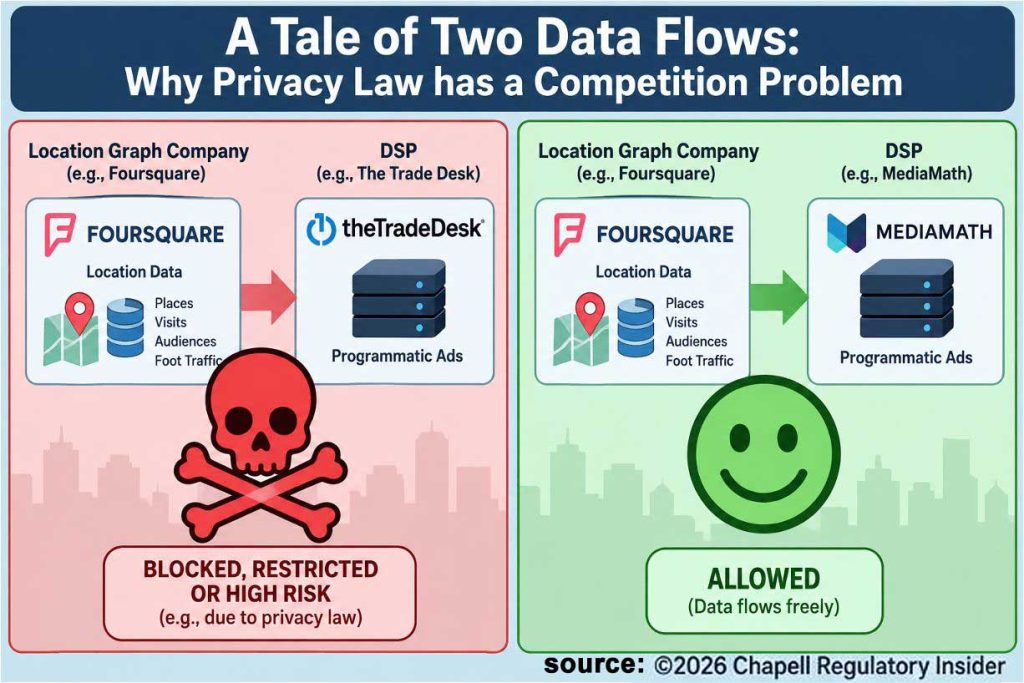
Privacy lawyer Alan Chapell argues that Infillion’s acquisition of Foursquare gives its MediaMath platform access to precise location data that a DSP buying the same data could be barred from using. His concern: privacy rules that turn on whether data changes hands can reward ownership without reducing the risks of using it.
Read: Privacy Law’s Competition Problem (Sept. 23) – Alan Chapell on Marketecture’s The Monopoly Report
LLMs & CHATBOTS
Developments
- “Why the Biggest AI Opportunity Is Still Ahead” (Sept. 23) – Ellen Zentner and Sarah Wolfe, Morgan Stanley
- “Midmarket’s AI Opportunity: Move Fast, Out-Execute” (Sept. 24) – BCG
- Video: “Accel Sees AI Opportunity Shifting to Applications” (Sept. 25) – Bloomberg
MORE
- Microsoft extends reach: Sony opens streaming inventory on PS5 and Bravia TVs to Microsoft Advertising and LinkedIn advertiser campaigns (Sept. 25) – Jason White, VP Advertising, Sony on LinkedIn
- AI creative’s storytelling test #1: “Are AI Ads Ready for Prime Time?” (Sept. 25) — Adweek (Higgsfield-sponsored content)
- AI creative’s storytelling test #2: “AI Video Startup Higgsfield Says it Tops $1 Billion Run Rate” (Sept. 25) – Bloomberg (subscription)
- Provenance: AI ads are popular in the 2026 midterms, but state laws haven’t stopped a lack of disclosure (Sept. 25) – Associated Press
- Agentic customer acquisition: Layers founder Mike Khristo on agents that create content, buy ads and trace installs (Sept. 24) – Unharnessed podcast on Spotify