
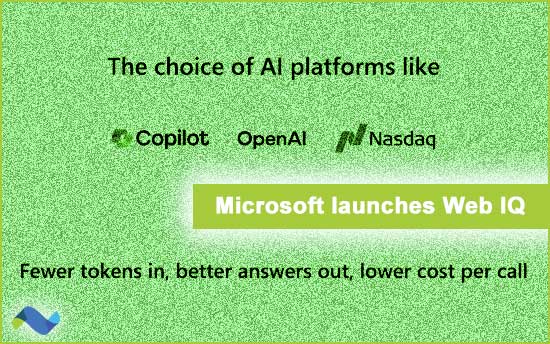
Echoing CEO Satya Nadella at Microsoft’s Build conference, Microsoft CVP Tim Frank announced Web IQ, a new grounding API designed to provide AI systems with fresh information at inference time.
Frank wrote: “Every AI system needs connective tissue to the real world. Models are trained on enormous data, but they can’t encode everything and information goes stale fast. Web IQ fills that gap with fresh, specific information just in time for an application to reason and act.”
Also: “We quietly rebuilt our entire search stack to optimize for AI applications. A completely different set of goals, a different architecture, a different set of constraints than web search for humans.”
Microsoft rebuilds search for AI apps.
Read more on LinkedIn. (June 2)
More: Announcing Microsoft Web IQ (June 2) – Microsoft Bing Blog
From tipsheet: The most interesting claim in Microsoft’s announcement is not the API. It’s that the company says it rebuilt its search stack around the needs of AI applications rather than human users. If that trend continues, search may split into two systems: one optimized for people and another optimized for AI systems.
That raises a larger question: If Microsoft rebuilt search for AI applications, how and when does Google respond? Recent initiatives such as WebMCP suggest Google’s answer may extend beyond search and into the browser itself.
LLMs & CHATBOTS
Developments
- Building a hill-climbing machine: Launching seven new MAI models (June 2) – Microsoft AI blog
- Expanding Project Glasswing (June 2) – Anthropic
- Codex for every role, tool, and workflow (June 2) – OpenAI
MARKETING
Stempeck: AI search moves 10x faster
Evertune CEO and co-founder Brian Stempeck joined The Trade Desk’s The Build podcast with Sincera co-founders Mike O’Sullivan and Ian Meyers.
The former The Trade Desk CSO offered a comparison between the programmatic era and today’s AI search market, arguing that AI search optimization is moving much faster because CMOs and boards can see the problem directly in ChatGPT and Gemini.
Stempeck said:
[45:33]
(lightly edited)
“At The Trade Desk, Programmatic was a slow burn where because it’s behind the scenes infrastructure of how ads are bought, it’s not an immediate sale. A buyer puts money in, they see good results, they put more budget in, they keep going.
In this AI search space, every brand on the planet — the CMO is using ChatGPT or Gemini. And they’re like, ‘What does it say about my brand?’ And they type it in and if they don’t like the results… I’ve been in board meetings where the board member will ask the CMO, ‘How come you didn’t show up in my AI search?’ (…)
So this problem is front and center for every brand. They’re all thinking about it.
And so the market moment was there — the adoption was there.
Raising the Series A was kind of a no-brainer for us because we knew we had to go faster. And also the scope of the problem was expanding….”
[59:15]
“Programmatic always moves fast, but in the AI search space, it feels like it’s moving 10 times faster.
It’s because of the pace of the labs themselves, where ChatGPT will release shopping and checkout, and then three months later, pull it back and change completely.
Or they’ll ship these algorithm changes — where we saw at one point — if you ask for any given category, the number of brands that ChatGPT would recommend dropped by a third one day. They just cut off the tail.
Or they start training on certain data sets. They’re training on Reddit heavily, then also next week they’re not. So it’s really fluid.”
[1:01:15]
“We launched something this week to say, ‘Hey, if your brand isn’t showing up, we’ll run an ad on ChatGPT for you.’
The example we used was for portable Bluetooth speakers during the summer…
…so, you’re looking for a speaker
… Harmon Kardon has a product
… it does not come back in AI search — it comes back 4% of the time. We’ve seen that across a million prompts.
Long term, you should be investing in content and GEO to change that.
Short term, you better run an ad. It’s Memorial Day. People are buying the speaker, so go show up there.
Again, that’s super reactive to what’s happening in this AI search space.”
Listen: “Brian Stempeck on Building for Brand Visibility in the Age of AI Search” (June 2) – The Build podcast on The Current
More: “Evertune Launches Visibility Boost Ad Agent for ChatGPT” (May 20) – Evertune
From tipsheet: The “Ad Agent” launch highlights a familiar ad tech pattern. Optimization businesses often expand toward activation, media and spend as customers seek both long-term performance improvements and immediate results.
Stempeck’s comments highlight several themes about the future of AI search and advertising:
- Understanding the proper balance between AI search optimization and advertising is just beginning. Stempeck’s comments suggest an emerging GEO/ads dynamic that resembles the SEO/SEM relationship from the traditional search era. Long-term visibility comes from influencing how models understand and represent a brand. Short-term visibility can be purchased through advertising.
- The difference is that chatbot interfaces may become more important decision environments than traditional search results pages. Users spend more time in conversation, ask follow-up questions and move from discovery to evaluation and purchase within the same interface.
- If that happens, managing both model visibility and paid visibility could become as important to brands as managing SEO and SEM was during the search era.
PLATFORMS
Twitch exposes Amazon’s commerce graph limits
Amazon has enlisted outside firms to help sell portions of Twitch’s advertising inventory, according to The Information. Goodway Group’s Andrea Kwiatek told the publication that advertiser demand tends to be concentrated around Prime Video and Amazon’s commerce data — Twitch, not so much.
The Information’s Catherine Perloff writes:
“Amazon’s use of outside ad firms for selling some of its ads, the extent of which hasn’t been previously reported, may seem like a surprising setup for the tech giant. By contrast, Meta Platforms and Google do not allow outside advertising technology firms to sell ad spots on Facebook, Instagram, YouTube or Google search.
Moreover, Amazon has been expanding an advertising technology business that helps other media companies, such as Netflix, Spotify, and Roku, sell ads on their platforms.”
Read: Amazon’s Media Empire Quietly Taps Outside Ad Sales Help (June 2) – The Information (subscription)
From tipsheet: Amazon and Walmart (see last week) appear to be pursuing the same playbook: use commerce signals as the foundation, then distribute those signals across a growing network of media and advertising partners. The media inventory matters, but the commerce graph may matter more. Twitch illustrates the limits of that strategy. The graph can bring buyers to the table; the inventory still has to close the deal.
MEASUREMENT
Retail media and incremental ROAS
Apple juice brand Martinelli’s is evaluating retail media performance using incremental ROAS (iROAS), a measurement approach designed to estimate sales caused by advertising rather than sales merely attributed to it.
AdExchanger’s Allison Schiff reports:
“For a brand like Martinelli’s, which wants to attract new buyers and not just repeat purchases, incrementality is the only metric that answers whether media is actually growing the business, because it separates campaigns that win new households from those that monetize loyalists.
‘Our household penetration is still relatively low,’ [Scott Lee, VP of marketing at Martinelli’s] said, ‘so the goal is to bring in new customers, not just get existing customers to buy a little more, which is why iROAS makes sense.’“
Read: How Juice Brand Martinelli’s Gets To The Core Of Retail Media Incrementality (June 1) – AdExchanger
From tipsheet: Are these retail media ads creating new demand or simply capturing demand that already exists? The shift from ROAS to incrementality reflects a broader push toward causation rather than attribution. As retail media budgets grow, the networks that can prove incremental outcomes may gain an advantage over those that primarily report attributed sales.
MARKETING
Coca-Cola bets on AI-powered decisioning
Coca-Cola is using AI and scenario modeling tools to improve marketing and commercial investment decisions, according to CFO Dive.
At Gartner’s Finance Symposium, Coca-Cola Global Resource Allocation Lead Shelley Kench said the company’s Fuel Light 360 platform helps teams evaluate investment scenarios and respond more quickly to changing market conditions.
“What we’ve done is really moved from a meeting that’s all about reconciling and arguing about whose data is right to making choices,” Kench said.
The company said the platform combines AI, analytics and scenario planning to support decisions across marketing, commercial and operational investments.
Read: Inside Coca-Cola’s use of AI to sharpen marketing spend (June 2) – CFO Dive
From tipsheet: The tug-of-war between CFO- and CMO-types continues as brands like Coca-Cola use AI to make decisions about where marketing dollars should go and which investments are most likely to generate returns. The goal isn’t just better analysis but better decisions.
CREATIVE
Positioning: Canva wants to own workflow
Content creation platform Canva argues in sponsored content on The Guardian that AI advantage comes from intentional integration, governance and workflow adoption rather than experimentation alone.
Read: The state of marketing and AI: Intentional AI integration (June 2) – Canva sponsored content on The Guardian
From tipsheet: Beneath the AI messaging is a broader platform ambition. Canva wants to become a workflow platform for creative and marketing teams, not just a design tool.
LLMs & CHATBOTS
ChatGPT’s Reddit ‘fanouts’ surge
Profound’s Josh Blyskal reported that ChatGPT is increasingly searching Reddit before generating answers and citing the platform more frequently in responses.
According to Profound’s analysis of behind-the-scenes retrieval queries — known as “fanouts” — and roughly 7 million ChatGPT citations, Reddit-related fanouts increased from roughly 0.15% to 3.68% of responses between January and late May, while Reddit’s share of ChatGPT citations rose to 8.5%.
Blyskal described the Reddit phenomenon:
“Reddit is an information class in its own right: it represents real human buying signal.
People saying ‘we tried this and hated it.’
People saying ‘this worked until we hit 100 seats.’
People saying ‘support was great until renewal.’
It’s messy, specific (and sometimes wrong), but it’s full of the buyer language that answer engines clearly want.”
He argued that marketers should pay attention not only to citations but also to the sources AI systems actively seek during retrieval.
Read Josh Blyskal on LinkedIn. (June 2)
From tipsheet: The bigger signal may not be Reddit itself but what it reveals about retrieval. AI systems appear to select different evidence sources for different tasks. That’s the competitive playing field marketers and GEO platforms need to think about — not just AI visibility, but what evidence AI systems seek when evaluating products, vendors and claims.
TECH
McDonald’s pairs AI with transparency
OK, this isn’t exactly advertising, but…
McDonald’s is experimenting with AI-powered drive-thrus as it looks for ways to improve efficiency amid inflation and rising operating costs.
Bloomberg reports, “McDonald’s sees automation as part of the solution. The company has been working with Google to develop AI-powered order-taking for its drive-thrus. The system is 90% accurate, CEO Chris Kempczinski said, declining to disclose the company’s target.”
In parallel, the company is creating larger drive-thru windows so that customers can see their orders being made.
Read: “McDonald’s bets on fancier chicken, AI drive-thrus and playful stores to keep diners coming” (June 2) – Bloomberg on The Los Angeles Times
From tipsheet: AI may automate the transaction, but customers still want visibility into what’s happening. McDonald’s is pairing automation with transparency rather than replacing the human experience altogether.
MORE
- Opinion: “Digital Advertising Needs Guardrails For AI” (June 2) – James Deaker, consultant, Korukea Media on AdExchanger
- Blackstone-backed Liftoff targets $3.7 billion valuation in US IPO (May 29) – Reuters
- “Shoppable AI Data Sets New Standard For Media Buyers” (June 2) – MediaPost
- How we used Gemini to build Google I/O 2026 (June 1) – Google The Keyword blog
- Hyve — owner of Possible — to be acquired by PE firm Hellman & Friedman to accelerate next phase of growth (June 2) – Hyve