
Meta announced Muse Spark yesterday describing it as “the first in a new series of large language models (LLMs) built by Meta Superintelligence Labs.”
Though there is nothing specifically advertising-focused, enhanced personalization for the consumer is a key element of the new model and echoes the addressability Meta’s ad system — led by Advantage+ — is designed to deliver.
How Muse Spark eventually intersects with Meta’s RecSys modeling, which was highlighted a week ago, remains to be seen.
But, the key takeaway is that the new model enables a more personalized conversation between the AI chatbot and the consumer — a conversation that takes place in the Meta AI app today and rolled out to Meta experiences such as Facebook, WhatsApp and Instagram in the coming weeks.
Meta says the conversation enabled by Muse Spark now includes better recommendations for shopping, too. A blog post explained: “Meta AI can now help you discover what to wear, how to style a room, or what to buy for someone you know. Shopping mode draws from the styling inspiration and brand storytelling already happening across our apps, surfacing ideas from the creators and communities people already follow.”
There’s no mention of plugging retailer product feeds into the LLM yet. But Meta added in a statement, “We are also opening access to the underlying technology. It will be available in private preview via API to select partners, and we hope to open-source future versions of the model.”
Read:
- “Introducing Muse Spark: MSL’s First Model, Purpose-Built to Prioritize People” (April 8) – Meta
- “Introducing Muse Spark: Scaling Towards Personal Superintelligence” – Meta AI
- Try on Meta[dot]AI
From tipsheet: A few thoughts:
- When does Meta launch an “ads in a chatbot” pilot?
- A more effective chatbot conversation for the consumer creates more data and improves retention, and that’s good for Meta and ads.
- Integrating Muse Spark and Meta’s Superintelligence efforts with Meta’s well-honed Lattice, Andromeda and GEM systems seems like a big strategic ad opportunity ahead for the company.
- Though it stressed “safety and privacy” in Muse Spark’s rollout, Meta could quickly bring audience targeting to “ads in a chatbot” which would differentiate it from OpenAI. OpenAI has signaled that it’s focused on using context for ChatGPT ads.
- The fruits of high-profile investments made by Meta in AI employees is being realized including Alexandr Wang, Meta’s Chief AI officer since 2025.
LLMs & CHATBOTS
Developments
- Claude Managed Agents: get to production 10x faster (April 8) – Anthropic
- The new, AI-powered Google Finance is expanding to more than 100 countries. (April 8)- Google’s The Keyword blog
- Perplexity revenue jumps 50% in pivot from search to AI agents (April 8) – Financial Times (subscription)
COMMERCE MEDIA
Universal Commerce Protocol onboarding
Google’s agentic commerce open standard, Universal Commerce Protocol, or UCP, has rolled out a new onboarding guide according to Search Engine Land.
The guide outlines “how merchants can integrate with the system and enable checkout directly from product listings in AI Mode and Gemini.”
Search Engine Land’s Anu Agdebola observed:
“As AI search evolves from discovery to transaction, Google is pushing to keep users within its ecosystem by embedding shopping and checkout into conversational experiences. (…) If widely adopted, the Universal Commerce Protocol could redefine how online shopping works – turning search into a full-funnel, AI-powered checkout experience.”
Read: Google rolls out onboarding guide for Universal Commerce Protocol (April 8) – Search Engine Land
More:
- How to onboard to the Universal Commerce Protocol in Merchant Center – Google
- Getting started with Universal Commerce Protocol on Google – Google
Related: ‘It’s relevancy on steroids’: if LLMs’ own discovery, how should retailers respond?” (April 2) – The Drum
MARKETER
Google on ads that ‘anticipate and assist’
Google’s President Americas & Global Partners, Sean Downey, was touting his company’s Direct Offers product yesterday and revealed new clients taking part in an AI Mode Google Ads pilot.
At NRF 2026 in January, Google announced Direct Offers which is an ad in the form of an offer (or coupon) and served in Google Search’s AI mode. It allows retailers to make an offer to consumers while they’re shopping.
Mr. Downey said on LinkedIn yesterday:
“The future of commerce is intuitive and personal. We’re moving away from the era of ‘search and find’ into an era of ‘anticipate and assist’ where technology does the heavy lifting for shoppers.
Direct Offers is a feature that allows retailers to provide tailored, verified discounts to shoppers at the exact moment they’re actually making a decision.I am thrilled to welcome Gap, Chewy and L’Oréal to our Direct Offers pilot.
One of our key launch partners Han Wen, Chief Digital and Marketing Officer at L’Oréal US, put it perfectly: ‘Direct Offers is a new innovative way we can use Google AI to make shopping easier. It allows us to turn a moment of inspiration into an action, right when our customer is ready to buy.’”
More: “New tech and tools for retailers to succeed in an agentic shopping era” (January 11) – Google
AGENCIES
Publicis adds agentic layer with Microsoft
Microsoft and agency holding company Publicis Groupe announced an expansion of their existing strategic partnership to embed Microsoft AI and agentic technology across Publicis and for its clients.
A press release called the results “a full-stack marketing solution.” In practical terms, Microsoft will layer AI agents into Publicis’ consulting and digital transformation arm, Publicis Sapient, and Epsilon’s identity data stack.
Deal points include:
- A new Microsoft cloud deal for Publicis Sapient
- Microsoft Copilot and Microsoft Agent 365 integration with Publicis Sapient’s client-facing Bodhi workflow platform
- Identity-based data modeling that combines Microsoft AI with Epsilon data.
Publicis Groupe CEO Arthur Sadoun said in a statement: “Ten years ago with Microsoft we co-created Marcel, marketing’s first AI platform. (…) Both our companies believe that the future of AI requires agents in service of people and humanity, and with this partnership we are creating a unique opportunity for our clients to lead against this ambition.”
Publicis Sapient built and launched the Marcel AI platform in 2018.
Read: Microsoft and Publicis Groupe expand their strategic partnership to power the future of agentic marketing for businesses worldwide (April 8) – Microsoft
Also: Publicis is now Microsoft’s media agency-of-record with expected billings of $1.2 billion. Read more in Adweek. (April 8) The Drum says Dentsu was Microsoft’s previous media agency-of-record.
From tipsheet: The extended tech partnership with Microsoft differs from Publicis’ “Power of One.”
Power of One gives clients access to everything. This partnership gives Publicis the ability to run everything.
TECH
Pomo: Fortune 500 marketing for all
AI startup Pomo announced that it has raised $4.5 million in seed funding from a number of investors including Databricks Ventures and Mehdi Ghissassi, the past product head of DeepMind and Google Brain.
On its website, the company promotes itself as “Fortune 500 marketing for all.”
Business Insider’s Lucia Moses explained more:
“Pomo is a tool that plugs into major ad platforms like Google Ads, Meta, and TikTok, as well as CRM software (which manages a company’s interactions with customers) like HubSpot.
It works in the background, tracking a brand’s activity as well as competitors’ ad activity and product launches, and scanning social media platforms for relevant trends.
Pomo then displays a briefing that summarizes performance and suggests opportunities to act on. For example, Pomo might report that a competitor’s product was trending on TikTok and Reddit and suggest different ways the user could tweak their ads to react.”
Former Googlers Praneet Dutta and Joe Cheuk are Pomo’s co-founders.
Read: “This AI startup raised $4.5 million to help marketers fine-tune ads and respond to rivals. Read its pitch deck.” (April 8) – Business Insider (subscription)
SELL-SIDE
Survey: AI helps publishers with experience
In a survey of 40 publishing professionals who are involved in AI strategy and investments, Digiday says, “AI has moved from the margins to the mainstream of editorial workflows. Publishers have increasingly embedded AI tools into daily functions, especially when it comes to streamlining tasks and improving the audience experience.”
Read: “Publishers apply AI to streamline tasks and improve audience experience” (April 8) – Digiday
From tipsheet: A takeaway isn’t that publishers are using AI to create content.
It’s that they’re using it to decide what content to show, to whom, and when.
MEASUREMENT
eMarketer’s visibility leaderboard and finance
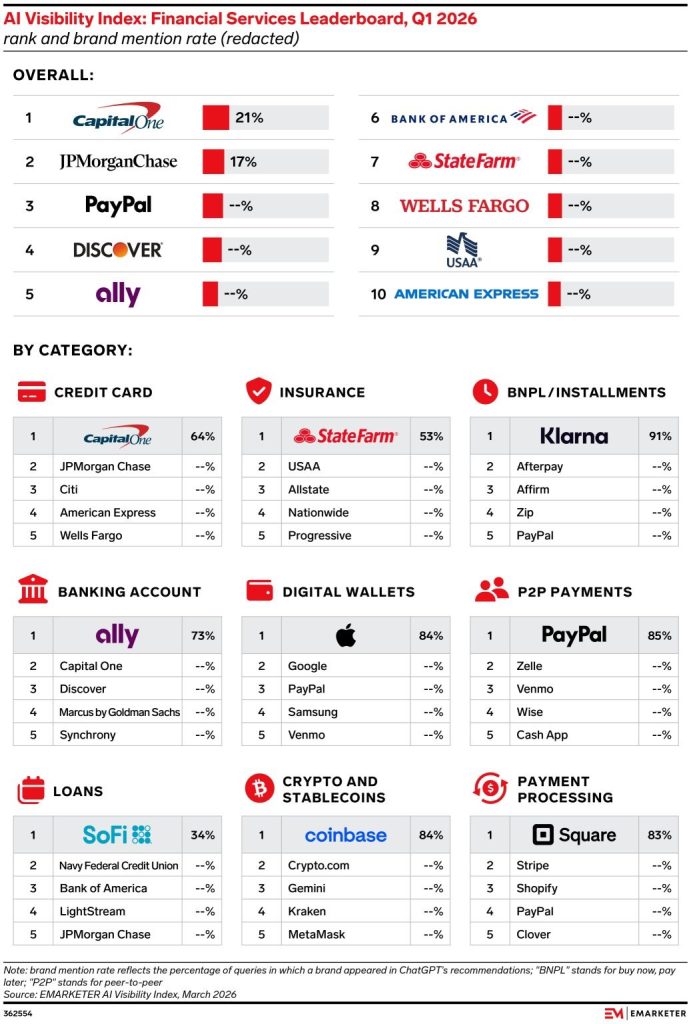
eMarketer CEO Matthias Braun returned to LinkedIn yesterday with the latest AI visibility results for the financial vertical the company is tracking.
According to eMarketer’s Q1 2026 data, the highlights for financial brands in chatbot conversations included:
- ”Capital One is the #1 most-recommended financial brand overall, appearing in 21% of ChatGPT queries in the category”
- ”Klarna dominates BNPL/Installments with a 91% mention rate”
- ”PayPal leads P2P Payments (85%), Apple leads Digital Wallets (84%)”
- “Coinbase leads Crypto (84%), and Square leads Payment Processing (83%)”
- ”Ally tops Banking Accounts at 73%, ahead of Capital One and Discover”
- ”SoFi leads Loans at 34%, ahead of Navy Federal Credit Union and Bank of America”
Read more on LinkedIn. (April 8)
Here’s the eMarketer graphic breaking down the verticals within finance:
From tipsheet: The volatility of AI visibility remains a key challenge for marketers as well as companies trying to help with generative engine optimization. At the least, services, such as the one eMarketer is providing, are directional with the potential for becoming a standard.
MARKETING
Q&A: 37Arc on ‘marketing work flow’
Earlier this week, former 360i and Profitero executives Bryan Wiener and Sarah Hofstetter launched a new CMO-focused consultancy called 37Arc. The company describes itself as “an AI-native workflow intelligence company that helps enterprises map and rewire how marketing work flows across teams, tools, and partners.”
Joining the duo are President Adam Broitman, CPO/CTO John Swords and former LinkedIn executive Penry Price.
Read: “Bryan Wiener and Sarah Hofstetter launch CMO-focused AI firm” (April 7) – Ad Age (subscription)
Co-founder and CEO Bryan Wiener answered a selection of follow-up questions from tipsheet via email.
tipsheet: “Do large language models (LLMs) meaningfully change marketing workflows today, and where are they still mostly noise for CMOs?”
Bryan Wiener: “In enterprise marketing, LLMs do not fundamentally change workflows on their own.“
“Most organizations are layering AI onto systems that were never designed for this level of speed or complexity. The result is faster outputs moving through the same fragmented processes, which leads to more activity, not better outcomes.“
“This is not a technology problem. The underlying AI is already good enough. It is a visibility and change management problem. Until companies can see how work actually flows and redesign it, AI will remain underutilized.“
“As Nick Turley, head of ChatGPT, has said, enterprises need to “get proximate to the problems.” That is exactly right. AI only creates value when it is embedded directly into how work gets done, not layered on top.“
“We are starting to see that realization take hold more broadly. Anthropic is reportedly in talks with major private equity firms to form a roughly $200 million joint venture focused on helping enterprises actually implement AI. That is a signal that the bottleneck is not model capability. It is execution inside the enterprise.”
Additional questions include:
- In an AI-driven world, what does it actually mean to scale a consulting business — more people, more software, or something else?
- Where have you seen AI fail inside marketing workflows, not because of model limitations, but because of how the work itself is structured?
- What does the agency model realistically look like one to three years from now?
Read: “Q&A: 37Arc targets ‘How marketing work flows’” (April 8) – tipsheet
PROTOCOLS
How to build an AdCP agent
Scope3 CEO Brian O’Kelley, a leader of the consortium which launched Ad Context Protocol, shared a screenshot of his own agentic development in Claude.
He said yesterday:
“3 minutes and 52 seconds. That’s how long it takes to build an AdCP signals agent from scratch using Claude Code.
Here’s the prompt I used (which you can try!)…”
See the screenshot on LinkedIn. (April 8)
Related: “AgenticAdvertising[dot]org Brand Protocol: brand identity and rights for AI creative” (April 6)- Brandan Naglak, engineer, Appliscale and Bedrock Platform on LinkedIn
PEOPLE MOVES
Now hiring
-
Brenda Tuohig joins Bazaarvoice as SVP of Strategic Partnerships (April 7) – LinkedIn
MORE
- Who is OpenAI’s global head of ads, David Dugan? (April 8) – Digiday (subscription)
- Dairy-Free Creamer Brand Nutpods Is Cracking Fragmentation With AI-Powered Insights (April 6) – AdExchanger
- TikTok, HubSpot Integration Unifying Campaign Management (April 7) – MediaPost
- How Chatbot Ads Distort Reality (April 8) – Mother Jones
- NIQ and Adsquare Collaborate to Bring GeoPurchase Audiences to the Programmatic Ecosystem Across Europe and North America (April 8) – NIQ