
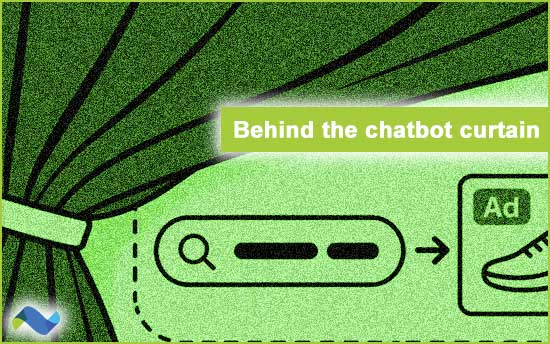
A ChatGPT ad can appear in response to a search the user never typed.
Three OpenAI executives, including CTO of Applications Vijaye Raji, told Adweek reporter Trishla Ostwal that an AI agent called the “orchestrator” reads the conversation, infers what the user might want to buy and writes its own queries to find relevant ads. If the user’s ad personalization settings allow it, the agent can also draw on earlier chats.
The orchestrator ranks the ads it finds and sends its top picks to an auction. The auction weighs advertisers’ bids alongside how useful each ad is likely to be. Buyers see aggregate results, but the queries that put their ads in contention stay hidden.
“Transparency is very weak,” one advertiser told Ostwal, who shared the comment on LinkedIn (Nov. 23).
Read: “ChatGPT’s Agent Writes Its Own Queries to Serve Ads. Advertisers Don’t Get to See Them” (Nov. 23) – Adweek (subscription)
From tipsheet: Say a running shoe brand sees a low click-through rate. Did its ad fall flat with people shopping for shoes? Or did the orchestrator read too much purchase intent into conversations about running? The missing query makes it harder to tell what to change.
SEARCH
Pinterest opens visual search to Microsoft demand
Microsoft Advertising customers can now opt in to show ads from eligible search campaigns as native-looking Pins in Pinterest’s search results, home feed and related Pins.
Jason Fairchild, Pinterest’s general manager of programmatic and affiliate marketing, tells Ad Age what makes the deal different from its programmatic business:
“It’s different than the programmatic dynamic where we’re selling the audiences or packaging the audiences. This is actually placing the ads from search onto Pinterest.”
Ad Age reporter Garett Sloane explains why Pinterest wants those search budgets:
“The deal is part of Pinterest’s push to turn its visual search platform into a bigger performance advertising business. The company is betting that the billions of searches conducted monthly in its app can attract more advertisers looking to reach consumers as they consider purchases.”
Read:
Related: When Pinterest introduced Visual Search Ads on Sept. 17, CEO Bill Ready described the technology behind them as “our AI-enabled visual understanding of images, products, taste and intent.”
From tipsheet: A shopper might save three photos of rooms with oak dining tables before ever typing “oak dining table” into a search box. Those saves feed Pinterest’s “Taste Graph,” which helps its AI infer which products might appeal to that shopper.
AGENTS
What does an UMP add to a DSP?
In his weekly column, Marketecture founder and ad tech product leader Ari Paparo looks at a category mapped by ad tech investment firm Aperiam Ventures: the UMP.
A Unified Media Platform (UMP) brings campaign data from Google, Meta and demand-side platforms (DSPs) into one place, according to Aperiam. And some UMPs also promise to use AI to decide where a brand should spend its next ad dollar and buy media on its behalf.
Paparo sees the appeal of a single dashboard, but he’s skeptical of the buying pitch, especially for advertisers that already use a DSP. He writes:
“A big part of the business pitch for UMPs is that they will use AI to buy media to enhance existing media outcomes. This also makes some intuitive sense: If you have all the existing media for a brand in a single place, you should be able to make good incremental media decisions.
The problem with this logic is how it potentially interacts with a customer using an existing DSP for media buying…”
For Paparo, the question is what the UMP actually does. If it creates a media plan and sends it to the advertiser’s existing DSP through an API, he sees a familiar ad tech arrangement. What makes that buy agentic?
Read: “Are UMPs Getting the Right Call?” (Nov. 23) – Marketecture
Related: An AI agent can plan a campaign, but the DSP still decides what each impression is worth, writes Nexxen’s Oscar Rondon in “Why DSPs Still Matter in the Agentic Era.” (undated) – Nexxen sponsored content on Adweek
LLMs & CHATBOTS
What’s a citation chip?
When ChatGPT cites a source, the little clickable label beside the sentence is a “citation chip.” It works like a footnote. But does anyone click it?

On LinkedIn yesterday, Josh Blyskal, head of insights at AI marketing platform Profound, shared where readers landed on Profound’s site during 4,954 human visits from ChatGPT last week.
Who says AI search doesn’t deliver referrals? It does if you’re a GEO firm.
Blyskal inferred the link type from the landing page, so the split is an estimate.
-
- Citation chips. 38% of visits landed on pages that usually appear as citation chips. Those visits were spread across hundreds of pages, including guides, research and product pages.
- Inline links. Another 50% landed on pages ChatGPT typically links to in the text of its answers. Profound’s homepage alone accounted for 47% of all visits from ChatGPT.
Read more on LinkedIn. (Nov. 23)
MARKETING
Unilever structures product claims for AI
Unilever wants to know what gets its brands recommended by AI. Consumer Goods Technology reports:
“The company is simplifying its data pool of claims and evidence — about 150,000 proprietary scientific documents — so that AI systems have an easier time parsing through the insights to create recommendations. It is tracking more than 1 million prompts per week to understand what influences these suggestions.
The results: Over the past six months, 91% of the brand market positions it tracks have improved. A Unilever brand now shows up as a top-three recommended brand in eight of its ten largest markets.”
Read: “Unilever Scales AI Marketing Across 4 Core Pillars to Cut Content Costs by 90%” (Nov. 23) – Consumer Goods Technology
MEASUREMENT
Sourcing the intel in advertising
Stockholm-based Stravito runs a consumer intelligence platform where marketers can get feedback from AI personas. A marketer comparing two ads, for example, can ask a Gen Z persona why one might resonate more than the other. Each answer cites the research behind it, according to founder and CEO Thor Olof Philogène.
AdExchanger’s Joanna Gerber explains how Stravito builds the personas:
“Stravito connects to a brand’s first-party data as well as other sources, like surveys and syndicated research, plus Stravito’s data from prior campaigns. From there, it builds out different AI personas for different audiences.”
If the persona favors one ad, the marketer needs to know why. Which parts of its reasoning can the brand trace to consumer research, and which did the AI infer? Philogène says Stravito flags that distinction.
Read: “AI Needs To Cite Its Sources. This Consumer Intelligence Platform Ensures It Does” (Nov. 23) – AdExchanger
Related: Stravito says its MCP server lets marketers query their brand’s consumer research from ChatGPT, Claude or Copilot and see the sources behind each answer. (Sept. 24) – press release
AGENTS
Update: Walmart-Muse collab
In yesterday’s tip, we quoted analyst Joe Kaziukėnas saying Meta’s Muse would ask Walmart’s shopping agent, Sparky, about orders, stores, policies and product comparisons.
Kaziukėnas revised his assessment yesterday morning. He now says Muse appears unlikely to rely on Sparky for customer-account questions and no longer sees this as agent-to-agent commerce.
Walmart told The Verge that its shopping integration with Muse would roll out Nov. 23, reversing a one-day delay.
LLMs & CHATBOTS
Developments
-
- “NVIDIA Board Reinstates Jensen Huang as President, CEO and Board Director” (Nov. 23) – NVIDIA
- “Introducing Claude Ship” (Nov. 23) – Anthropic
- “RL infrastructure at Microsoft AI” (Nov. 23) – Microsoft AI
MORE
-
- AI Search: “Google’s Liz Reid: AI search has less room for commodity content” (Nov. 23) – Search Engine Land
- CloudX on AWS: Within two weeks of mobile SSP CloudX’s first production test, AWS RTB Fabric was handling most of its outbound bid traffic. Dyck describes CloudX as a mobile SSP focused on “AI-driven workflows.” (Nov. 23) – Trevor Dyck, Head of Product, Adtech Infrastructure, AWS on LinkedIn
- Funding: “Brazil’s Newell & Simon raises $3.36M for AI marketing agency” – Dealroom
- CTV fraud: “BADBOX 3.0, the CTV ad fraud scheme generating 40 billion bid requests a day” (Nov. 23) – Digiday (subscription)
- Testing AI features: “When Can You Ship on Offline Evals Alone?” (Nov. 19) – Spotify engineering blog (h/t Eric Seufert)