
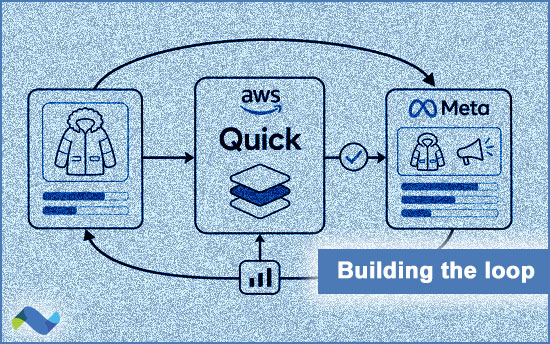
Amazon Web Services (AWS) on Saturday added a Meta ads connector to Quick, its AI workspace for businesses. Through Meta’s Model Context Protocol (MCP) server, advertisers can use plain language to analyze results, create campaigns and change budgets from within Quick.
One example from AWS’ Chris Geiger and Mark Botto gets at why a buyer might do this outside Meta’s Ads Manager. A retailer could ask Quick to compare Meta campaign results with its own stock levels and profit margins. Winter coats might deserve more budget even with a lower return on ad spend if the retailer earns more on each coat and has plenty in stock. Quick can recommend the shift and, with the buyer’s approval, apply it in Meta.
Read: “Meta ads is now available in AWS Quick” (Nov. 21) – AWS blog
From tipsheet: Meta still gets the ad dollars, but Amazon has a hand in how the retailer spends them. If the retailer comes back to Quick next week to see how many winter coats sold and decide whether to shift the budget again, that’s a feedback loop any walled garden would want. I’d imagine the retailer’s agency would like to be in on that conversation, too.
TECH
AWS is busy
- AI monetization: “How publishers can prepare their content for AI monetization on AWS” (Nov. 20) – AWS blog
- RTB Fabric: “Introducing AWS RTB Fabric Modules available through AWS Marketplace: AdTech partner intelligence, inline in the bid path” (Nov. 19) – AWS blog
AGENTS
Spotted in the wild: Walmart-Muse collab
Meta named Walmart as a shopping partner for its Muse AI agent at September’s Connect event. On Saturday, analyst Joe Kaziukėnas shared a screenshot showing how the arrangement would work.
“Walmart and Muse are about to launch the first agent-to-agent agentic commerce integration. Muse will talk to Walmart’s Sparky to get information on ‘orders, stores, policies and comparisons’ and use Walmart’s MCP to do the rest like get products, create carts and place orders. That’s new: all previous integrations between agents and retailers were only for data exchange.”
Read more — and see the screenshot — on LinkedIn. (Nov. 21)
Google’s James Kennedy explained in the comments why Walmart might want Sparky to answer questions while Muse handles cart changes through Walmart’s MCP tools:
“Keeping Sparky read-only is the smart part. Every cart change is a command you can trace, not a conversation one agent can talk another into. I suspect most retailers copy that boundary.”
Kaziukėnas predicts the connector will go live this week — just in time for Black Friday and Cyber Monday?
More: “Official Walmart connector coming soon — additional 30+ other new connectors added” (Nov. 21) — r/MuseAgent on Reddit
From tipsheet: Bring on the ads! If a shopper asks Muse what to buy at Walmart, who gets to sell the sponsored recommendation: Meta, Walmart or both?
PLATFORMS
Microsoft builds out both sides of shopping
Microsoft made two moves last week around the data needed to turn shopping interest into sales.
Commerce
On Friday, Microsoft CVP Tim Frank highlighted Web IQ Commerce, which gives developers building AI shopping agents access to structured data drawn from more than 40 billion offers through three APIs now in private preview: Commerce Search, Commerce Offers and Commerce Product Details. Agents can use the data to find products, compare offers across merchants and link shoppers to a place to buy, provided they preserve the attribution in the offer links Microsoft supplies.
Read more on LinkedIn. (Nov. 20)
Advertising
Microsoft says it has rebuilt the model it uses to predict whether a click will lead to a sale and how much that sale will be worth, its biggest bidding upgrade in a decade. The company reports an average 10% increase in conversion value per click at a similar ROAS for advertisers using Maximize Conversion Value or Target ROAS, based on its internal data.
Read: “Building the next generation of automated bidding at Microsoft Advertising” (Nov. 18) – Microsoft Advertising
From tipsheet: Microsoft is building infrastructure for AI shopping discovery while improving the models that optimize ad bids for sales. Will it eventually connect shopping-agent referrals, merchant outcomes and advertiser bidding into a feedback loop?
LLMs & CHATBOTS
ChatGPT has a measurement problem
Advertisers have seen ChatGPT both overreport and underreport conversions, Ad Age’s Garett Sloane reports, leaving buyers with a practical question about when to trust the numbers enough to bid on them.
Search intelligence company Adthena says roughly half of 30 enterprise brands that shared their ChatGPT ad results reported spending more than they were getting back, while about a quarter said their results matched or beat Google.
The brands reported results from July through September, so the figures offer an early read rather than a broad measure of the channel.
Sloane wrote on LinkedIn: “For one, marketers might want to hold off on conversion bidding until they can trust the conversion data.”
Read more on LinkedIn. (Nov. 20)
The Ad Age piece also looks at context hints, which OpenAI describes in its targeting documentation as information about an ad group’s products, use cases or customer needs that the ads and landing page may not fully convey.
Read: “How to improve ChatGPT ad performance—5 lessons from early campaigns” (Nov. 20) – Ad Age (subscription)
From tipsheet: “Context hints” FTW. ContextHints[dot]com? Performance marketer Tarun Kapoor got there first.
Related: “Measuring Clicks Is Making ChatGPT Ads Look Like A Bad Bet” (Nov. 19) – Maor Sadra, CEO, INCRMNTAL on AdExchanger
SEARCH
Can AI Max replace the keyword list?
A speaker at last Wednesday’s SMX Next event gave phrase match and exact match two years before advertisers stop building search campaigns around them, according to New Street Research analyst Dan Salmon, whose team attended the conference.
In a Friday note to investors, Salmon explained why he thinks Google’s search ads platform AI Max is suited to the way people search in AI Mode and AI Overviews:
“AI Max already uses broad and keyword-less matching to find queries beyond an advertiser’s selected keywords, which we think is essential as AI Overviews and AI Mode bring longer, more conversational queries that are harder to anticipate with a keyword list.”
A lift for Google’s network?
Salmon also picked up on a change in how advertisers reach the Google Display Network. Buyers using Demand Gen can now buy display inventory alongside placements on YouTube, Discover, Gmail and Maps. He thinks that easier access may be drawing in ad dollars buyers otherwise would have spent elsewhere.
Google Network revenue rose 1.4% in the third quarter after 16 consecutive quarters of declines. Alphabet’s filing credits AdMob with most of the $101 million increase, partly offset by lower AdSense revenue. Salmon is careful about how much to read into the buyer comments: “[Google] has not attributed the growth to Demand Gen, and migrating existing Display budgets would not itself lift revenue.”
One more from SMX: An agency executive said clients are still testing ChatGPT ads. Salmon is watching whether they come back with a second budget.
Related: “Google Ads automation drift: Why better performance numbers don’t always mean better results” (Nov. 20) – Search Engine Land
TECH
Meta speeds up ads model upgrades
Meta engineers published two posts Wednesday explaining how the company is speeding up improvements to the models that rank ads.
Meta VP Matt Steiner, whom tipsheet interviewed last month, said Friday that engineering time and computing capacity have constrained how quickly a proven technique can spread across Meta’s many models.
He described two ways the team is addressing that problem:
“Standardization and automation: a template framework organizes models into a small set of reusable and composable building blocks, so an innovation validated once at the template level can propagate automatically to every model built from that template, with automation handling the deterministic steps.
Agentic automation: AI agents manage judgment-heavy, non-deterministic decision making across the end-to-end process, bringing deep intelligence to the system.”
Read more from Steiner on LinkedIn. (Nov. 20)
Read:
-
- How Meta Uses AI Agents to Scale ML Innovations Across Ads Ranking Models (Nov. 18) – Meta Engineering blog
- Design Once, Deploy at Scale: Building a Template-Driven ML Ecosystem (Nov. 18) – Meta Engineering blog
From tipsheet: When we spoke with Steiner in October, he said techniques including semantic tokenization would take time to reach Meta’s entire model fleet. The new posts show how the company is trying to close that gap: Meta credits its templates with cutting engineering time per model iteration by 92% and estimates that AI agents now handle more than 60% of technique propagation. Engineers still review key decisions and approve what ships.
MARKETING
Forrester warns of AI marketing overload
AI can help cross-channel marketing hubs produce campaigns faster, but that may also mean more irrelevant promotions and too many messages to customers, Forrester analyst Rusty Warner writes.
His advice to marketers evaluating these platforms: look for evidence of better customer outcomes and ask whether the hub can work with outside models and agents while preserving control.
MoEngage partnerships director Nick Ippel shared the Q4 2026 Forrester Wave graphic on LinkedIn. Adobe scores highest on strength of offering among the 12 providers evaluated, while MoEngage and Zeta Global are both classified as Strong Performers.
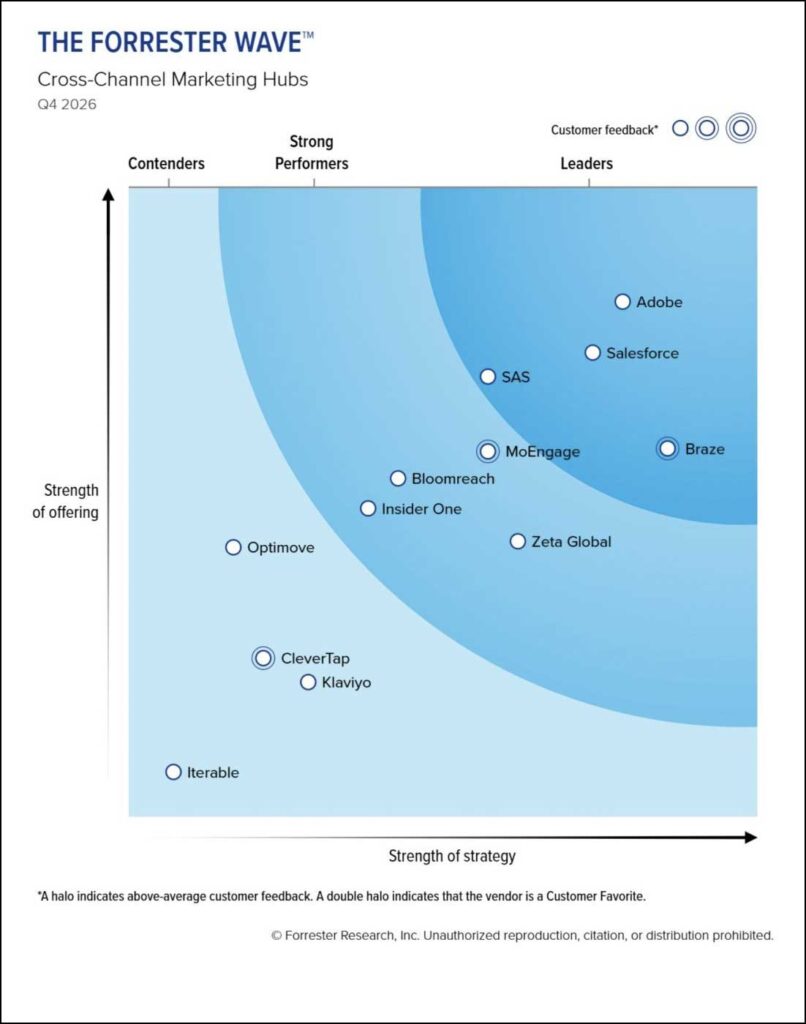
MoEngage bills itself as an “Agentic Customer Engagement Platform.”
Read: “Make Your Cross-Channel Marketing Hub More Than An AI Assembly Line” (Nov. 19) – Rusty Warner, VP, principal analyst on Forrester Research blog
PEOPLE MOVES
Now hiring
AdCP governance: “I’m pleased to share that I’m joining AgenticAdvertising[dot]org as Chief Executive Officer. AAO is the nonprofit trade association whose members develop and steward the Ad Context Protocol (AdCP)… When journalism and culture thrive, democracy thrives. That’s why I believe that AAO is the right governance model for a future in which people govern AI agents and support information integrity with sustainable funding, investment and policy.” (Nov. 20) – Former CBS Interactive executive Christy Tanner on LinkedIn
LLMs & CHATBOTS
Developments
-
- “Amazon closes in on $7.5bn deal to buy AI start-up Decart” (Nov. 21) – Financial Times (subscription)
- “Databricks In Early Talks To Raise Funds At $225 Billion Valuation” (Nov. 20) – The Wall Street Journal (subscription)
- “Perplexity and Intelligence” (Nov. 22) – OpenAI
MORE
-
- Comcast split machinations: “Ampersand Is Offloading Its Indie Agency Business To Comcast And Spectrum Following Mass Layoffs” (Nov. 20) – AdExchanger
- Streaming rises: “Broadcast Ad Exposure Time Jumps With Start Of New Season” (Nov. 20) – MediaPost
- Super-fast delivery: “Quick commerce boom lifts Alibaba e-commerce earnings to $11.72b” (Nov. 20) – Retail Asia
- AWS RTB Fabric: “Introducing AWS RTB Fabric Modules available through AWS Marketplace: AdTech partner intelligence, inline in the bid path” (Nov. 19) – AWS blog