
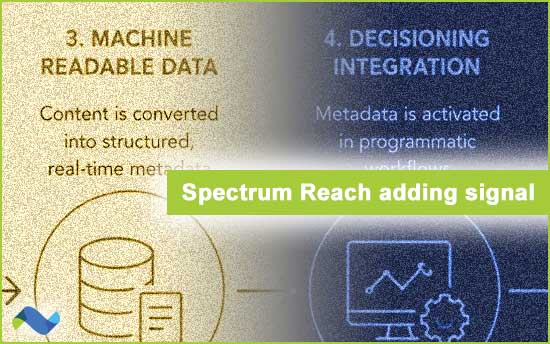
Spectrum Reach is partnering with contextual video intelligence company Anoki and its ContextIQ technology to bring scene- and segment-level context to streaming TV inventory.
Use case from a press release:
“It works like this: advertisers set guidelines, such as avoiding certain content topics or choosing shows with a specific message. Then, using real-time data, ads are matched to the most suitable ad breaks within milliseconds. For example, when a story about Father’s Day runs live on Spectrum News, an advertiser can have its barbecue grill commercial placed to appear seconds later, with real-time placement supported by the Magnite and Index Exchange supply-side platforms (SSPs). ”
Decisions around contextual targeting and brand suitability are at the center of the integration.
On Anoki’s website, ContextIQ is positioned as “CTV’s first end-to-end multimodal AI platform and Copilot for advertising.”
Read: Spectrum Reach and Anoki AI Team Up to Achieve Improved Real-Time Transparency in Streaming TV (June 10) – press release
From tipsheet: Spectrum Reach appears to be pushing beyond channel-, app-, and show-level targeting toward a future where TV content itself becomes machine-readable. As AI systems generate metadata about scenes, topics, events, and context in real time, streaming inventory becomes easier for algorithms and agents to understand, evaluate, and optimize against.
The Magnite and Index Exchange example is notable because it suggests this intelligence is being injected directly into programmatic decisioning workflows rather than existing as a standalone reporting layer. The long-term opportunity may be less about transparency and more about transforming television from a programming environment into a structured decision environment.
Related: Samsung brings Smart TV home screen inventory into programmatic workflows via Magnite (June 10) – Samsung
LLMs & CHATBOTS
Developments
- Visa Partners with OpenAI to Power the Next Generation of AI Commerce (June 10) – Visa
- Policy on the AI Exponential (June 10) – Dario Amodei, CEO, Anthropic on his blog
- DiffusionGemma: 4x faster text generation (June 10) – Google The Keyword blog
TECH
Amazon DSP adds attention targeting
Amazon DSP users can now apply Adelaide‘s attention scores as a pre-bid targeting parameter, allowing buyers to target high- and medium-attention inventory while filtering out lower-attention placements before an auction takes place.
Amazon is also integrating Adelaide’s AU Quality Floor, which excludes inventory in the bottom 10% of Adelaide’s attention rankings and filters out many made-for-advertising sites.
Benjamin Lichtman, head of performance marketing analytics and insights at Nestlé Health Science, tells AdExchanger:
“If those audiences prove to bring in higher-quality traffic and LTV, and make measurable halo impacts across other channels or substantially cut down waste, then they become really important and could be layered into other types of targeting.”
Read:
- Amazon DSP Adds Adelaide’s Pre-Bid Attention Targeting (June 10) – AdExchanger
- Adelaide Brings Attention-Based Pre-Bid Segments to Amazon DSP, Helping Advertisers Reduce Waste and Prioritize High-Quality Inventory (June 10) – press release
Case study: Amazon DSP AU Study Reveals Haleon’s Full-Funnel Outcomes – Adelaide
From tipsheet: Attention vendors have spent years trying to prove that attention predicts outcomes. The more interesting development is that platforms are increasingly turning those signals into bidding inputs. Amazon DSP’s Adelaide integration is another example of machine-generated signals moving from measurement and reporting into auction-time decisioning, where they can directly influence how media dollars are allocated.
As more intelligence moves into the auction, the market increasingly shifts from buying inventory to buying predictions about inventory.
CONNECTED TV
Amazon’s identity spine advantage
“At Amazon’s upfront last month, the company announced that its authenticated graph now deterministically reaches 90% of US households with verified, logged-in, non-modelled data. To put that number in context: it’s the result of decades of Prime penetration. Prime is the most ubiquitous loyalty programme in the US. Every household that signed up, every Prime Video subscription, every Alexa device in a living room, built the foundation of an identity graph that Amazon has been quietly assembling for years. The Roku partnership announced last summer enhanced that spine by closing the remaining gaps. (…)
Amazon’s pitch to a brand or agency is simple: centralise your TV buys on the Amazon DSP because the identity layer here is the highest-fidelity available anywhere. You get cleaner reach and frequency management than you’d get on The Trade Desk, DV360, or any other enterprise DSP. And the Amazon DSP is the only place to buy Prime Video ads.”
Read: “Understanding Amazon’s Data Advantages and the Path to $100b in Ad Revenue” (June 10) – Adam Epstein, CEO, Gigi on his Substack
From tipsheet: Amazon’s TV strategy looks like identity infrastructure monetized through inventory.
B2B MARKETING
LinkedIn pursues trust signals
Microsoft-owned LinkedIn is launching a creator marketplace that helps advertisers discover creators, evaluate their audiences and form partnerships directly through the platform.
Business Insider’s Lara O’Reilly reports:
“Creators can opt in to share their contact information with brands and showcase their best posts. Advertisers can boost creator content featuring their brands through ads or connect with the creators directly to explore other partnerships, such as speaking at a conference.”
Underlying the launch is a simple idea: people trust people more than brands.
The company says 61% of B2B marketers believe creator content delivers stronger ROI than traditional brand-created content.
Read:
- “LinkedIn is stepping up its pitch to creators with a new marketplace” (June 10) – Business Insider
- “LinkedIn’s Creator Marketplace, a new ecosystem for brand/creator connection” (June 10) – Sam Corrao Clanon, Director of Product, LinkedIn on LinkedIn
- “Helping Brands Deliver Impact With Creators and Stronger Creative” (June 10) – LinkedIn
From tipsheet: Last week, Google introduced creator profiles in Search to help users evaluate who is behind the information they find. As AI makes content easier to generate, platforms increasingly need ways to surface expertise, identity, and credibility. LinkedIn’s Creator Marketplace points in the same direction. The marketplace is the product and trust signals may be the strategy.
More trust signals: TikTok now has a seat next to Amazon and Walmart in RFPs (June 8) – Digiday (subscription)
LLMs & CHATBOTS
Perplexity tests the marketing stack
Perplexity Computer, an AI agent that can browse websites and perform tasks on a user’s behalf, is being promoted on LinkedIn as a landing-page optimization tool called “Conversion Rewrite.”
Called “Conversion Rewrite”, the company explains that “Perplexity Computer analyzes your landing page, finds conversion gaps, and rewrites the copy into a sharper offer, proof points and CTA flow.”
Read: Rewrite your pages for conversions – Perplexity Computer
An ad on LinkedIn read in part: “Perplexity Computer runs the full conversion workflow, from diagnosing issues to rewriting pages – with 20+ AI models in parallel.”

From tipsheet: Back in February, Perplexity threw cold water on OpenAI’s entrance into advertising while observers questioned whether the company’s reach was sufficient to support a meaningful ad business. Yet this latest offering pushes Perplexity further into marketing workflows.
Today the company is helping rewrite landing pages. Tomorrow it could help create ads, optimize campaigns, analyze performance, allocate budgets and execute other marketing tasks. Whether Conversion Rewrite is a product, a feature or simply a showcase for Perplexity Computer, it moves Perplexity one step closer to influencing business outcomes.
PLATFORMS
Creative Agent bets on feedback loop promise
Bedrock Platform announced a new agentic product called Creative Agent in partnership with creative ad tech firm Advertible. The agent is a synthesis of Bedrock’s media decisioning platform (Pathfinder) and Advertible’s AI-generated creative capabilities, according to a press release.
Also:
- “The Creative Agent empowers users to leverage AI to iterate on thousands of creative variations instantly, optimize them for specific audience segments, and ensure brand safety, all within the Bedrock environment. As a result, time-to-market is dramatically reduced, while campaign performance is enhanced at scale.”
Read: Bedrock and Advertible Close the Agentic Loop from Decisioning to Creative (June 10) – press release
Recall that Index Exchange announced availability of Bedrock’s containerized demand-side platform (DSP) within its Index Cloud product in April. At the time, Bedrock argued that bringing its bidder closer to the impression would allow it to compete on decisioning and performance rather than infrastructure.
From tipsheet: Positioning around decisioning rather than media buying alone is an emerging trend.
Bedrock appears to believe that media platforms will become increasingly agentic and that creative is one of the last major manual steps remaining in the optimization process.
The agentic goal goes beyond automating bids and targeting, and connects everything — signals, decisions, creative generation, execution and measurement — into a continuous learning system.
The remaining question is whether, and when, advertisers are willing to entrust larger portions of their budgets to these continuously learning systems.
AGENCIES
Dentsu’s 360i revival points to a smaller-team future
Agency holding company Dentsu is reviving 360i as a social-focused offering built around a four-person team, fixed-fee pricing and AI-enabled workflows.
Christine Cotter, who will lead 360i, discussed the launch on LinkedIn:
“Algorithms and AI are reshaping how everything gets discovered faster than agencies and brands can keep up. Brands are looking for partners that are more adaptive, more specialty, and less operationally complex.
The market is primed for a disruptor. So here we are, again.
360i is back as an AI-native, social-first, dentsu solution built for brands that want to grow in the most modern way possible. Sitting at the intersection of creative and media. Commerce built in. Specialist speed and expertise with the power and scale of the dentsu network. Fixed-fee, organized around outcomes, designed to move without barriers.”
Read more on LinkedIn. (June 10)
More:
- “Don’t Call It A Comeback. It’s A Reckoning.” (June 10) – 360i on Substack
- New 360i website
MediaPost noted 360i will implement fixed-fee pricing models for all clients.
Read: “Dentsu Revives 360i As U.S. Social-First Solution” (June 10) – MediaPost
From tipsheet: AI may be shifting agency economics from scale through headcount to scale through software. The revived 360i pairs a four-person specialist team with Dentsu’s broader infrastructure, suggesting a future where clients buy expertise and outcomes rather than organizational complexity.
The open question: If AI increases the leverage of specialist teams, what becomes the optimal size of an agency?
CREATIVE
Vidmob launches Vidmob360 intelligence platform
Creative ad tech platform Vidmob announced yesterday:
- “By combining Vidmob’s core SaaS platform with a MCP services layer, Vidmob360 makes creative data accessible and actionable across the enterprise tools, AI systems, agents, and media workflows where advertising decisions are made. Marketers can connect leading AI assistants like Claude, Gemini, or ChatGPT to evaluate creative against brand guidelines, diagnose campaign performance, or surface recommendations in real time. Agencies can embed custom client creative data directly into planning and activation workflows, with no custom development required.”
Read: Vidmob Launches Vidmob360, Bringing Creative Intelligence Into the AI Advertising Era (June 10) – press release
From tipsheet: Vidmob wants creative intelligence to be agent-accessible.
MORE
- WWDC 2026: Implications for the App Economy (June 10) – Analyst Eric Seufert on Mobile Dev Memo (subscription)
- Equativ and SofiaPulse Partner to Bring Creative Intelligence to Omnichannel Advertising (June 10) – press release
- How Coca-Cola is using AI and emotion in bid to win World Cup fans (June 9) – Ad Age (subscription)
- Ads in New York must now label AI-generated ‘synthetic performers’ (June 9) – Associated Press