

Uber’s $15 billion acquisition of Germany’s Delivery Hero, announced yesterday, is about more than expanding its food delivery footprint. Liberty Sky Advisors analyst Ian Whittaker argues the real prize is the higher-margin advertising and intelligence businesses built on top of the delivery network.
He writes on LinkedIn:
(Condensed.)
“Uber Advertising crossed a $2 billion annualised run rate last year, up more than 50 percent… The point is not revenue. It is margin. Advertising inventory of this kind runs at 70 to 90 percent margins… A dollar of advertising therefore carries the profit of many dollars of delivery… That is the engine Uber is buying. The delivery network is the cost of acquiring the customer… Once advertising is the margin, every platform deal is really a consolidation of inventory and first party data… The food delivery is what Uber is paying for. The advertising profit is what it is actually buying.”
Read more analysis on LinkedIn. (July 16)
From tipsheet: The physical business increasingly becomes infrastructure for an intelligence business. Delivery isn’t just moving food. It’s creating the first-party relationships and behavioral signals that underpin higher-margin advertising today and AI-driven commerce over time.
PLATFORMS
Q&A: Google expands Buyer Direct to open beta
On Tuesday, tipsheet covered Google’s Buyer Direct product and its potential implications for demand-side platforms. The company has now responded to our questions.
Buyer Direct allows publishers to sell guaranteed inventory directly to agencies within Google Ad Manager.
In an email to tipsheet, a Google spokesperson confirmed Buyer Direct has expanded to open beta, outlined the company’s vision for agentic media buying and explained how the product connects with its new Gemini-powered Ask Ad Manager assistant.
From the email exchange:
tipsheet: Buyer Direct is shown as currently in beta. When did the beta begin, who has access today and what’s the timeline for broader rollout or general availability?
Google: Buyer Direct rolled out in Beta around the time of our announcement in the fall of 2025. It was rolled out to open beta earlier this month, meaning it’s available for all publishers and agencies.
tipsheet: How is Buyer Direct priced? Are there transaction fees or other costs for agencies and publishers?
Google: Like our other features, Buyer Direct operates on a percentage of media for agencies and revenue share for publishers.
tipsheet: As advertisers increasingly adopt AI agents to plan and execute media buying, what role do you envision Buyer Direct playing in that workflow? How should agencies think about Buyer Direct alongside DSPs?
Google: Agencies should think about Buyer Direct as an enabler for their agentic planning and media buying needs, allowing them to buy premium reservation inventory within Google Ad Manager. In the future, we plan to integrate agentic capabilities into Buyer Direct, helping buyers generate more effective media plans using Ad Manager’s sophisticated optimization capabilities.
tipsheet: Does Buyer Direct integrate with Ask Advisor or other Gemini-powered workflow tools announced at Google Marketing Live? If not today, is that part of the long-term vision?
Google: Buyer Direct is supported by our new conversational AI agent built with Gemini, Ask Ad Manager, which is currently rolling out in beta. This new in-platform agent helps publishers automate routine tasks, accelerate troubleshooting and uncover reporting insights.
For Buyer Direct, Ask Ad Manager will:
-
Identify delivery issues: Publishers could prompt the agent with a question like, “How are my deals with a Buyer Direct supply path delivering? Are there any underdelivering I should look at?”
-
Understand revenue and reporting: Publishers can ask questions like, “How much did I earn in revenue last month via Buyer Direct supply path? Is it increasing or decreasing?” and “Who are my top Buyer Direct buyers?”
See tipsheet coverage of Buyer Direct earlier this week. (July 14)
PLATFORMS
Apple hints at broader ad ambitions
Analyst Eric Seufert notes Apple emailed advertisers this week with revised Advertising Terms of Service that take effect July 28. The updated language states that Apple Ads may appear on “other properties.”
He observes:
-
“The updated language in the terms gives Apple broad latitude to place Apple Ads on apps, websites, and platforms that it doesn’t operate. This would be a dramatic departure from the current Apple Ads operating model, which is limited to Apple-controlled inventory in the App Store, Apple News and Stocks, and MLS programming in the Apple TV app, with Apple Maps inventory coming soon.”
Read: “Did Apple just signal a third-party expansion of Apple Ads?” (July 15) – Eric Seufert on Mobile Dev Memo (subscription)
Nebojsa Radovic, Senior Director of User Acquisition at Zynga, commented on X about Seufert’s observations:
“Apple has a uniquely valuable first-party dataset across its users, including engagement and purchase behavior. If Apple starts using that data to compete for high-value users outside of its own properties, it could put some pressure on AppLovin’s business… this is less of an existential risk and more of a new competitive dynamic worth watching.”
Read more. (July 15)
From tipsheet: eMarketer forecasts Apple will generate $8.85 billion in U.S. advertising revenue this year while selling ads primarily on its own properties. If Apple Ads expands to third-party apps and websites, Apple wouldn’t simply be growing its advertising business. It would be transforming it into a much broader advertising platform.
SEARCH
The second golden age of search
Co-founder and CEO Jared Belsky of digital marketing agency Acadia argues on LinkedIn that AI is ushering in “the second golden age of search marketing” as search evolves from delivering links to delivering answers and transactions.
He writes:
“The ad is no longer the interruption. It’s the answer. That’s the part I want you to sit with. For twenty years we optimized ads to survive being an interruption between the user and what they wanted. Now the ad IS what they wanted. 75% of AI Mode users report making faster, more confident decisions. That’s not annoyance. That’s usefulness. Acadia is seeing this same thing for [Amazon’s] Rufus and [Walmart’s] Sparky as well, so this is not isolated.”
Read more. (July 16)
From tipsheet: Search is becoming another recommendation engine. As AI increasingly chooses what to show users, competitive advantage shifts from buying visibility to earning inclusion.
LLMs & CHATBOTS
LLM developments
- Kimi K3: Open Frontier Intelligence (July 16) – Kimi
- Create, edit and star in videos with two Google Vids updates (July 16) – Google
- DoorDash CLI lets you order DoorDash directly from your AI agent. (July 16) – TechCrunch
LLMs & CHATBOTS
The next GEO battleground: Accuracy
Profound has launched FactCheck, a tool that identifies inaccurate AI responses about brands, traces the sources of those errors and routes corrective actions to AI agents.
Co-founder James Cadwallader wrote on LinkedIn:
“Profound FactCheck is the market’s first tool that shows brands how AI is misrepresenting them, why it’s happening, and which sources are feeding the errors. Then it routes the fix to an Agent.”
Read more on LinkedIn. (July 15)
Wearable fitness company Whoop, which tested the product in beta, initially found that 7.9% of AI responses about its brand contained accuracy issues, according to a Profound case study. View it.
More:
- “Introducing FactCheck: the first way for brands to analyze AI accuracy at scale” (July 14) – Profound blog
- Profound Launches FactCheck to Measure the Accuracy of AI Answers About Your Brand (July 14) – press release
From tipsheet: GEO is evolving from measurement into knowledge management. Early tools focused on visibility and sentiment. FactCheck adds accuracy by comparing AI responses against a brand’s own knowledge base. More broadly, it reflects how AI is compressing the distance between measurement and action, turning dashboards into operational systems that identify problems and initiate corrective workflows.
COMMERCE MEDIA
Product feeds become the creative
Entrepreneur Joe Kaziukėnas says ChatGPT has begun testing a new ecommerce ad format built from retailer product feeds rather than manually created ads. Instead of creating ads for individual products, retailers provide a product feed and OpenAI selects which products to promote.
He writes, “Scheels is not creating ads for each product manually but is instead letting OpenAI pick which products to advertise,” and then adds, “There is no ad creative – it is just the product image and details.” See screenshot below.
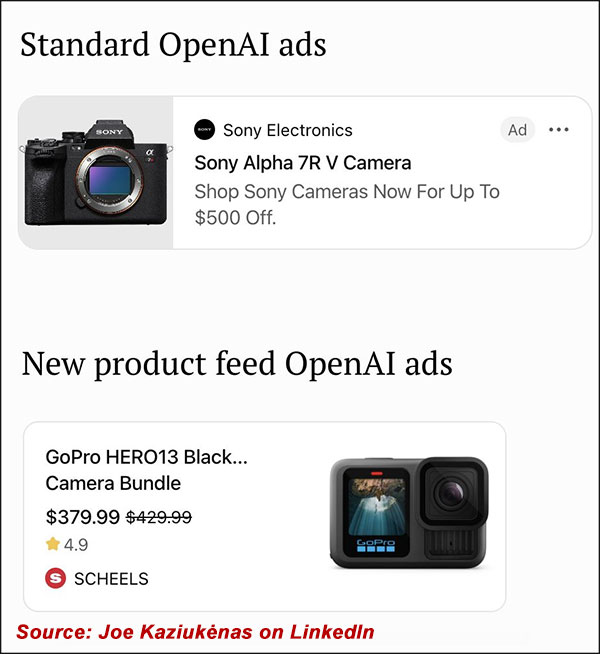
Read more on LinkedIn. (July 16)
From tipsheet: As AI takes over more campaign decisions, product feeds become the creative. Retailers increasingly provide structured product data while the model decides which products to recommend and promote.
One question worth exploring is whether conversational media ultimately uses a single product feed for both earned and paid recommendations, with the “Ad” label, and perhaps ranking priority, being the primary distinction.
FINANCIALS
Earnings reported yesterday
Companies exposed to the AI-driven advertising and marketing opportunity are beginning to report their latest quarterly financial results.
Yesterday included:
Netflix
- Markets: Netflix stock was down 8% in after-hours trading.
- Stat: “Our 2026 outlook is consistent with our prior forecast: we are narrowing our revenue forecast to $51.0-$51.4B, which represents 13%-14% growth (~12% F/X neutral), driven by growth in memberships and pricing, and a projected rough doubling of our ads revenue to approximately $3 billion..”
- Company: Letter to shareholders – Netflix
- Read: About 300 Netflix Programs Used Generative AI This Year, Company Reveals (July 16) – Variety
Publicis Groupe
- Markets: Publicis Groupe stock was down 1.4% yesterday.
- Stat: “Strong Q2 accelerating to +4.8% net organic growth. Continued momentum in H2 leading to guidance upgrade.”
- Company: Publicis Groupe First Half 2026 Results (July 16) – Publicis Groupe
- Read: Arthur Sadoun on AI Pitch Promises, Sapient’s Slowdown, and John Wren (July 16) – Adweek (subscription)
- Transcript – Sadoun on LiveRamp acquisition: “And the truth is that for our clients, this is a nonevent, all of them. And the reason why it’s a nonevent, which come back to your question, is that you need to understand that LiveRamp technology is neutral by design. LiveRamp is a technology. It is a platform of data collaboration. And so it will live within our technology. It will work particularly with Sapient to build agent for sure. But more than that, at the moment, it’s very difficult for me to tell you.” Read the earnings call transcript.
MORE
- Stagwell is building its own AI media curation marketplace (July 16) – Digiday (subscription)
- EU orders Google to share search data with rivals starting in 2027 (July 16) – Search Engine Land
- How Georgia-Pacific Rolled Out Its Own Programmatic Media Team (July 16) – AdExchanger
- Retail Media’s Next Evolution: Getting Into Content (July 16) – Adweek (subscription)
- Omnicom retires Kinesso and Annalect brands as Kinesso’s EMEA leader exits (July 16) – Campaign