
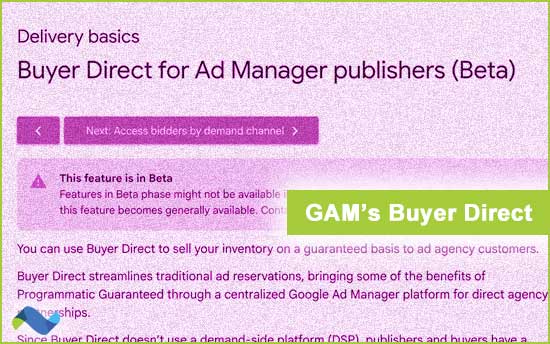
On the AdTech AdTalk podcast, Chalice co-founder Adam Heimlich and Gamera’s Gareth Glaser discuss Google’s Buyer Direct beta, which could reshape where agencies build agentic media-buying workflows.
Google’s Scott Sheffer, VP of Sellside Monetization, first announced Buyer Direct for publishers last November.
“Streamline direct deals with agencies
As the industry shifts toward more direct connections, we’re rolling out Buyer Direct in Ad Manager. This new feature combines the control of a traditional direct deal with the efficiency of programmatic technology, including cross publisher frequency optimizations, real time reporting and consolidated billing.
This feature enables publishers and advertisers to reap the benefits of traditional reservations at scale, introducing new revenue opportunities and a more direct path.”
Read: “New monetization and AI tools for publishers” (November 6) – Google Ads & Commerce blog
Heimlich and Glaser observe that Buyer Direct gives agencies a way to buy reservation inventory directly from publishers without relying on a traditional DSP. Glaser adds that fees for the product are “10 points,” a potentially huge discount to today’s ad tech fees.
More: “Fruit of the Poisonous Tree” [15:15] (July 10) – AdTech AdTalk podcast on YouTube
Glaser first raised the product’s implications in a tweet last week.
A Google Ad Manager (GAM) Help page explains further:
“Buyer Direct brings agencies and publishers closer together for their direct reservation campaigns. The workflow is similar to Programmatic Guaranteed; however, instead of the buyer working in a DSP, they work in the Agency interface.
- Buyer Direct introduces a new supply path for your reservation campaigns, so you can now choose either Buyer Direct or the demand-side platform (for Programmatic Guaranteed).
- Buyer Direct combines concepts from both traditional reservation buying and Programmatic Guaranteed to make booking ad campaigns in Ad Manager more efficient.”
Read: “Buyer Direct for Ad Manager publishers (Beta)” – Google Ad Manager Help
More: Google Ad Manager gives advertisers a more direct path to buy ads from publishers (November 6) – Ad Age (subscription)
Tipsheet has reached out to Google for comment.
From tipsheet: Buyer Direct raises a strategic question for agencies. As AI automates media buying, will the intelligence layer live in independent agentic platforms or inside Google Ad Manager? The answer could determine whether agencies own their AI workflows or rent them from the platforms they buy through.
Related: Perion expands Programmatic Guaranteed into digital out-of-home with Google’s DV360 (July 13) – Perion
PLATFORMS
AI moves decision-making to the auction
Nate Woodman, who helped establish the agency trading desk model in programmatic advertising, argues that the open web is shifting toward a context economy in an op-ed for AdExchanger.
He previewed his piece on LinkedIn:
-
“The open web is moving from an audience economy to a context economy. For a decade, identity graphs told us who someone was and what they bought. Containerized bidding shifts the work inside the auction, where systems interpret the moment instead of matching a segment. That is the change that matters.”
Read the LinkedIn post. (July 13)
The core of Woodman’s argument: “The auction becomes less about static targeting and more about live interpretation.”
Read: “The Open Web Is Shifting From An Audience Economy To A Context Economy” (July 13) – Nate Woodman, advisor, Proof in data on AdExchanger
From tipsheet: AI moves the differentiating intelligence into the auction. Advantage will come less from owning the best prebuilt audience segment and more from interpreting each impression’s context faster and better than competitors.
MARKETERS
Marketers are becoming validators
As advertisers gain more experience with Meta’s AI creative tools, some say they are spending more time validating AI-generated assets than creating them.
Business Insider reports that marketers have encountered AI-generated product changes, distorted images and other errors. Some agencies also say bugs have occasionally enabled AI creative features they intended to leave off.
The report offers a vivid example:
“Jessica Gleim, an ads consultant who works with female-founded brands, told Business Insider she regularly sees odd outcomes in Meta’s AI creative recommendations for ads she’s working on.
For one of her clients, a pajama brand, Meta recommended new assets that altered the actual product. The brand was promoting a pajama dress, and Meta suggested a new image with a shirt and pants. For another client, a networking group for women in Montana, Meta had a new vision for those ads: adding men.”
Still, Gleim said, “Meta’s still the best platform.”
Read: Meta’s AI advertising dreams have become a nightmare for brands (July 13) – Business Insider
Last week, Meta launched its new Muse Image model, which will power the company’s Advantage+ ad buying platform.
From tipsheet: AI shifts marketers from production toward supervision. As creative generation becomes abundant, judgment becomes scarce: knowing what to approve, what to reject and what is not fit to reach customers.
MEASUREMENT
Standardizing AI content measurement
Publishers are trying to build a common measurement layer for AI content use. The coalition behind Standards for Publisher Usage Rights, or SPUR, has proposed a framework for reporting when, where and how AI systems access publisher content.
Digiday’s Jessica Davies reports:
“After years of watching AI products treat their journalism as a free buffet, publishers have formed a coalition to create a new standard that tracks how AI systems access their content at every step.
SPUR has gathered momentum since its March launch, signing its first U.S. founding member, the Associated Press, last week.”
Read: “WTF is SPUR’s publisher-run Content Telemetry Framework?” (July 13) – Digiday (subscription)
More:
- SPUR Telemetry Standard Published for Public Comment (June 12) – SPUR
- “Content Telemetry: an open standard for reporting AI content usage” – GitHub
From tipsheet: Markets need shared measurement before they can price usage. SPUR is trying to create the accounting layer for AI content—turning access into evidence, and evidence into licensing, attribution and payment.
LLMs & CHATBOTS
Developments
- Teachers and Local Businesses Win as Meta Expands Louisiana Data Center (July 13) – Meta
- Why AI Might Actually Help Solve the Next Labor Crisis (July 13) – The Wall Street Journal (subscription)
- AI is changing older workers’ careers, research finds — here’s how (July 13) – CNBC
LLMs & CHATBOTS
Forecasts diverge sharply on OpenAI ads
eMarketer analyst Nate Elliott believes OpenAI will fall well short of its reported advertising revenue projections.
Elliott reiterated the point on LinkedIn yesterday:
“Congratulations, ChatGPT Advertising! Today you turn 178 days old – one day older than Instant Checkout was when OpenAI pulled the plug on it.
No, I don’t think OpenAI is going to kill its ad product. Nor do I think it will generate anywhere near the revenue OpenAI hopes – as Adweek’s Trishla Ostwal reported this morning, citing our latest eMarketer forecast.”
Read more on LinkedIn. (July 13)
Adweek’s Ostwal wrote, “OpenAI is projecting $100 billion in ad revenue by 2030. eMarketer puts the ceiling for the entire chatbot ad market at just $5.41 billion.”
Read: OpenAI’s Ad Business Is on Pace to Miss Its Own Forecast By 90%, Analyst Says (July 13) – Adweek (subscription)
More:
- “US AI Advertising Forecast” (June 4) – eMarketer (subscription)
- Summary: “Our new eMarketer US AI Advertising Forecast predicts strong growth over the next five years: AI ads will more than double from over $32bn in 2026 to more than $68bn in 2030. But more than 80% of AI advertising in 2026 will appear next to AI content…” – Nate Elliott on LinkedIn
As tipsheet reported yesterday, New Street Research analyst Dan Salmon modeled OpenAI’s advertising business with a 2030 range of $23.7 billion in his bear case and $110.1 billion in his bull case.
From tipsheet: Forecasts for OpenAI’s advertising business vary enormously because they rest on very different assumptions about user growth, commercial intent and ad load. The debate isn’t whether ChatGPT can sell ads. It’s how large that opportunity ultimately becomes.
TECH
Opinions
- Undeployed Agents (July 13) – Keith Petri, SVP, Viant on his personal blog
- Why unpaid media is now essential to AI visibility (July 9) – Abigail Niziankiewicz, VP, Mediassociates on Marketing Dive
- AI Creates New Opportunities For Audio Advertising (July 13) – Spencer Morris, EVP, Triton Digital on Inside Radio
PEOPLE MOVES
Board appointment
-
“I’m confident that The Trade Desk now has one of the best boards in ad tech history. Today we announce the addition of Penry Price to our Board of Directors at The Trade Desk. Penry is an advertising industry veteran who has spent 20+ years in leadership positions at LinkedIn, Dstillery, Google, and led the DoubleClick acquisition…” (July 13) – The Trade Desk CEO Jeff Green on LinkedIn
MORE
- There’s a massive opportunity for agencies despite AI pressure, says 3C Ventures’ Michael Kassan (July 13) – The Current
- VideoAmp, Nielsen One Pull Out Of MRC Accreditation Process (July 13) – MediaPost
- JWX’s QuantumPath adds Amazon DSP integration, multi-DSP campaign orchestration and workflow automation, positioning itself as an “agentic media buying platform.” (July 13) – Jeff Hirsch, President, JWX on LinkedIn