
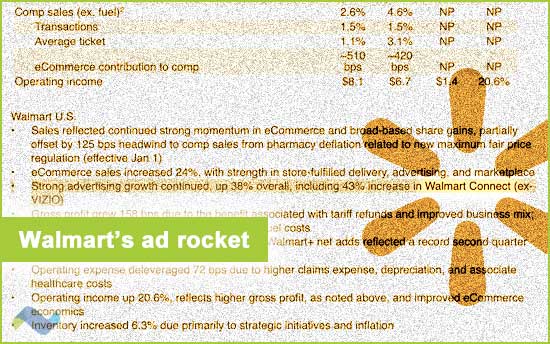
Walmart’s FY Q2 2027 results disappointed investors, but its advertising business continues to rocket.
Global advertising grew 38%, while Walmart Connect in the U.S., excluding VIZIO, grew 43%. Walmart U.S. e-commerce grew 24%.
And Walmart is connecting those numbers to the economics of the entire company.
CFO John David Rainey told analysts that Walmart U.S. e-commerce generated double-digit incremental margins during the first half, driven partly by advertising and membership revenue. He later said advertising continues to grow at roughly a 40% clip on a much larger base and is outpacing e-commerce growth “by a large margin.”
Rainey:
“Our business is fundamentally changing.”
Nearly half of the profit growth came from businesses including membership, advertising and Marketplace, he said. Walmart U.S. operating income grew 10%, excluding tariffs, against a 2.5% U.S. comp.
The recently acquired Vibe is part of the next leg. CEO John Furner said the video advertising platform expands Walmart’s ability to reach advertisers of all sizes through self-service tools while measuring performance against shopping behavior. Rainey said Vibe gives Walmart access to a new market of small and medium-sized advertisers.
Read:
- Walmart FY Q2 2027 earnings transcript (August 20) – Investing[dot]com
- Walmart FY Q2 2027 earnings release – SEC[dot]gov
From tipsheet: Retail media is starting to change Walmart’s financial model. E-commerce creates more digital activity, advertising monetizes it at higher margins and Walmart is now acquiring technology to expand the advertiser pool. The important number may eventually be less how fast Walmart Connect grows than how much advertising changes the profitability of Walmart itself.
COMMERCE MEDIA
Walmart 2 of 2: AI shoppers spend more
Walmart dropped an intriguing data point about Sparky, its AI shopping assistant, in its FY Q2 2027 earnings call.
CEO John Furner said the number of customers using Sparky is up 70% from last year, while customers who use it for shopping spend 40% more per order than those who don’t.
Furner then offered a glimpse of what those shoppers are doing:
“Someone recently shared with me that they asked Sparky for a weekly meal plan of healthy foods with high protein options. Within a few seconds, Sparky shared recipes and meal kits with the ability to add all the ingredients they needed to their basket with one click. Sparky even recognized the ingredients they had recently purchased, both online and in-store, so they did not buy something they already had. It is building trust.”
Read: Walmart FY Q2 2027 earnings transcript (August 20) – Investing[dot]com
From tipsheet: Ding ding ding! This echoes what Albertsons told the Wall Street Journal as we covered on Tuesday. Albertsons said its more comprehensive AI assistants, which can plan recipes and find ingredients, produce about a 26% lift in average order value. Now Walmart says Sparky shoppers spend 40% more per order.
The numbers aren’t directly comparable, and Walmart’s figure doesn’t establish that Sparky causes the higher spending. But the emerging pattern is interesting: AI may be particularly valuable to retailers when it moves beyond product search and starts building the basket.
That’s the middle ground in agentic commerce we highlighted with Albertsons: the human provides the objective and AI does more shopping.
LLMs & CHATBOTS
Developments
- Agentic coding is now multiplayer Introducing Slack Code (August 20) – Salesforce
- Inside the Gemmaverse: Celebrating one billion Gemma downloads (August 20) – Google
- Lawyers square off in fight over voice data used to train AI (August 20) – Reuters (subscription)
GOVERNANCE
1 of 2: Standards are competing
IAB Tech Lab CEO Anthony Katsur writes on LinkedIn:
“A must-read from IAB Tech Lab COO, Shailley Singh.
Too much of the industry analysis around #AAMP versus AdCP starts with a convenient assumption: that the two address different, complementary layers of the advertising workflow.
They do not.”
Read more from Katsur on LinkedIn (August 19).
The distinction, according to IAB Tech Lab: ARTF is the real-time execution component of AAMP, not AAMP itself. Singh argues the broader AAMP framework overlaps significantly with AdCP across planning, discovery, audiences, negotiation, transactions, campaign execution, governance and reconciliation.
Read: “Clarifying the AAMP Scope: Why So Many AAMP vs. AdCP Comparisons Miss the Mark” (August 19) – IAB Tech Lab COO Shailley Singh on LinkedIn
From tipsheet: The agentic advertising standards debate is sharpening. Rather than two protocols naturally occupying different layers of the stack, Tech Lab is making the case that AAMP and AdCP offer competing approaches to many of the same advertising workflows.
GOVERNANCE
2 of 2: Institutions are drawing closer
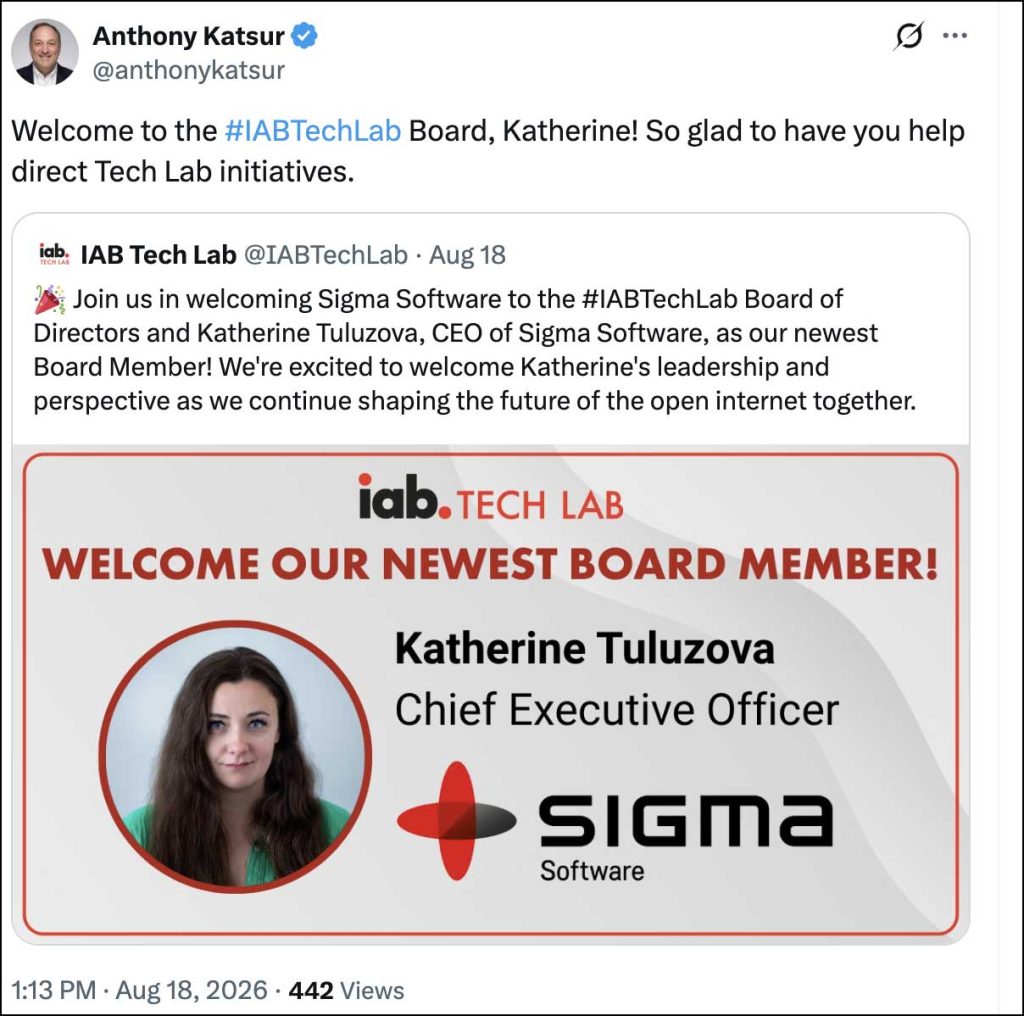
Sigma Software CEO Katherine Tuluzova, who has been leading Prebid’s LLM & Publisher Monetization Task Force since January, has joined the IAB Tech Lab’s Board.
IAB Tech Lab CEO Anthony Katsur said on Tuesday:
See: Katherine Tuluzova – IAB Tech Lab
Tuluzova’s Sigma Software colleague Olga Paramonova is currently the vice chair of Prebid’s Agentic Project Management Committee which was formed in January to manage development of Ad Context Protocol’s Seller Agent, now known as Prebid Sales agent.
From tipsheet: The standards may be competing, but the institutions are drawing closer. Tuluzova’s appointment adds to the personnel overlap between Prebid’s agentic work and IAB Tech Lab, even as AAMP and AdCP increasingly overlap technically.
LLMs & CHATBOTS
ChatGPT ads: 25% biweekly growth since March?
From Adweek on LinkedIn:
“OpenAI said it will expand its ChatGPT ads pilot to 31 European markets, up from its earlier rollout limited to countries including the U.S., Canada, Australia, and the U.K.
The move follows a more than 25% jump in ad revenue since early August, according to enterprise CMO Colin Fleming, who said ChatGPT now reaches 1 billion weekly active users and that 20% show commercial intent.
OpenAI began testing ads in February and has since added tools like an ads manager, conversion tracking, and AppsFlyer measurement, as it looks to diversify beyond subscriptions and strengthen its enterprise business amid heavy losses and IPO preparations.”
Read more. (August 18)
More: “OpenAI Is Taking Its Ad Business to 31 New European Markets” (August 18) – Adweek (subscription)
From tipsheet: That 25% jump may not be an aberration. Hear me out:
- In late March, OpenAI said its six-week-old advertising business had crossed a $100 million annualized revenue run rate (Reuters, March 26).
- Last week, CNBC reported that advertising was “approaching” a $1 billion annual run rate. CNBC (August 14).
Going from $100 million to nearly $1 billion over that period implies average compounded growth of roughly 26% every two weeks — remarkably close to the 25% increase Fleming just reported.
Now let that growth rate work its magic through year-end.
- A $1 billion annual run rate is about $83 million a month.
- If revenue continues growing 25% every two weeks, the annualized run rate would climb to roughly $2.2 billion by the end of September, $3.6 billion by the end of October, $5.9 billion by the end of November and nearly $10 billion by year-end.
- Using roughly the same growth curve between the March and August waypoints, and accounting for revenue as the run rate grows within each month, implies ChatGPT ads could generate around $1.6 billion in total revenue in 2026.
And here’s the rub: OpenAI reportedly projected $2.5 billion in advertising revenue for 2026 earlier this year (Axios, April 9).
Even if ChatGPT ads maintains roughly the extraordinary 25% biweekly growth rate implied since March, our back-of-the-envelope math suggests it would still fall well short of that target. To reach $2.5 billion, growth would need to accelerate further.
PLATFORMS
Better automation requires fewer controls?
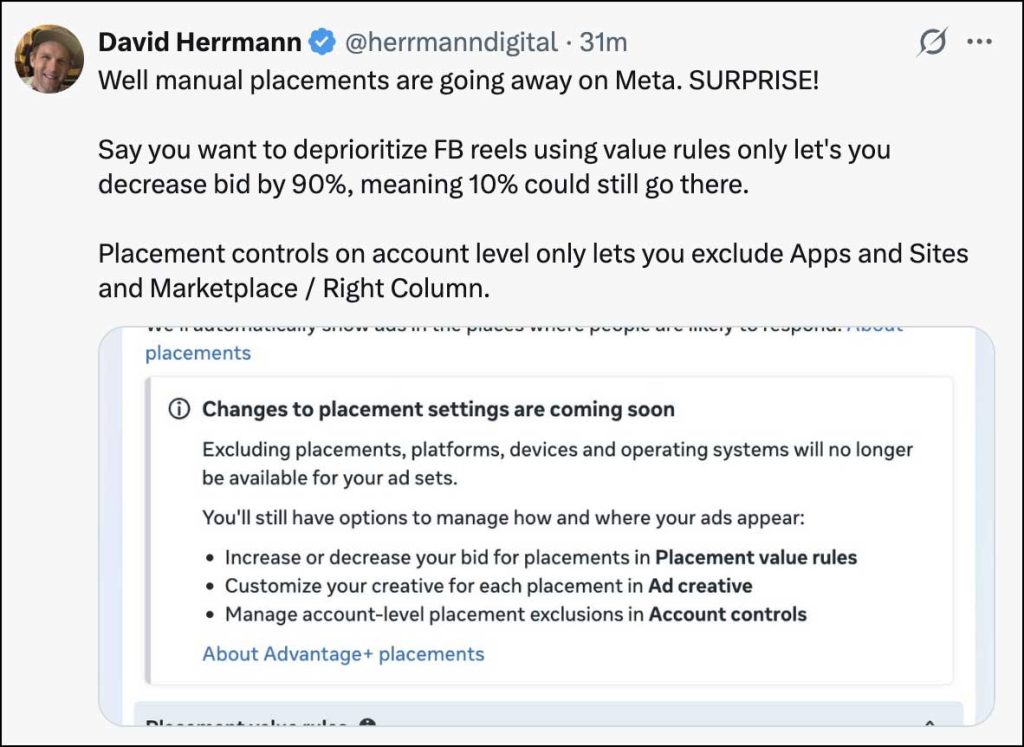
Digital advertising marketer David Herrmann shared on X yesterday new guidance from Meta showing certain placement types will no longer be manually targetable by marketers in Meta’s AI ad platform Advantage+:
From tipsheet: Controls are transitioning to AI. We’ve seen the same direction of travel at Google when it announced last week it was stripping out campaign-level language targeting.
The question is whether better automation actually requires fewer controls.
Related: “In order to simplify bidding and make it easier for advertisers to achieve success on the Microsoft Advertising platform, we will be removing the ability to add a Max CPC to new campaigns using stand alone Max Conversion, Max Conversion Value, and Max Click bidding strategies October 1, 2026.” – Navah Hopkins, Ads Liaison, Microsoft on LinkedIn
AGENTS
Salesforce gives the campaign a goal
Salesforce is previewing a Marketing Goals Agent (currently a pilot) that turns a marketer’s goal, budget and audience into a campaign strategy and then optimizes against the goal.
Salesforce SVP Strategy Martin Kihn writes (lightly edited):
“The marketer defines a goal for the campaign (clicks, sign-ups, general engagement, etc.), along with a budget and who can see it.
The agent suggests a strategy that you can change or approve (human-in-the-loop) or simply monitor (human-on-the-loop).
Suggestions include target audience, message selection, channel selection and timing.
So this is AI-driven, human-gated campaign creation.
The Agent is designed to be self-optimizing based on observed performance, so it gets better — closer to the goal — with each cycle.
Once it’s activated and approved, the Agent is supposed to run autonomously within the guardrails you’ve set.”
Read more on LinkedIn. (August 20)
More: Salesforce Puts an AI Marketing Team in Every Marketer’s Hands (June 3) – Salesforce
From tipsheet: The campaign brief is starting to become executable: the marketer defines the objective and guardrails, while the agent figures out how to get there. It’s the same basic idea behind Albertsons’ AI shopping assistants/basket building: give AI the outcome, not just the task.
PEOPLE MOVES
Now hiring
-
“I’m thrilled to share that I’m joining Quantcast to lead the North America Corporate Sales team.” (August 20) – Former Taboola and Yahoo exec Michael Colgan on LinkedIn
MORE
- Omnicom Offloads Hundreds of Staffers Who Built Its AI Platform to Third-Party Contractor (August 20) – Adweek (subscription)
- Meta launches a business agent for ad campaigns (August 20) – Analyst Eric Seufert on Mobile Dev Memo (subscription)
- The Agency Black Box Is Breaking. Horizon Media’s Bob Lord Explains Why (August 19) – AdExchanger
- Make AI Max work for your business with new testing and planning tools. (August 20) – Brandon Ervin, Director of Product Management, Search Ads on Google Ads & Commerce blog
- NBC News strikes ad sales deal with Taboola for programmatic display ads (August 19) – Axios