
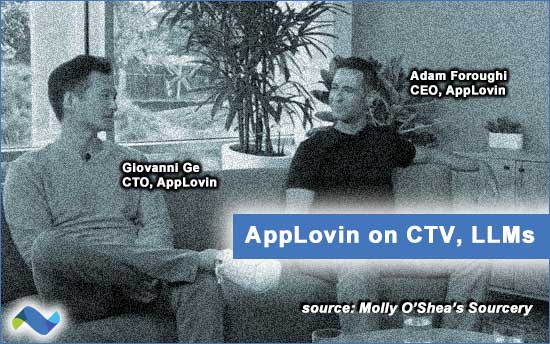
AppLovin is watching advertising opportunities in LLMs, but CEO Adam Foroughi sees a more natural extension for its ad engine in connected TV.
Foroughi tells Sourcery’s Molly O’Shea in a video interview that chatbot advertising today looks more like search: A consumer expresses an intent and an ad helps close the transaction. AppLovin’s system is built around a different problem [59:15]: “We’re trying to go show consumers things that they don’t know they want to go get,” he says.
That makes CTV interesting. AppLovin is doing R&D on extending its platform to television, where Foroughi sees the same discovery problem: The viewer hasn’t expressed purchase intent, but an ad can start the journey and AppLovin can try to predict what will convert. Open-web video is another potential expansion area.
Watch: “How AppLovin Built a $100B Ad Machine” with Adam Foroughi and Giovanni Ge, CTO of AppLovin (August 14) – Sourcery with Molly O’Shea on Substack
AppLovin has already put CTV on its supply-expansion roadmap, although Foroughi said on the company’s Aug. 5 earnings call (transcript) that it isn’t ready to make the move yet. He laid out the sequence as non-gaming apps first, the open web second and CTV third.
From tipsheet: AppLovin is looking beyond mobile for places where its ad engine can do what it does best: predict what people might want before they go looking for it. Search and LLM ads can harvest expressed intent. CTV gives AppLovin a chance to create discovery before intent exists.
From tipsheet #2: Is this a feint? I wouldn’t rule out AppLovin making an exclusive deal with ChatGPT, Claude or Perplexity, or assembling a collection of smaller AI players into a new advertising network. Today’s LLM ads may look too much like search for AppLovin. The conversation layer itself could still become distribution for Axon.
MEASUREMENT
Anthropic’s marketing measurement stack
No ads in a chatbot yet. But…
Anthropic is bringing marketing mix modeling in-house as it builds its marketing measurement operation “from the ground up.”
Read: “Data Scientist, Marketing” – Anthropic
LLMs & CHATBOTS
Reddit fruitlessly warns marketers
The effects of generative engine optimization (GEO) are being felt on Reddit. Brands want more influence over Reddit conversations now that those conversations can shape what AI recommends and, as you might guess, Redditors are pushing back.
The Wall Street Journal’s Katie Deighton points to jewelry company Brilliant Earth, which sought a “Reddit strategy manager” to shape how the brand appears in conversation “that cascades across search engines, LLMs, and customer decision-making.”
Noting the job posting, a moderator of r/jewelry said, “If there’s a sudden wave of positive Brilliant Earth content on here, it might not be coincidental.” The moderator then added that Reddit is “possibly the very last place on the internet for genuine company reviews and feedback.”
For its part, Reddit Chief Communications Officer Adam Collins warned brands against trying to “hack the results on another platform,” saying it will “usually…wind up with unhappy results for you.”
Read: “Brands Suddenly Care About Reddit. Redditors Don’t Return the Feeling” (August 14) – The Wall Street Journal (subscription)
From tipsheet: You gotta be kidding me. This is nothing. Creating conversation for GEO purposes is going to be a much bigger business than it is today. There’s too much at stake if conversational media continues to grow like it has. Hence the birth of advertising to the same bots that are reading the web on behalf of AI systems.
Related: GEO gets a decay curve: “This morning, Ravish Agrawal at Gamma said he wished Profound could show the “lifetime” of a citation and its half-life. So we shipped it.” (August 13) – James Cadwallader, CEO, Profound on LinkedIn
PLATFORMS
Apple making moves
- “Introducing Apple Ads Platform API…” (August 14) – Blake Reese, Director, Product Management, App Ads & Local Ads at Apple on LinkedIn
- New Apple Ads Platform API – Apple
- Apple Maps Rolls Out Ads, Targets Madison Avenue (August 14) – MediaPost
PLATFORMS
Google strips out an advertiser signal
“Want to learn English?”
Starting in September, Google Ads will remove campaign-level language targeting for Search ads in Search and Performance Max campaigns, replacing another advertiser-set parameter with Google’s automated decisioning.
Google Ads Product Liaison Ginny Marvin said on LinkedIn Thursday the setting has become “redundant” because Google already determines language using signals including “the language of the ad creative and landing page, search term language and the user’s language settings and preferences.”
“The system will prioritize ads that match the user’s search term language,” Marvin writes. When multiple campaigns or ad groups in different languages are eligible, Google will use “AI-driven ad and asset group prioritization” to select what it considers the most relevant language based on the user’s search context.
But a thoughtful discussion in the comments surfaces a harder question: What if the advertiser is using the language setting to communicate something Google doesn’t interpret as language?
Marketing specialist Manuel Lodi offered an example of a campaign targeting Italian speakers even though its keywords, creative and landing page are all in English: “The Italian language is inserted precisely to avoid useless leads and wasting budget.”
Read the post on LinkedIn. (August 13)
More:
- About language targeting – Google Ads Help
- About ad group and asset group prioritization within a Google Ads account – Google Ads Help
From tipsheet: This is another example of what we mean by learning (i.e. intelligence): the accumulated understanding of what works, for whom and under what circumstances that improves the next decision. Google is restructuring campaign controls around the signals its AI can interpret. But the advertiser has learning, too. Lodi’s example shows the tension: the human may know a distinction matters that isn’t apparent from the signals Google uses to make its decision. As controls disappear into AI-driven decisioning, whose learning determines the next decision?
“Gooooooool!”
AGENTS
Agentic buying meets its SPO test
“It will take some more time before AI agents are a seamless part of the modern media buying process, Andrea Kwiatek, director of strategic partnerships at the indie agency Goodway Group, told AdExchanger. To help move the process along, Goodway Group is actively testing agentic media buying. The tests involve feeding buyer agents a client’s campaign media briefs and assessing which audiences and inventory sources the seller agent recommends, Kwiatek said.”
Read: Agentic AI Is A Shiny New Object, But Supply-Path Optimization Is A Reality Check (August 14) – AdExchanger
SEARCH
GEO pizza has many ingredients
On Friday, Brian Stempeck, CEO at GEO firm Evertune shared a graphic on LinkedIn saying: “We worked with The Economist to identify what AI models think are the best pizza places in Rome. As TikTok virality drives longer lines at some restaurants, AI is actually having the opposite effect – creating a broader range of recommendations, customized to the person asking.”
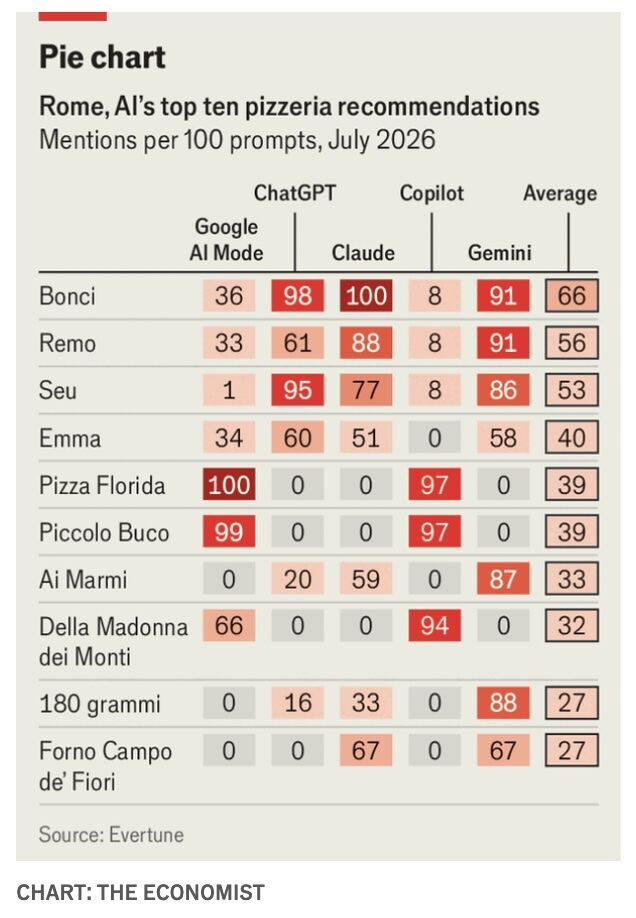
Look at the differences between models. Pizza Florida appears in 100 of 100 Google AI Mode prompts and 97 of 100 Copilot prompts, but not once in ChatGPT, Claude or Gemini. Meanwhile, Seu pizza appears optimized for the AI chatbot troika.
For marketers, that’s the point: There isn’t one AI recommendation market. Visibility can vary dramatically depending on which model a consumer asks.
Read: “Can AI save tourists from the TikTok herd?” (August 13) – The Economist (subscription)
From tipsheet: Welcome to the supreme pizza challenge of GEO measurement.
MEASUREMENT
Are platforms harvesting demand?
Are advertising platforms getting better at creating incremental demand, or getting better at harvesting demand that already exists?
Andrew Lipsman argues in Media, Ads + Commerce that measurement helps keep advertiser dollars concentrated with Google and Meta even when the outcomes may not be incremental.
“Google and Meta are often the number one and two line items in an advertiser’s budget, but should they be? Probably not. However, dollars follow measurement, and taking credit for non-incremental outcomes has been the duopoly’s core competency for a long time.”
Lipsman points specifically to Google’s benefit from last-click attribution and questions whether Meta’s 28% Q2 ad revenue growth can really be explained by AI-driven improvements in targeting efficiency.
Read: Where Will In-Store Retail Media Investment Come From? (August 14) – Andrew Lipsman on his Media, Ads + Commerce Substack (subscription)
From tipsheet: Anybody else noticing the “speed” trend? Speed the measurement, speed the learning (i.e. intelligence), speed the optimization. But faster isn’t necessarily better if AI is rewarded for attributed rather than incremental outcomes. A faster loop could just make it better at harvesting existing demand.
LLMs & CHATBOTS
Developments
-
- OpenAI CFO Friar tells investors that enterprise business now bigger than consumer by revenue (August 14) – CNBC
- “Rolling out over the next few days, you can decide if your image, video, and music creations made with Gemini will have visible watermarks.” (August 14) – Google Gemini on X
- How Claude’s text watermark works (August 14) – Anthropic
MORE
- Webinar: “How To Build A Marketing Strategy With ChatGPT Ads” with OpenAI VP of Monetization Benji Shomair on August 20 – StackAdapt (registration)
- “AppLovin’s Play To Reach Non-Gaming Advertisers” (August 14) – AdExchanger’s The Big Story podcast
- Spotify’s GLIDE: generative retrieval for podcast discovery (August 14) – Eric Seufert on Mobile Dev Memo (subscription)
- “Tubi Is Testing Whether Better Metadata Can Make CTV Inventory More Valuable” (August 13) – The Streaming Wars
- AWS launches a free, 40-course learning path for AI-powered video advertising and operations (August 13) – Amazon Web Services