
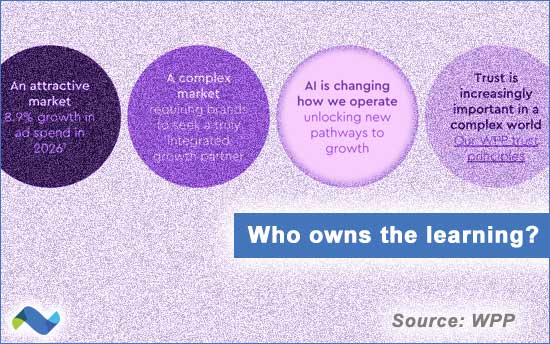
WPP CEO Cindy Rose is drawing a distinction between two sources of marketing advantage: identity and intelligence.
“For the past 20 years, the marketing industry has built its advantage around identity-based consumer targeting,” Rose said during WPP’s H1 earnings call last week.
She continued:
“But marketing in the era of AI has changed and the industry has been slow to adapt. Identity remains a useful starting point, but identity alone cannot tell us how someone’s preferences, beliefs or behaviours are changing in real time or what they may do next. Marketing has entered the era of intelligence, and that has significant implications for brands.”
WPP’s answer is to combine brands’ data with live signals from more than 350 data partners through WPP Open. (tipsheet interview, January) Rose said AI can turn those signals into intelligence unique to each brand, helping predict behavior and identify new audiences. Underlying client data remains in the client’s environment through WPP’s InfoSum technology, which WPP acquired in 2025.
Read:
- WPP publishes its Interim Results 2026 (August 6) – WPP
- WPP H1 FY2026 earnings call transcript (August 6) – WPP (PDF)
More:
- “It will take a few years”: WPP CEO Cindy Rose says outcome-based pay is still years away (August 6) – Digiday (subscription)
- WPP Is ‘On Track’ With Turnaround Plan, as Revenue Drops 5.6% in First Half of 2026 (August 6) – Adweek (subscription)
From tipsheet: The last era of marketing competition centered heavily on who owned the identity graph. The AI era may increasingly be about who owns the learning.
WPP is explicitly trying to keep that intelligence with the advertiser, and Rose said WPP’s architecture reflects a belief that competitive advantage should sit with clients.
WPP doesn’t need to own the client’s intelligence to create value from it. Instead, the agency can provide the infrastructure, signals and AI that help the client continuously build its own.
MEASUREMENT
Google: From insight to action
Yesterday, Google announced new AI and agentic capabilities across Google Ads and Google Analytics, extending Ask Advisor, its in-product AI agent, further into marketers’ measurement and decision-making workflows.
Google Ads is rolling out personalized AI insight cards and a prompt box for custom analysis. In the coming weeks, Google Analytics will add natural language dashboards that turn prompts into visual reports and explanations of why performance changed, with the ability to carry that context into Ask Advisor for further analysis. Benchmarking against anonymized performance from similar businesses is expected later this year.
Built with Gemini, Google says the new tools will “help marketers move from insight to action even faster.”
Read: “Evolve your marketing with new AI tools” (August 10) – Google
From tipsheet: Another example of feedback loop compression. Google’s Nick Fox emphasized the importance of feedback loops in a May tipsheet interview. AI can identify a change, investigate why it happened and shorten the path to what the marketer does next. Meanwhile, the distance between measurement and decisioning keeps getting smaller.
COMMERCE MEDIA
Retail media moves into the recommendation
AI shopping assistants are starting to produce sales for major retailers, reports Adweek’s Lauren Johnson. Less than a year after retailers worried that AI assistants could disintermediate ecommerce, companies are building assistants of their own. Most of the assistants Johnson examined already include advertising, opening a new surface for retail media.
Read: “How AI Assistants Are Driving Sales for 6 Big Retailers” (August 10) – Adweek (subscription)
From tipsheet: The interesting shift isn’t simply from search boxes to conversations, but where advertising can enter the decision.
Traditional retail media lets brands pay for visibility on a digital shelf or search results page. An AI shopping assistant recommends what to buy, creating the possibility of moving upstream, from sponsoring shelf position to sponsoring consideration within the recommendation experience.
That makes ownership of the recommendation layer more valuable.
LLMs & CHATBOTS
Researchers audit the early days of ChatGPT ads
Last week, an independent academic audit offered a look back at how advertising first appeared inside ChatGPT shortly after the ad product’s launch.
Researchers Sorelle Friedler, Danaé Metaxa, Emma Lurie and Ro Encarnación ran 91 simulated U.S. accounts from February 6 through May 20, recording 3,602 ads from 191 advertisers across more than 127,000 conversations. OpenAI began testing ads in the U.S. on February 9. The researchers observed ads primarily from March 8 onward. Among accounts that received advertising, the median account saw an ad after 24% of subsequent prompts.
What users were talking about mattered. Prompts involving purchasable products, fitness and cooking generated relatively high ad rates, while categories including relationships, politics and mental health generated relatively few or no ads. The researchers also found that accounts associated with lower-income ZIP codes were more likely to receive ads, though the audit could not determine what caused the difference or whether income itself played a role in ad delivery.
Read: “The Beginning of ChatGPT Ads” (August 5) – arXiv
From tipsheet: This is a snapshot of ChatGPT advertising in its earliest months, not necessarily a description of the product today. OpenAI has been rapidly adding capabilities since the research was conducted.
But the audit captures an important feature of the ad product from the beginning. Search advertising monetized the query. Conversational advertising can potentially monetize something broader: the intent embedded in the problem a user is trying to solve.
Someone asking how to fix a dishwasher, clean a bathtub or make a particular meal isn’t necessarily searching for a product. But the conversation can reveal a commercial need anyway.
LLMs & CHATBOTS
Developments
- Meta introduces Muse Glimmer, an open model for always-on agents (August 10) – Meta AI Research
- “The Future Is for Everyone” (August 10) – Mark Zuckerberg on personal superintelligence and Meta’s vision for AI – Meta
- Anthropic taps Macquarie, GIC for dedicated data center infrastructure (August 10) – Macquarie
PEOPLE MOVES
Now hiring
- “After 4 years building Uber Advertising, I am thrilled to be joining PubMatic as Global Chief Revenue Officer…” (August 10) – Megan Ramm on LinkedIn
- Former Verve and Moloco executive David Simon joins TripleLift as its new Chief Revenue Officer (August 10) – TripleLift CEO Dave Helmreich on LinkedIn
MORE
- People Inc. explores licensing unpublished reporting data to AI companies, says Jonathan Roberts (August 8) – The Wall Street Journal (subscription)
- Ari Paparo: “The Week the Open Web Died” (August 10) – Marketecture
- OpenAI is building out its SMB advertising operation (August 10) – Digiday (subscription)
- Article preview: “There is a clear connection among brands adopting AI for marketing and search strategies, and ad tech firms developing agentic AI trading tools, and Big Tech platforms developing LLMs for advertising and commerce.” (August 10) – Garett Sloane, senior editor of technology and AI, Ad Age on LinkedIn
- A New Bill Targets ‘Bad Bots’ That Scrape Websites Without Permission (August 10) – AdExchanger