
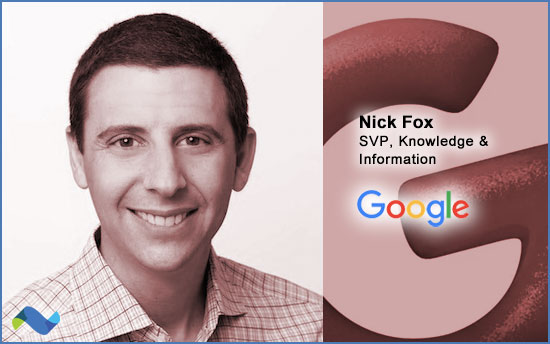
As a veteran of Google and its transformation into the advertising and information powerhouse it is today, Google SVP of Knowledge & Information Nick Fox has had a front-row seat to some of the company’s biggest shifts — from the evolution of Search and programmatic media to the rise of AI-driven discovery and commerce.
Now Fox finds himself at the center of another major platform shift driven by AI agents.
At Google I/O and Google Marketing Live this week, Google outlined an agentic future where conversational interfaces increasingly shape how people search, shop and interact with advertising.
Fox spoke to tipsheet yesterday about Google’s strategy, including:
- Fox’s standout product announcement
- Search vs. the Gemini app today
- How Search and Gemini may differentiate in five years
- The evolving role of the marketer
- Is a commercial OS of sorts emerging from Google?
- Preserving utility and trust as ads become more conversational
- What AI agents mean for commerce
- Google’s definition of agentic commerce
- “Direct Offers” and merchandising versus ads
- Universal Cart and the potential for ads
- Google’s AI-generated creative with Asset Studio
- AI Max, Performance Max and Demand Gen
Scroll down for the interview, which has been lightly edited for clarity.
tipsheet: There was a cascade of announcements coming out of Google Marketing Live today. What would you say is the highlight for you?
Nick Fox: I’d say both today, as well as yesterday at Google I/O, the big thing is how Gemini is supercharging so many parts of Google’s products and business.
A big part of Google I/O was about upgrading Search, Gemini app, Antigravity and Gemini 3.5 Flash – obviously, that’s a big deal.
Also, our new search box really leans into this new AI search era — the evolution of Search from a product that has AI features in it to being AI search through-and-through is a big moment. The search box reflects that shift.
Fast-forward to Google Marketing Live today, you’re seeing how Gemini is supercharging the advertising business and its products as well.
I’m also excited about our new ad formats for AI Mode that allow advertisers to tap into this AI search opportunity — but it was more than that. We talked about how Gemini is supercharging Demand Gen and ads on YouTube, and enabling campaign creation and creative generation. It really is across the board and that’s the moment that we’re in.
At Google I/O yesterday, VP of Search Liz Reid said that “Search is AI Search now.” At the same time, the Gemini app continues evolving into a broader assistant and execution layer which was visible in yesterday’s agentic announcement. How does Google think about the long-term relationship between Search and the Gemini app?
Well, we have two products: we have Search, and we have the Gemini app, and both are evolving. We’re excited about both of them.
Search, as you mentioned, is evolving from search to AI search. What’s unique about our approach is that it’s not AI or search, it’s not AI or the web, but really it’s bringing those together. We are deeply committed to the web, and our view is that the web — and the connection to the web — is what makes a search engine so powerful.
But we can really make that much more helpful for users by bringing AI into that experience. So that’s really what we’re doing with Search. It’s still Search at its core.
The Gemini app is your assistant — it’s with you as you go about your day, and it’s helping you get things done. We talk about it as being personal, proactive, and powerful, but that’s really pushing forward on the system that’s helping you get things done as you go about your day.
There is definitely some Venn diagram overlap between the two products, which we’re okay with. We want to make sure that we’re meeting users where they are, and if a user is doing a more informational, search-y kind of question in the Gemini app, we’ll support that. We won’t say, ‘No, I can’t help you with that, you’re in the wrong product.’
Similarly, in Search, if you’re trying to get something done — make a purchase, book a flight, things like that — we also want to help you get things done in Search. So it will be assistive as well.
So, there’s overlap in the products, but they have different ‘north stars.’ One is really focusing on being a search engine, and the other is being your personal assistant.
Five years from now, what do you think fundamentally differentiates a search interaction from a Gemini app interaction? It just seems like there’s going to be one “search/Gemini box” at the top.
Five years is a long time. But I think there’s a number of ways this can evolve.
I expect there will still be some notion of a search engine and some notion of an assistant — and so that’s why we think of these as ‘north stars’ in which they’re evolving.
But let me speak for Search for a bit. Search will become more personal over time. We announced “Personal Intelligence” earlier this year. It’s been amazing how much it improves the experience because users who opt in can connect Gmail, Calendar and Photos to search. And Search is able to bring in insights as well as make the responses more useful based on that personal contextual information.
At Google I/O, we talked about how Search will become more agentic. We’ll bring agentic experiences into Search. One of the things I was most excited about is what we call “information agents,” which is basically having search do the searching for you, behind the scenes, 24/7.
An example we gave was when new sneakers might come out. The power of information agents is that it’s searching behind the scenes all the time for you — and it comes back to you and alerts you the moment that something happens. It gives you both context around what’s happened as well as helps you dig deeper and reads additional resources on it.
The search of five years from now will look quite different from the search of today. We’re already starting to see that evolution toward Search becoming more agentic, more personal.
Thinking about marketers and how their role is evolving, marketers are seeing AI systems increasingly generate creative, optimize targeting and make real-time decisions. What’s that role that you all see for the marketer?
I’m a big believer in people. Even as AI becomes more helpful, more useful, what we’re doing is equipping people with tools that give them superpowers. I don’t think the marketer of the future goes away. The marketer of the future is way more effective at what they do.
What the marketer is doing is saying here’s the creative direction we want to go, here’s our goals — they’re setting the boundary and saying, “I want to reach these people.” And then the tools are helping them achieve that… particularly as we go through this AI search transition. Queries are getting longer and more complex. There are follow-up queries. It’s impossible to reach users in all those moments without automation and AI-powered tools to help. And so that’s what we’re doing. We’re equipping marketers with the tools to enable them to do their jobs and reach users in this new moment.
When you step back and look across all the channels Google touches as it relates to ads — such as Search, Gemini, Maps, Commerce, Ads, AI Mode, UCP — Google increasingly feels less like a collection of products and more like a connected commercial operating system of sorts coordinated by AI. How do you see it?
The way we view it is users shouldn’t need to be thinking about exactly where they are within one of our products. If users feel the seams of our products, we’re letting the user down in some way.
It’s actually one of the reasons personal intelligence is so compelling. If I do a search that could be helped with something that’s in my Gmail, I shouldn’t have to go to my Gmail to go find that. Being able to pull that directly into Search is actually really useful. Likewise, if I’m looking to buy a product, I shouldn’t need to go to some other site or Google experience. Rather I should just be able to look for that product within Search, and then through UCP and other tools, we should bring that in and make it very easy to find what I’m looking for — and then check out.
So that is a big part of our approach right now: break down the seams across the products and just make it work for users, so they can find whatever they’re looking for and get whatever they want done.
A similar example could be with what we announced yesterday with Gemini Spark. If I’m looking to write an email, I should be able to do that directly from within Gemini Spark. I don’t necessarily need to go out to Gmail to do that and can pull information from my calendar, my photos or my docs or drive, or whatever it might be. All of these things are coming together in a cohesive way for users. They don’t have to think about what product they’re using, they just have to think about the tasks they’re trying to get done.
Same question from the marketers’ perspective — is what Google is building a commercial operating system of sorts? For example, can they come with their budget and their idea for selling a product and just hand it over to Google which will take it from there and generate the transaction?
I would say marketers are on a spectrum of where they want to be with automation.
For sure it should be the case that the marketer can come and say, “Here’s my catalog of products, here’s my budget, or here’s my ROI goal,” and Google just does the rest. Google should find users whether they’re in Search, YouTube or elsewhere and show their ads to them in the moment that it matters. Many advertisers are interested in that opportunity. We provide tools across a spectrum of control but, ideally, they should not need to think about all the details of how all this works. We should simply return value for them.
Regarding some of the new ad formats such as highlighted answers or conversational answers, these appear to be more like AI-assisted recommendations than traditional ads. This raises questions around consumer trust. How does Google preserve utility and trust as ads become more conversational and recommendation-driven?
Trust is the foundation of everything we do. It’s the foundation of how we’ve approached search and approached advertising in our search experiences as well. We are operating with a set of core principles starting with ads that are always clearly marked and clearly separated.
If we’re providing a recommendation, it’s clear whether that recommendation is organic or if ads play a role. It’s also really important that the ads are relevant. If a user is looking for a certain type of product or service, and we show an ad for something that’s completely unrelated, that’s not going to work. But we have 25 years of building ads into the search experience in a way that is helpful and users appreciate. It helps the user achieve what they’re trying to get done, and so we’re extending those same principles to ads in our AI search experiences.
This week, Google has discussed agents (for Search and Gemini), Universal Commerce Protocol (UCP) and Universal Cart as foundational infrastructure for agentic commerce. Can you discuss the future you all are seeing for AI agents as it relates to the future of commerce?
First, I’m super excited about the agentic future of commerce.
I see two main parts: how you figure out what to buy and the other is how you transact. Both can be supercharged through this agentic moment.
On the “what to buy,” for years and years we’ve been using drop-downs, filters and short keyword phrases to specify what we’re looking for. What I think is so exciting about this moment is people can just type in exactly what they’re looking for by saying who they are, what the specific problem is, what they’d like and “make sure it’s not too expensive and in this color.” The user provides the full detail of what they actually want, which is what they have in their heads.
People can now express that through their queries and do follow-ups as they’re seeing what’s coming back. I think that dramatically makes it much easier to find what one is looking for — and we’re already well along our way of doing it.
Also, once the user finds what they’re looking for, it can be a burden to check out. They may be on a site that they haven’t used before and they’re giving your payment information, their address, all this kind of stuff for the first time. All of this leads to a burden for the user. And oftentimes, users abandon at that point. Abandoned carts are a big thing — that’s lost opportunity for users and businesses.
So that’s where UCP enables us to make that experience much better. The part that connects the user and their abandoned cart is the Universal Cart, which we announced on Tuesday. It will be universal across many Google products including search, the Gemini app, Gmail, YouTube and merchants so that as you’re going about your shopping journeys, you’re able to add stuff to your cart and check out with ease through UCP. This agentic moment will make shopping way more effective and powerful. I think it’ll also be more fun.
How does Google define agentic commerce? Agentic commerce has been defined by some as, ultimately, the agent making decisions for the consumer including the purchase. Is that a future that Google is driving towards? How do you all think about an agentic commerce definition and/or that use case, in particular?
I expect that for the majority of the things that we buy as humans, we will continue to be in the loop. I think people actually like shopping. People like picking out their clothes, a car or a hotel because it’s a reflection of who we are and how we want to show up. It reflects what experiences we want to have.
For most things in agentic commerce, it’s about making it easier to specify and find what you’re looking for, and easier to transact.
I think a world in which you’re handing off all the decision-making in terms of taste and choice and all of that — it might exist for commodity items like paper towels but for the bulk of the things, or at least for the high-value things we’re buying, a human will still be heavily involved in that decision making.
Moving to updates to Direct Offers, which was originally announced in January, there’s certainly an advertising angle to direct offers, but it appears to be more closely aligned with merchandising and commerce orchestration systems. How does Google think about the evolution of offers and promotions in AI native shopping environments, especially as you compare it to what has been, classically, an ads solution?
Where Direct Offers came from is people like saving money — and the insight was, as users provide longer and more specific questions, what’s the right way for a retailer or merchant to reach that user? The thought we had was if you’re able to bring together specific highly targeted offers for the moment where the users are looking to buy, it could be highly valuable for the user and for the merchant to win that purchase, that transaction.
More broadly, as we approach modernization of these new experiences, we’re not just taking an existing ad product and bolting it on by saying what worked before will work here. Instead we’re using it as an opportunity to rethink these experiences from a user, retailer and marketer point of view. What actually makes sense for users, retailers and marketers? Then build toward that future.
Along those lines with Universal Cart, there appears to be an opportunity to have advertising integrated. Is that a possibility?
We’ll see. We haven’t announced anything along those lines at this point. Merchandising at the cart stage is, for sure, interesting for retailers, but exactly how that evolves is TBD.
Thinking about the creative side to this, and Google announced updates to Asset Studio and continues to innovate on the creative side. Thinking back, we were once in a dynamic creative optimization (DCO) phase and now we’ve evolved to this AI moment. How much further can creative innovation go?
I think it goes pretty far. What Gemini and these models are really good at is generation of content. I think it’s reasonable to view it as an extension of dynamic creatives, but taken to a whole other level.
Does Google think about creative generation in the context of a closed loop system?
The feedback loop is important. One of the hallmarks of Google’s ads approach is showing ads that are more likely to perform well for users and advertisers and understanding likely click and conversion rates. So, those feedback loops are a core part of how it works and all of that goes to the ‘next level’ through this moment that we’re in.
AI Max, Performance Max and Demand Gen – can you talk through the ‘division of labor’ there and where do you see that going?
AI Max and Performance Max are really optimized around enabling these AI experiences. AI Max, in particular, [is focused on] AI experiences in Search.
For example, the new ad formats that we announced today are available within AI Max and Performance Max. It’s not a full reinvention of the campaign structure and campaign type, but it’s an easy way for marketers to tap into this AI opportunity within Search.
Demand Gen does the same for YouTube and those non-search experiences.
So that’s how we see it evolving: both are getting AI power and massive improvements through our Gemini models, which make them that much more effective.
What we’re trying to do is enable marketers to reach users at the moment that they’re most relevant to them with the least amount of work possible on the marketer’s end.
Does it make sense to bring AI Max, Performance Max and Demand Gen together at some point?
We’ll see how it evolves. We’ll listen to the market for a view back on it.
For more on Google ads, marketing and commerce product updates released yesterday as part of Google Marketing Live, read:
- “Google Marketing Live 2026” – Google Ads & Commerce blog
- A new generation of ads for the AI era of Search – Google Ads & Commerce blog
- Meet Ask Advisor, your new AI-powered collaborator – Google Ads & Commerce blog
- Turn data into decisions with unified measurement – Google Analytics Products
- Qualified future conversions – Accelerate with Google
- Asset Studio is entering a new era of AI-powered creativity. – Google Ads & Commerce blog
- Fuel your next wave of growth on YouTube with Demand Gen – Google The Keyword blog
- How we’re helping retailers thrive with new Universal Commerce Protocol features and AI tools on Google – Google Ads & Commerce blog