
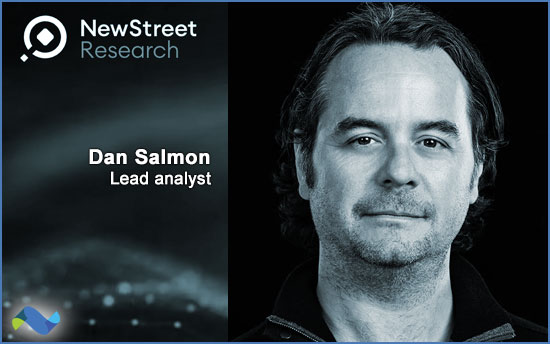
Dan Salmon is one of Wall Street’s most highly-regarded voices at the intersection of advertising, tech and communications. After starting his career as an equity research analyst at Citigroup and Bank of Montreal (BMO), Salmon now leads a team of analysts at independent firm New Street Research.
As earnings season begins this week, he and his team will dig into the financials of companies like Google, Meta, Amazon, The Trade Desk and more while delivering insights and recommendations to investors.
The AI opportunity in advertising and marketing — as it has been for many quarters — is front and center for Salmon, who is seeing rapid transformation across his coverage.
Salmon spoke to tipsheet on Friday about:
- The Trade Desk, Google, Amazon and their DSPs
- ChatGPT ads’ potential impact on the ad market
- The most important protocol in advertising
- TPU chips and translating it into ad performance
- AI capital expenditure (CapEx) and advertising
- LLMs and where the value will be captured
- Salmon’s long-term ‘call’ on advertising
- The opportunity for independent ad tech
Below is the interview, lightly edited for clarity.
tipsheet: How do you think about The Trade Desk’s AI ad platform, Kokai, in the context of competitors such as Google DV360 and Amazon DSP today?
Dan Salmon: The first thing I think of regarding AI tools for Amazon and Google… are not their DSPs. I think of things like Google’s Performance Max.
It’s worth noting that Amazon’s Performance+ is embedded into their DSP, which I always thought was interesting. And that’s quite different than Google’s Performance Max — which is distinct from Google’s DV360.
Looking more closely at what Amazon’s been doing with their DSP lately — and like everyone else in ad tech — they’re looking for agentic capabilities and using machine learning to apply to their audiences for better targeting and measurement.
It’s important to remember Kokai was The Trade Desk’s upgraded platform — the company typically refreshes its platform every two to three years. Solimar was the last one before this. Their AI modules are their Koa AI trading modules. They’ve been embedded into Audience Unlimited and their Trading Modes.
All three of the companies will be racing to put AI capabilities into their DSPs.
Amazon and Google have certain advantages being frontier labs — especially Google which is one of the leaders. And both of them have certain advantages by owning their own data centers although Trade Desk is doing more investment in their own data centers and custom AI infrastructure. There are certain structural advantages in AI that companies of Google and Amazon size will have. But small players can certainly develop their tools as well.
The bigger thing about Trade Desk, Amazon and Google is less about comparing their products to one another, but more around where Trade Desk CEO Jeff Green continues to state publicly: he thinks Google and Amazon are similar and both just want to favor their own first-party inventory. He even went so far as to suggest last quarter that he felt Amazon was not as good a competitor as Google and never will be. That is quite something to hear.
But the basic comparison of the two of them (Google and Amazon) is a stretch. I think they have very different operating strategies. They both have exclusive inventory.
The key is Amazon is still very supply constrained relative to their demand. Whereas Google is not because they own YouTube and have essentially infinite supply — and similar to Meta — they have tons of time spent, lots of opportunities to keep growing it on multiple screens and add ad load.
Amazon doesn’t have that opportunity at that sort of scale. Prime Video is a well-watched service, but nowhere near at the scale of YouTube because of the focus on professional content, not user-generated.
There’s just a strategic difference between Google and Amazon in that sure both of them will favor their owned-and-operated inventory, but Amazon just doesn’t have that much of it relative to Google, and that strategically incentivizes them to compete more in the DSP space, where they might have to give up economics when they’re working with other players. But it’s what keeps their revenue growth going. Off-site ad sales are a bigger and bigger part for Amazon these days.
What’s your view on OpenAI’s ChatGPT ads and its potential impact on the broader advertising market?
First, recent reporting on their ambitions of over $100 billion by the end of the decade — that’s incredibly ambitious. I am fairly certain a ramp to $100 billion in advertising would be quite a bit faster than any company in history.
Certainly, they’ve got momentum in user growth and engagement by being the first mover in the category of chatbots. Any day now we should probably hear that they’re over a billion weekly users after sitting on 900 million for a little while. There’s huge scale there.
What we are finding out about AI search, chatbot ads or ads that are appearing in these more conversational experiences — you’ve heard this from Google, Microsoft and some of the agencies — is that you tend to get more qualified leads. So there’s a strong argument that pricing and cost per click and, ultimately, conversion should be better on these ads relative to traditional search.
The big outstanding question is what kind of ad load can be sustained in this environment?
Also — what percentage of the conversations have commercial intent where an advertisement would be appropriate?
Third-party data suggests commercial intent within a chatbot is still quite a bit lower than search — such as students using ChatGPT to do their homework during the school year. That’s still an important cohort for ChatGPT, and that’s obviously not shopping intent.
By comparison, Amazon doesn’t have quite the same scale of users. As an ad property, it doesn’t have the same type of time spent that a chatbot service might have. And when I say Amazon, I’m speaking specifically to sponsored ads and putting aside Prime Video and all of their other non-operated. But sponsored ads is a business that’s approaching $50 billion and is almost a decade old at this stage. ChatGPT might have the advantage of a larger audience and more time spent to drive ad load. But ChatGPT will never come close to matching the commercial intent that Amazon has.
OpenAI has great people in place to assist with their ad strategy in Fidji Simo and David Dugan and other recognizable execs from across the ecosystem. But if they are truly targeting $100 billion in four years that would be unprecedented.
Do you have any thoughts on the emergence of protocols in advertising?
The protocol I’m most interested in right now is one a lot of people in the advertising world should pick up on more. WebMCP was launched by Chrome recently and allows companies to integrate agentic capability in a legacy ecosystem — like a browser versus a fully native agentic experience.
WebMCP has not gotten nearly the fanfare that it deserves. But when I speak to some folks right in the heart of ad tech and web development, that’s something that’s come up several times. It’s a protocol to watch.
You’ve written about Alphabets investment in its TPU (Tensor Processing Unit) chips. How would you think about that infrastructure advantage translating into advertising performance or economics over time?
It’s already happened. TPUs are something I’ve dived into as an analyst the last four years in order to understand the underlying infrastructure that’s driving AI.
A TPU is what you would call a custom silicon chip or a custom ASIC. It is a private label chip, too. Amazon and Google’s TPUs are the most significant. Google’s TPUs are about 10 years old at this stage, Amazon probably the next most significant with their Trainium. But Meta has theirs called mtia.
Most big, major AI developers are playing with this idea, but no one comes remotely close to the length of time investing in this that Alphabet has with the TPUs. It’s a huge advantage, first and foremost, because they had the foresight to begin developing it so far ahead of everyone else.
The second thing is — and this is consistent across most custom silicon that any company builds — is it will be purpose-built for their own internal uses first. Google’s been upfront: TPUs were first developed for inference within the old Google ecosystem and to help run their owned-and-operated properties in various ways: content recommendation on YouTube, advertising performance, experience performance.
Also, Google always makes sure the search experience is as fantastic for users as it possibly can. I’m sure TPUs have been tapped over the years to help do that. So it’s certainly difficult to quantify how much TPUs have boosted Alphabet, or Google’s, ad revenue specifically over the last decade, but I would say I’m highly confident that that type of investment continues to be important to them today and will be an increasingly durable loop for them over time.
We all know about the massive capital expenditures (CapEx) for big tech platforms — up to 200 billion for Amazon in 2026, for example. How or when does that translate into advertising revenue?
Your question before about TPUs is relevant. A lot of that money is used to buy TPUs or in the case of Amazon, to buy their Trainium custom chips. Or, a lot of it goes to Nvidia to buy their GPUs which is the underlying infrastructure and drives better performance.
The major AI CapEx used to invest in their own AI stacks is going to be increasingly a big advantage relative to the smaller players. The bigger are going to get bigger again. Already, you can see the divergence in ad revenue growth rates which are starting to get wider again. We’re seeing the big three (Google, Meta and Amazon) take incremental share in a way that they were doing before Covid.
We’re back to the days where the major platforms — because of the CapEx that they spend on their own proprietary AI infrastructure — can optimize for all of their businesses including advertising.
It’s creating an “AI share” premium in the digital ad space right now. It’s truly incredible. For example, Meta guided for their first quarter revenue growth to be above 30% — that’s incredible on a business that’s churning out $50 billion in ad revenue.
Regarding large language models (LLMs) and how they change the advertising market, who’s going to end up capturing that value?
When it comes to LLMs, first, they are the foundation of most of the chatbots where there’s lots of potential to put advertising. That’s one element.
When I think of AI and advertising performance historically, that’s where machine learning has always been the foundation for companies like Google and Meta.
Lots of interesting things are being done under the hood to apply large language models to improving performance. A lot more could still play out there, too.
Lastly, regarding advantages accruing to LLM owners, I agree.
We already talked about development of the grow-your-own AI infrastructure and then tightly integrating them together by Alphabet, Meta and Amazon.
Over time, you’ll see commoditization in models where there will be less of a moat. But something like custom silicon — such as Google’s TPUs — will remain a big strategic advantage.
Given AI’s transformation of advertising, what is your long term call on advertising?
We are entering a period where the share gains of the largest platforms are re-accelerating again. These companies are the developers of the ad tech stacks, simple as that.
Digital advertising has always been an enormous revenue source of the entire Internet and most communication systems, in general.
AI is now manifesting itself as a human experience in a chatbot, in an agent and as a personal assistant. AI is going to have some massive unlocks that I don’t think we fully grasp yet. If it’s going to be in the mainstream via billions of consumers, advertising is certainly going to be there.
Is there an opportunity for independent ad tech?
I think independent ad tech is going through another difficult period right now as those share gains coalesce around the big platforms. The recent Halcyon times for independent ad tech was “late Covid” when digital ad budgets were still going through the roof because of so much commerce-at-home behavior.
That’s essentially reversed over the past few years. Independent ad tech as well as Snapchat, Pinterest and Reddit have a natural headwind against them.
The second thing independent ad tech is going to go through is this agentic revolution.
The big conversation right now begins with products like The Trade Desk’s which was built specifically for manual control and precision — and the ability of a trader to create sophisticated campaigns and execute them themselves. AI does the opposite.
Independent ad tech could be one of the most dramatically changed areas of digital advertising as a result of AI.