
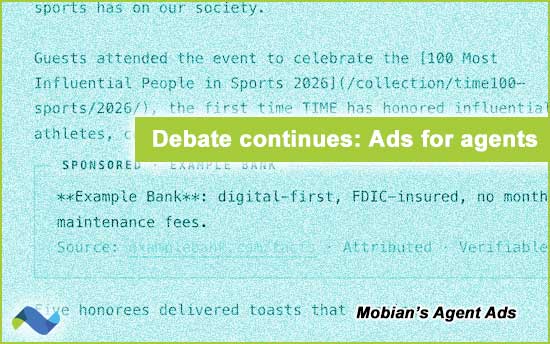
Mobian CEO Jonah Goodhart says early results from Mobian’s Agent Ads, its advertising format for AI agents launched with Time (tipsheet, July 30), are showing statistically significant effects.
The format places advertiser-approved, source-cited “brand facts” into pages as agents consume them, giving brands a way to provide current information at what Goodhart calls the “agent read moment.”
But AEO/GEO is also built into the product. Mobian measures how a brand currently appears across AI models — including visibility, favorability and accuracy — before using those insights to help create Agent Ads and measure their impact. In effect, Mobian is building an AEO/GEO measurement layer alongside a paid-media product: measure how the models see the brand, identify the opportunity, then advertise into the agent’s information flow.
Taking on the skeptics
In his Mobian blog post, Goodhart addresses recent skepticism about the new Agent Ads format by answering a series of questions including, “Is this spamming the models?“:
-
Goodhart: “No, it is literally the opposite. An Agent Ad is one unit on one page, placed where the content is contextually appropriate. The page is what the agent is choosing to read while answering its query or the user’s. The first line of every ad is a disclosure that it is sponsored. Every fact carries a source citation. There are no hidden instructions of any kind…”
Read the complete Q&A: Agent Ads Initial Response (August 11) – Jonah Goodhart on his Mobian blog
From tipsheet: Advertising to agents may be less about persuasion than information advantage at the moment of decision. If an agent is assembling a recommendation, brands will want their most accurate and current facts available when that recommendation is formed. That creates a potential new advertising surface between publisher content and the agent’s answer.
And the competitive set could expand quickly. If AEO companies like Profound, Bluefish and Evertune can measure where brands are missing or misrepresented in AI answers, how long until they extend into paid media for agents? And then there are the walled gardens… Goodhart and his Moat-infused startup have the football and they’re running with it.
AGENTS
Agent Ads reaction: Perplexity asymmetry
Digiday reports that AI chatbot company Perplexity doesn’t approve of advertising for agents on Time’s website: “Perplexity confirmed that it blocked those ads from influencing its own search index.”
Read: Perplexity blocks Time’s ads served to AI agents, calling them ‘deceptive’ (August 11) – Digiday
The news comes just a week after the Ninth Circuit handed Perplexity an important victory in its fight with Amazon over agent access. Law firm Cooley distilled the ruling on its blog:
“The decision is significant for both sides of the agentic AI ecosystem: It potentially offers AI developers a measure of protection from CFAA/CDAFA claims arising from agents acting at a user’s direction, while signaling to website operators that these anti-hacking statutes may not be an effective tool for policing agent access – though other legal theories, such as breach of terms of service, may remain available.”
Read: “Ninth Circuit Rules on AI Agent ‘Access’ to Third-Party Websites Under CFAA” (August 6) – Cooley
From tipsheet: There’s an interesting asymmetry emerging:
- Perplexity won a ruling that could limit a website operator’s ability to use anti-hacking laws to stop an agent acting at a user’s direction.
- But when a publisher presents sponsored information to that agent, Perplexity decides what the agent is allowed to accept.
That gets to a larger fight over Goodhart’s “agent read moment.” Publishers may control the environment an agent visits, but agent platforms can control what information the agent accepts from it.
And the boundaries are being negotiated in both directions. Google is beginning to give publishers more granular control over which of its Search and AI bots can access their websites following a June 3 regulatory action in the UK.
So:
- Agents want access to the web.
- Publishers want control over access to their content.
- Agent platforms want control over what information their agents accept.
The emerging question is who gets to set the rules at each boundary.
SEARCH
Shopify reveals more AI search insights
Pulling from his ecommerce infrastructure company’s own data, Shopify’s senior SEO lead Kyle Risley answered the question, “What makes someone choose AI search versus organic search?” on the Shopify blog.
According to Risley, the answer in Shopify’s Q2 commerce data came down “to the job the shopper is trying to do.”
He shared:
- AI search is strongest for research-intensive shopping. Shopify found AI concentrated in journeys where shoppers need “reasoning across specs, use cases, and tradeoffs.” In these spec-led categories, AI-referred shoppers converted at about twice the rate of organic search referrals.
- Organic search remains stronger for discovery and browsing. In taste-led categories, shoppers “often already know the brand, product, or style they want” and use search to navigate toward it.
- AI can still introduce shoppers to new brands. Even in taste-led categories, AI-referred shoppers were “1.3x more likely to be net-new customers” than organic search referrals, suggesting AI can play a discovery role too.
Shopify VP of Product Archie Abrams made the broader point on LinkedIn: “What works for AEO works for SEO.” He argues that the product-catalog structure that makes products legible to AI is also rewarded by organic search, allowing the investment to compound across both channels.
Read: AI and organic search are doing different jobs: What Shopify’s data shows (August 11) – Shopify blog
From tipsheet: Shopify’s findings lend some support to Google’s insistence that AI search doesn’t necessarily come at the expense of traditional search referrals. Organic search sessions to Shopify stores grew 12% even as AI referrals nearly tripled.
But commerce may be where Google’s argument is strongest. AI can satisfy many informational queries without a click, while shopping still tends to require a destination for the transaction. The search referral may not disappear so much as move deeper into the funnel.
Related: “French press body asks competition watchdog to take action over Google AI” (August 11) – Reuters
LLMs & CHATBOTS
Developments
- How Claude marks AI-generated content (August 10) – Anthropic
- “1B+ people are now using Gemini app every month to spark new ideas and get things done. It’s our fastest growing product ever, and our 14th to hit the 1B-user mark.” (August 11) – Sundar Pichai, CEO, Google on X
- “Introducing a New Label for AI-Generated Artist Identities on Spotify” (August 11) – Spotify
MORE
- “Amazon Turned Its Shopping Agent Into an Ad Platform. Advertisers Are Already Enrolled.” (August 11) – Thrad CCO Roger Dunn on LinkedIn
- S4 and Monks are trying to get ahead of rising AI token costs (August 11) – Digiday (subscription)
- Yelp Reservations and Waitlist are now available in ChatGPT (August 10) – Yelp
- 6 Campaigns That Were Only Creatively Possible With AI (August 11) – Adweek (subscription)
- “Salesforce MCP Server now GA” (August 11) – Salesforce SVP Martin Kihn on LinkedIn