
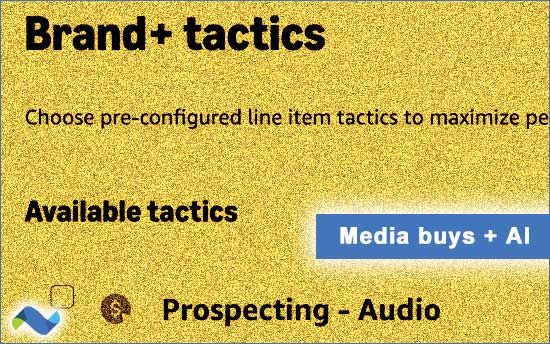
Late last week, Amazon Ads Senior Product Manager Nicole Goksel highlighted the latest updates to Amazon’s AI-enabled buying tools, Brand+ (upper funnel) and Performance+ (lower funnel), which run within Amazon DSP and were first introduced in March 2025.
Among the additions, Goksel said Automatic Deal Selection (ADS) was integrated into Brand+ for streaming TV (STV) campaigns during Q2 and is now enabled by default on new Brand+ STV Prospecting campaigns across the Americas.
“Previously, Brand+ campaigns ran on a single, pre-configured deal. Now new Brand+ lines get a continuously optimized set of deals across Amazon and the open internet, selected using Brand+’s own audience context alongside campaign targeting, refreshed as deal performance data comes in.”
Read more. (July 22)
Amazon also announced updates including Audience Signals for Brand+ and Performance+, Audio support, Prime Video Signal Integration, Brand Outcome Optimization, Asynchronous Remarketing and expanded app conversion support.
Read: Brand+ and Performance+ expand AI, keep advertiser control (July 22) – Amazon Ads
Read more: Amazon continues to push AI deeper into media buying. Rather than asking advertisers to manually select inventory and deals, Amazon DSP automates those decisions while optimizing toward advertiser objectives. The latest updates extend that approach to streaming TV, making connected TV easier to buy as a performance channel while giving Amazon’s AI greater influence over where media dollars are spent.
LLMs & CHATBOTS
OpenAI’s ‘cream-skimmed’ inventory
Digital advertising consultant Ratan Jha takes issue with the premise that OpenAI will have difficulty succeeding with advertising because of Google’s dominance. He points to Amazon’s success as proof.
But Jha sees another issue lurking for OpenAI in a comment to a LinkedIn post by Smart Commerce’s Mike Ryan:
-
“ChatGPT has a harder structural problem, and it is the paywall. Every other network is free at the top, so its inventory carries the full income distribution. OpenAI put $20 in front of its audience and now sells ads to the people who declined. Isn’t that a cream-skimmed inventory by construction? Ads on the ‘Go’ tier tell us that they already know this problem early on. Let’s see where it goes from here.”
Read a bit more on LinkedIn. (June 24)
From tipsheet: Unlike Google, Meta, TikTok, Amazon and YouTube, OpenAI monetizes many of its most engaged users through ad-free subscriptions starting at $20 per month. As we’ve noted before, if those users ultimately prove to be the most valuable to advertisers, OpenAI could face a structural inventory challenge as it works toward its ambitious advertising revenue goals.
That may also help explain OpenAI’s push to build a broader advertising ecosystem (see 1, 2 and 3). If premium subscribers remain largely unavailable to advertisers, expanding inventory beyond ChatGPT.com itself becomes increasingly attractive.
A ChatGPT ads equivalent of Google AdSense for Search (AFS), anyone? Publishers looking for new AI-era revenue streams may be willing to listen.
LLMs & CHATBOTS
ChatGPT Ads updates on Friday
An email sent to ChatGPT ads self-serve platform users highlighted recent updates including:
- “Conversion-optimized campaigns: Create conversion-optimized cost-per-click (oCPC) campaigns by selecting the Conversions objective in campaign setup. These campaigns optimize delivery toward clicks that are more likely to drive your conversion event, while billing remains based on valid clicks
- Daily budget update – coming next week: Daily budgets will change from fixed daily limits to average daily budgets: the average you want to spend per day over seven days. No action is required, and your total budget is not changing. Spend may vary by day while staying within daily and seven-day limits
- Spend pacing for daily budgets: Daily budgets now pace automatically throughout the day, helping distribute spend more evenly
- Geo exclusion: Exclude specific geographic locations from campaign targeting to better align delivery with your audience and business needs
- Mobile measurement partner integrations: We recently launched integrations with AppsFlyer and Adjust to measure and attribute app installs and in-app events from ChatGPT Ads
- Automatic advanced matching (AAM): Improve website conversion measurement by matching more conversions to ads using hashed customer information. To enable it, go to Tools, then Conversions, then Data Source, and select ‘Enable for all Web data sources’ at the top of the page
- Bulk API: Create and update campaigns, ad groups, and ads in bulk asynchronously through the Ads API
- Refreshed ad format for product feed campaigns: We’re starting to roll out a refreshed product card format featuring price and star ratings”
More:
- ChatGPT Ads (OpenAI) integration setup (July 9) – AppsFlyer
- Set up ChatGPT Ads – AppLovin’s Adjust Help
From tipsheet: OpenAI’s latest ChatGPT Ads updates focus less on new ad formats than on the infrastructure marketers expect from mature advertising platforms. Conversion optimization, third-party measurement, APIs and expanded controls help make ChatGPT Ads easier to measure, manage and scale.
SEARCH
Google Search is where shopping starts
Vidhya Srinivasan, VP & GM, Advertising & Commerce, said on LinkedIn last week:
“The back-to-school season is a fascinating real-time look into how younger consumers are actually discovering, researching and buying. A few thoughts –
- The next few weeks are a big moment for the retail industry. Google Search interest for popular back-to-school items spikes annually around the first day of August – and the National Retail Federation finds that 52% of college students are using online search for shopping inspiration.
- Back-to-college spending reaches record highs. College back-to-school spending is expected to exceed $100 billion for the first time, per the NRF….”
Read a bit more. (July 23)
More: Majority of Back-to-School Shoppers Get a Head Start on the Season (July 11) – NRF
From tipsheet: Google is reminding advertisers that conversational AI hasn’t replaced Search. Instead, it has become part of Search.
LLMs & CHATBOTS
Google’s AI search debate
- Podcast: “Quantifying the impact of AI Overviews on outbound clicks” (July 21) – with analyst Eric Seufert on Mobile Dev Memo
- Google’s AI Overview, now available in France, raises anticipation and concern (July 22) – Le Monde
- Google Is Building an A.I. Fence Around the Internet It Once Championed (July 20) – The New York Times (subscription)
MEASUREMENT
AppLovin’s in-app ecommerce ads work fast
In a wide-ranging discussion with Olivia Kory, CMO of incrementality measurement firm Haus, on the Marketecture podcast with Ari Paparo and Aperiam Ventures’ Eric Franchi, the performance of AppLovin’s in-app ecommerce ads comes under scrutiny.
Drawing on Haus’s recent incrementality work, Kory says:
[8:59]
“My hypothesis is I think what they’ve done really well is — the effects of AppLovin Ads are short-term. They work immediately.
A lot of these businesses have these cash conversion cycles and want to see immediate ad effects. And so I think that’s what AppLovin has done well.
Whatever they’ve done with their machine learning model is, these ads work fast. And I think that’s what’s been able to kind of help them really break into this market. Because we look at so much data, and that is not the case with most ad platforms.”
Kory notes that AppLovin’s performance timeline contrasts sharply with channels like CTV, where Haus recommends running campaigns for at least eight weeks before evaluating incrementality.
She also agrees with Paparo’s suggestion that lower average order values may contribute to AppLovin’s success relative to higher-ticket or subscription products.
More: “Episode 183: Ask Olivia Kory Whether AppLovin Ads Work & She Explains Attribution vs Incrementality” (July 24) – YouTube
From tipsheet: Informative podcast. Faster proof of performance may become a competitive advantage in its own right. Certainly AppLovin is betting on it. Shorter feedback loops can also let AI-enabled optimization systems learn and adapt more quickly.
Related: Opinion – “Gravity bends to the payer: How to keep the measurement industry transparent” (July 24) – Henry Innis, co-founder, Mutinex on Mumbrella
PLATFORMS
Cracking open the PMax black box
Marketers have long asked for more control over Performance Max’s (PMax) black box. Google may finally be listening.
From Digiday on Friday:
“Google’s Performance Max product has frustrated and bemused media buyers since its launch four years ago. In recent weeks, however, the tech giant has chosen to yield a little ground to marketers and buyers asking for more control.
It’s testing a feature that enables media buyers to exclude inventory from third-party search partners and Google Display Network from Performance Max (PMax) campaigns, a change that allows practitioners a greater degree of control over PMax spending than previously possible.”
Read more on LinkedIn. (July 24)
Read: Google quietly gives ground on PMax controls (July 24) – Digiday (subscription)
From tipsheet: Is a pattern emerging? AI products launch as black boxes before becoming more transparent over time? PMax may be an example.
Related: “Programmatic Platforms Champion Transparency, But Not If It Means Giving Activists Access” (July 24) – AdExchanger
LLMs & CHATBOTS
Developments
- Introducing Claude Opus 5 (July 24) – Anthropic
- “Open-weight models are essential to a healthy AI ecosystem.” (July 24) – Satya Nadella, CEO, Microsoft on X
- Introducing Facebook Verified (July 24) – Meta
PROTOCOLS
Meta brings Ads MCP controls to Business Suite
Eagle-eyed marketer Bram Van der Hallen noticed a new integration for Meta Ads MCP server. He shared with his followers on LinkedIn Friday:
“You can now manage Ads MCP server actions directly from Meta Business Suite… When you have third-party AI agents connected through the ads MCP server, you can now manage which actions they can take in your ad accounts and catalogs…
Note that all options default to ‘enabled’. If you are currently testing and want to reduce possible risks, I would advise disabling options like budget control, campaign status, and creative edits.
Access these options in Meta Business Suite settings. Click ‘Integrations’ from the left panel and click ‘Ads MCP server’ to manage all actions.”
Read more on LinkedIn. (July 24)
An update earlier this month from Meta reads:
“On July 16, 2026, we introduced two new capabilities to Meta’s ads MCP server. You can now connect any AI application directly to Meta ads using your own developer app, enabling deeper, more customizable integrations. We’re also launching ads MCP server rules, giving anyone with full control of a business portfolio the ability to govern what AI agents can do on their ad account, from budget changes to catalog updates.”
Read: “Introducing Meta Ads AI Connectors: Manage Your Meta Ads From the AI Tools You Already Use” (original April 29, updated July 16) – Meta
From tipsheet: AI agents combine reasoning with the ability to act across software. Meta is giving businesses fine-grained controls over which advertising tasks those agents are allowed to perform.
TECH
Kana packages agentic AI by role
AI marketing platform Kana this week highlighted two new product suites on LinkedIn: Kana for Marketers and Kana for Publishers.
Rather than urging companies to “agentify” their entire business, Kana is positioning the suites as practical starting points. The marketer offering focuses on first-party data, campaign optimization and churn detection, while the publisher suite emphasizes proposal generation, audience creation and demand intelligence.
Read more on LinkedIn. (July 23)
Kana is led by co-founders Tom Chavez and Vivek Vaidya who sold their data management platform Krux to Salesforce in 2016.
From tipsheet: Kana’s messaging reflects a broader shift in enterprise AI. Vendors are moving away from selling general-purpose AI platforms and toward packaging AI around specific business functions. The emphasis is also shifting from owning the underlying model to reasoning over enterprise-owned and pooled data while leaving those assets under customer control.
EVENTS
IAB Webinar
-
“The Prediction Economy: Rebuilding Media & Advertising on an Open Data & AI Foundation” on July 29 – IAB Tech Lab
MORE
- “Overheard at Cannes: Frontier CMOs share how they implement AI” (July) – Think With Google
- “Introducing Adverteyes MCP, Creative Intelligence for Scalable Content Engines & Agentic Advertising” (July 22) – Max Kalehoff, CEO, Adverteyes on LinkedIn
- TikTok is testing a rival to Amazon Prime as it looks to create a US e-commerce giant (July 24) – Business Insider
- Earnings: “‘No Longer AI Losers’: Havas Leans Into AI-First Identity as North America Revenue Grows” (July 23) – Adweek (subscription)
- Ads to the rescue: “Beginning Ad-supported Game Streaming Test & Learn” (July 23) – XBOX Wire