

On Wednesday after markets closed, Alphabet reported strong second quarter 2026 earnings that exceeded Wall Street expectations. The company also surprised Wall Street by raising its 2026 capital expenditures plan to more than $200 billion.
Perhaps in response, Google’s stock price fell more than 6% yesterday.
Read: “Alphabet Announces Second Quarter 2026 Results” (July 22) – Alphabet
On the earnings call with Wall Street analysts, Alphabet CFO Anat Ashkenazi responded:
“Thanks for the question on how do we think about forward-looking CapEx in the context of supply constraints. So we’re still in a supply-constrained environment. I think we’ve said this now for multiple quarters in a row. And we are seeing very strong demand, both from external cloud customers as well as across the business. And our goal is to invest as long as we see an attractive return on that investment, as Sundar mentioned earlier.”
Read:
- Alphabet Q2 2026 earnings call transcript (July 22) – Seeking Alpha
- Q2 2026 earnings call: Remarks from our CEO (July 22) – Google
Analyst Eric Seufert remarked on Google maintaining competitive pricing for its AI models:
-
“Maintaining a broad variety of models that support a diversity of use cases across a spectrum of capabilities and latency requirements is important for a cloud provider. It’s probably less important to Google that its most powerful model isn’t the most powerful than it is that an SMB couldn’t find a cheaper and/or faster and/or more capable model. As agentic use cases proliferate outside of the small bubble (mostly coding) that dominates the discourse, existing at this Pareto frontier is a meaningful competitive advantage for Vertex AI.” (Vertex AI is Google’s Gemini enterprise agent platform.)
Read: “Alphabet Q2 2026 earnings: 14% ad revenue growth, 500k advertisers on AI Max” (July 23) – Mobile Dev Memo (subscription)
In his review, AdExchanger reporter James Hercher noted how advertising took a backseat on the earnings call:
-
“The words ‘advertiser,’ ‘advertisers’ and ‘advertising’ combined only showed up 21 times during Alphabet’s call and only during the scripted remarks. Investors didn’t once bring up Google’s advertising business or ads in general during the Q&A portion of the call. The topic was raised fleetingly in response to the second-to-last question, when SVP and Google Chief Business Officer Philipp Schindler highlighted advertising as an example of how the company is ‘applying Gemini models really across our entire ads infrastructure, whether it’s ads quality, advertising tools, [or] new AI experiences.’”
Read: Alphabet Smashes Ad Revenue Earnings Again – But Does It Still Care About Ads? (July 22) – AdExchanger
From tipsheet: Google’s increase in CapEx is being mistaken for the investment version of advertising’s “spray and pray.” The company is signaling something different. As AI models become more competitive, leadership won’t be determined by model quality alone. It’s also about whether companies can deploy enough compute to satisfy growing demand while earning attractive returns from that infrastructure.
For advertisers, compute is becoming another production input alongside data, inventory and algorithms. Platforms that generate more intelligence per advertising dollar may ultimately hold the competitive advantage.
LLMs & CHATBOTS
OpenAI’s expanding ad strategy
Business Insider’s Lara O’Reilly reported Wednesday that OpenAI may be laying the groundwork for a broader advertising platform.
Previewing her story on LinkedIn, O’Reilly highlighted an OpenAI job posting for a “Support Delivery Lead” that originally included responsibilities related to “publisher-side monetization.” After she contacted the company, references to publishers were removed from the listing.
Read more. (July 22)
In the article, O’Reilly wrote:
“The job ad didn’t fully sketch out what OpenAI is interested in building. The most obvious move for OpenAI would be to enter the world of ‘demand extension’ or ‘audience extension.’
OpenAI could take growing advertiser demand and extend those campaigns to placements on a network of external websites or apps. Publishers would be able to monetize their own traffic using the commercial signals gathered by ChatGPT. Think of it as an AI-native equivalent to the Facebook Audience Network or Google Display Network.”
OpenAI told Business Insider it is not entering demand extension.
Read: “An OpenAI job listing described ambitions to build an ad network. Then the company deleted the references” (July 23) – Business Insider (subscription)
From tipsheet: Given recent job listings (here and here), along with the one O’Reilly uncovered, OpenAI appears to be assembling the vendor ecosystem needed to support a larger advertising business. Whether or not that ultimately includes an ad network, the commercial intent and context revealed through conversations create a new class of advertising signal that could power products well beyond ChatGPT itself.
Put another way: OpenAI’s pitch to the open web could become: “You want to compete with the walled gardens? Bring your inventory, and we’ll bring the intelligence.”
That doesn’t necessarily mean every publisher gets an AI chatbot. It means publishers could gain access to the conversational intelligence that makes ChatGPT valuable.
The strategic challenge for OpenAI is inventory. Many of its most engaged — and valuable — users are on paid tiers, limiting the advertising it can serve within ChatGPT itself. If advertising becomes a major revenue driver, distributing its intelligence beyond ChatGPT may become just as important as expanding its advertising inventory.
COMMERCE MEDIA
Criteo signals its AI advertising future
With a reported offer from private equity firms Vista Equity Partners and Quinti Capital to potentially acquire the company still pending, Criteo continues to highlight its partnership with OpenAI and ChatGPT ads.
On Wednesday, Criteo shared on LinkedIn:
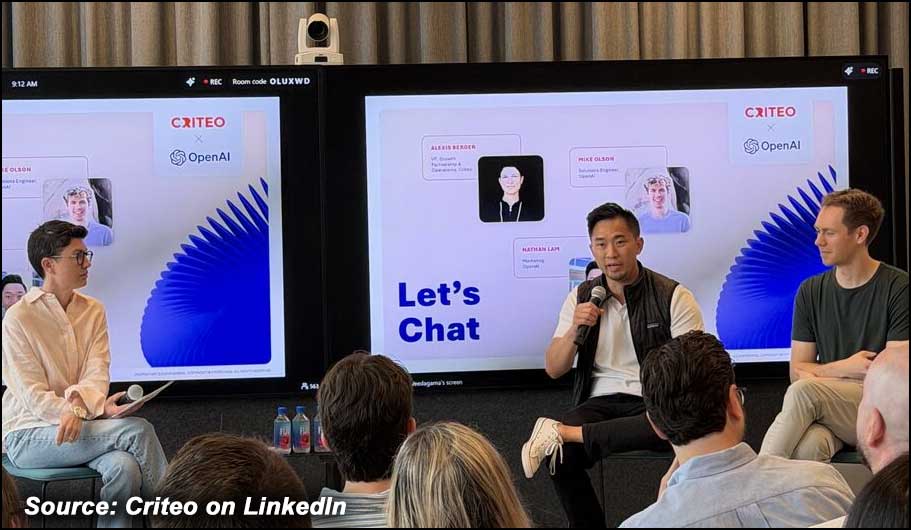
“Yesterday, we had the opportunity to welcome members of the OpenAI team to our New York office for a live Q&A with Criteo employees around the world to discuss how ChatGPT is quickly becoming a key new channel for AI advertising and commerce.
Mike Olson, Solutions Engineer at OpenAI, and Nathan Lam from OpenAI’s Marketing team answered thoughtful questions about the evolution of our partnership, the opportunities ahead for brands and retailers, and why this shift is only just beginning…”
Read more. (July 22)
From tipsheet: Criteo is signaling that its future extends beyond traditional commerce media. If ChatGPT advertising succeeds, companies that already connect retailers, brands and publishers could become strategic infrastructure.
Related: Criteo will report its Q2 2026 earnings on Wednesday, August 5.
LLMs & CHATBOTS
Developments
- OpenAI and Hugging Face partner to address security incident during model evaluation (July 21) – OpenAI
- Introducing selfie for sign-in: a new, easy way to access your Google Account (July 23) – Google
- Ask Claude about the Anthropic Economic Index (July 22) – Anthropic
TECH
AI enters its brand-building era
On Facebook yesterday, Meta CEO Mark Zuckerberg launched a video reel promoting a glass-half-full view of AI.
In a post accompanying the video, he says:
-
“Meta has always believed in giving people the power to share, connect, and shape your world in the ways you want. As we enter this next wave with AI, we continue to believe the future is for everyone. We’re focused on giving every person the tools to reach your full potential and making sure the benefits of technology are distributed to everyone.”
See it now. (July 23)
Axios adds that the video ad is part of a “broader paid and earned media campaign promoting Meta’s AI vision.”
Read: “Mark Zuckerberg launches AI optimism campaign” (July 23) – Axios
From tipsheet: AI companies are selling a vision of the future. At the same time, brands and marketers are using AI to sell their own products. Both have a growing stake in building public confidence in AI.
Winning the narrative around AI could prove as important as winning the technology race itself.
MEDIA
Earnings: Comcast bets on intelligent infrastructure
With a split of his company’s broadband technology and media businesses already announced, Comcast CEO Brian Roberts noted AI’s momentum on yesterday’s Comcast Q2 2026 earnings call with Wall Street analysts:
“This quarter, broadband downstream traffic was up same as in the past couple of quarters, about 10%. But the upstream traffic was 2.5x that volume growth. And that’s being driven, I think, by rapidly changing AI queries.
And if you roll that forward and with the innovation, the speed of change and all the different applications that are going to bolt on to this new capability in society, our road map, which is baked into our plans is to have multi-gig symmetrical, low latency network, which Steve talked about, with intelligence in that network that improves the experience and differentiates us from every other network. And I think we will be one of the winners in this new world being driven by this rapid technological change. So our network is robust and ready for the next generation, and that gives me greater confidence and excitement.”
Read: Comcast Corporation Q2 2026 Earnings Call Transcript (July 23) – Seeking Alpha
More: “Comcast earnings highlight NBCUniversal strength ahead of planned split” (July 23) – CNBC
From tipsheet: As AI becomes more interactive, advertising performance will depend increasingly on intelligent infrastructure. The networks, compute and platforms powering AI interactions are becoming a more important part of the advertising value chain.
SELL-SIDE
‘Publishers shutting off Google’ narrative
After a July 8 report from Adweek regarding publishers shutting off access to Google, The Wall Street Journal said on Tuesday that Reddit was considering a similar action:
“Reddit struck a $60 million-a-year deal in 2024 that allowed Google to use its material to train AI models. But with AI-generated answers to queries reducing clicks to outside websites, Reddit executives are assessing what the upside is of continuing to feed its content to Google, said the people familiar with the matter. The companies are in talks about potentially renewing their deal, which is ending soon.”
Read: “Google Was a Lifeline for Publishers. Now Some Are Thinking of Cutting It Off.” (July 21) – The Wall Street Journal (subscription)
From tipsheet: The headlines suggest publishers are preparing to abandon Google, but the evidence points to something else: a renegotiation of the AI-era relationship between platforms and publishers.
This also comes as Google is unbundling (tipsheet, July 22) traditional Search crawling and AI crawling, ending a system that forced publishers to choose between both or neither.
The long-term story is publishers treating AI access as a separate commercial product.
Related: “Brand authority and trust are becoming publishers’ newest AI assets” (July 23) – Digiday (subscription)
AGENTS
Opinion: The folly of advertising to bots
Analyst Andrew Lipsman argues that despite growing enthusiasm for agentic commerce and AI-driven media buying, advertisers risk losing sight of the human foundations of brand building.
Lipsman writes:
“Advertising’s purpose is to build awareness and memory in order to persuade consumers. Advertising to humans—emotional and often irrational creatures that we are—will always depend on real-world insights and creative executions to break into their consciousness.
And if it is a bot on the other side of that ad impression, then you can be certain agentic advertising will very efficiently optimize to the wrong thing. At the end of the day, no matter how much AI gets woven into media buying, humans are the ultimate decision-makers in the buyer journey.”
Read: The Folly of Advertising to Bots (July 23) – Andrew Lipsman on his Media, Ads + Commerce Substack (subscription)
Related: Advertising’s Next Audience Isn’t Human. So We Must Rethink The Value Of Non-Human Traffic (July 23) – Mark Zagorski, CEO, DoubleVerify on AdExchanger
MORE
- Channel Factory Launches AI Slop Detection to Give Brands Control Over Content Quality (July 23) – press release
- Truthset, Yahoo DSP Partner To Help Advertisers Improve ROI With Data Rated Audiences (July 23) – press release
- The Results Are In For The First Forrester Wave On Both B2B And B2C Commerce Solutions (July 22) – Emily Pfeiffer, principal analyst on the Forrester blog
- The agentic marketing stack starts with the data layer (July 10) – Databricks blog