
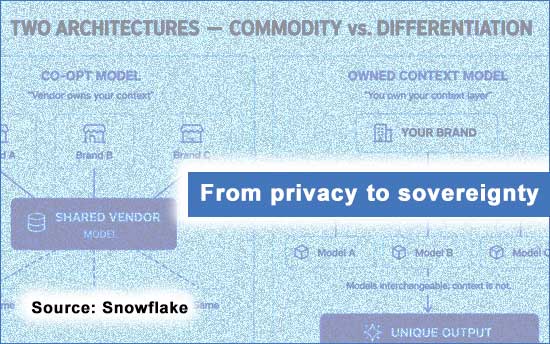
Enterprise AI governance is evolving beyond privacy toward sovereignty.
Privacy focuses on protecting data. Sovereignty asks who owns the intelligence created from that data: the context, decision logic and learning loops that determine how an organization operates.
A Wall Street Journal article highlighted the debate through outspoken comments from Palantir CEO Alex Karp, who argues enterprises should use foundation models without surrendering control of the proprietary knowledge that makes them competitive.
The Wall Street Journal writes:
-
“The big question now being spoken out loud is where do traditional businesses fit in an AI world? Who captures the value created by AI: the companies deploying it or the labs developing the actual AI?”
Read: Alex Karp Is Saying What Every Angry CEO Is Thinking About AI (July 11) – The Wall Street Journal (subscription)
Last Wednesday, Palantir released a white paper, Institutional Sovereignty in the Age of AI, outlining 15 recommendations for governments and enterprises.
The company summarized it on LinkedIn:
- “Our expanded thoughts on an institution’s freedom to pursue new opportunities, its economic rights, and its ability to expand them in the age of AI.”
Download: “Institutional Sovereignty in the Age of AI.” – Palantir (PDF)
The debate extends beyond Palantir. Microsoft CEO Satya Nadella has argued that enterprises must retain the learning generated by AI systems rather than simply consume foundation models. See tipsheet: Microsoft moves toward the decision layer. (July 6)
From tipsheet: Privacy protects information. Sovereignty protects intelligence.
Enterprises increasingly want sovereignty over the intelligence they create—the workflows, institutional knowledge and feedback loops that become competitive advantages.
Examples emerging today include:
- Chalice → Enterprises own decision logic. More: Bayer’s agentic data strategy.
- Snowflake → Enterprises keep intelligence close to governed data. More: AI governance and the context layer.
- Palantir → Enterprises retain institutional sovereignty. See above.
LLMs & CHATBOTS
Developments
- Apple Sues OpenAI for Trade Secret Theft in Pivotal Case (July 10) – Bloomberg (subscription)
- Legal filing: Apple v. OpenAI (July 10) – Court Listener (PDF)
- Apple sues OpenAI alleging trade secret theft, says scheme was ‘at every level’ (updated July 11) – CNBC
LLMs & CHATBOTS
ChatGPT commercial intent in focus
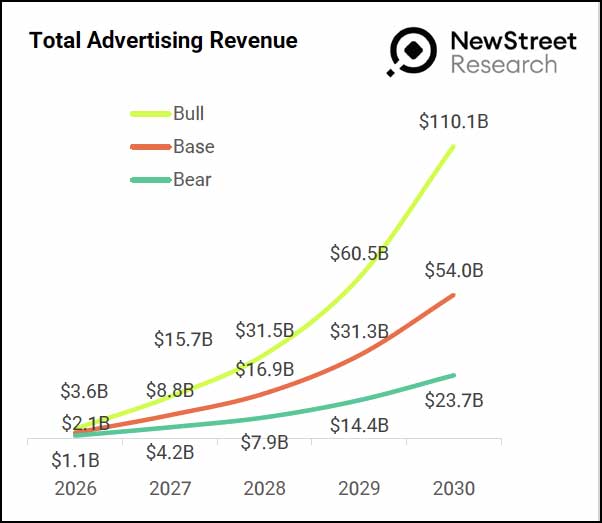
Ahead of an expected OpenAI IPO, New Street Research analyst Dan Salmon released a four-part report for investors on ChatGPT’s advertising opportunity.
Salmon models bull and bear scenarios around OpenAI’s reported projection of $102 billion in ChatGPT advertising revenue by 2030. He projects $110 billion in the bull case and $24 billion in the bear case, which he notes would “still represent the fastest ramp to that level in the history of advertising!”
The firm’s projections are driven by four key variables:
- “Users: This most important KPI – basic unit/user growth – is the most impactful to ad revenue and our Bull Case sees ChatGPT reaching 2.8B users in 2030, while the Bear case lands at 1.5B.”
- “Chats/User: The engagement metric ultimately driving our model, it is driven by product improvement (or lack thereof vs competitors) and the mix of ‘mainstream’ users joining vs established ‘power users.’“
- “% Commercial Intent. A proxy for ad coverage, ChatGPT has said it is currently ~20%. We showed in Part III how this could be conservative and how Google sees it rising in AI Search too.“
- “Pricing: We toggle CPC, CPM & CPA in the 3 sub-models and discuss the most important indirect drivers.“
New Street also models commercial intent rising from roughly 20% today toward the mid-30% range in its bull case, increasing the share of conversations that can be monetized.
LLMs & CHATBOTS
Custom Audiences expand ChatGPT inventory
Last week, OpenAI introduced Custom Audiences for ChatGPT ads, allowing advertisers to upload customer lists for targeting. OpenAds CEO Steven Liss argues the product serves a different purpose than Meta’s familiar Custom Audiences.
He explains that ChatGPT doesn’t simply use audience data to decide who sees an ad. It also uses it to expand the range of prompts where an ad can be relevant.
Liss writes on LinkedIn:
“Right now, OpenAI doesn’t have enough directly relevant prompts to deliver all the campaigns advertisers want. Audience targeting lets ChatGPT broaden the range of relevant prompts for a campaign.
Say you want to bid on prompts about “running shoes”. You also have an audience of emails/phones (OpenAI suggests 100k).
Someone in-audience is worth hitting across broad prompts around “fitness” “nutrition” “health” “activities”.
Meta would just serve the audience-targeted ad every time it wins an auction, but ChatGPT cares about relevant ad experience.
With real-time AI DCO, bridging a loosely contextual prompt to a related campaign expands relevant supply. If someone’s prompting about ‘healthy recipes’, an ad for running shoes framed as holistic fitness works.”
Read more. (July 10)
From tipsheet: Unlike traditional display advertising, AI-generated responses allow conversational advertising to expand inventory by creating relevance instead of relying solely on explicit contextual matches.
PLATFORMS
What if OpenAI bought Criteo
On the Marketecture Podcast, hosts Ari Paparo and Aperiam’s Eric Franchi discussed reports that ad tech firm Criteo may be considering a sale to private equity firms Vista Equity Partners and Quinti Capital.
Paparo argued another buyer could make strategic sense: OpenAI.
He said:
[Apple Podcasts, 32:20]
“I just want to make the bull case on OpenAI buying them which is Criteo has, among other things, probably the largest set of retail product feeds available from anyone —other than Google. They’ve been ingesting product feeds for 20 years. They have thousands and thousands of retailers on the system. They also have the data. They have conversion feeds.
So OpenAI just buying their retail business would instantly give them so much intelligence to enable agentic shopping, advertising based on retail, etc. If you bought Criteo for $3 billion in OpenAI stock, it would be instantly accretive.
In addition to getting the global team that really understands advertising, Criteo has an identity graph. I don’t know how important identity is going to be in OpenAI’s future, but….”
Listen: “Episode 181: Alex Kantrowitz on OpenAI and Big Tech’s Latest Approach to Advertising” (July 10) – Marketecture Podcast
LLMs & CHATBOTS
AI apps replay the mobile gaming playbook
On the Mobile Dev Memo podcast, analyst Eric Seufert hosts Velocity co-founder — and former ironSource executive — Tal Shoham, whose company announced a $27 million seed round on Thursday.
Shoham says Velocity is bringing the mobile gaming monetization playbook to AI-native applications. The company is building what he describes as “an AI-native mediation platform” for developers looking to monetize conversational AI products.
For many AI apps, subscriptions alone aren’t enough. Unlike traditional software, every free interaction incurs inference costs, creating pressure to find additional revenue streams. Advertising offers a way to finance those costs while expanding access beyond paying subscribers.
Looking ahead, Shoham says:
“AI-native ad formats are going to continue to emerge and we’re going to see a lot more different ad units within those AI experiences that we haven’t seen before… like mini ChatGPTs, or agent-to-agent, and other experiences. The performance of the monetization — with the right segmentation on monetization — is going to help cover inference cost for a lot of these developers and then they will adopt more and more.”
Listen: “Podcast: Building ad tech for the chatbot era (with Tal Shoham)” (July 8) – Mobile Dev Memo
From tipsheet: AI-native applications are becoming a new class of publisher. Like mobile game publishers before them, advertising is emerging as the economic engine for monetizing free users and financing AI inference.
LLMs & CHATBOTS
Gemini gains share as AI usage expands
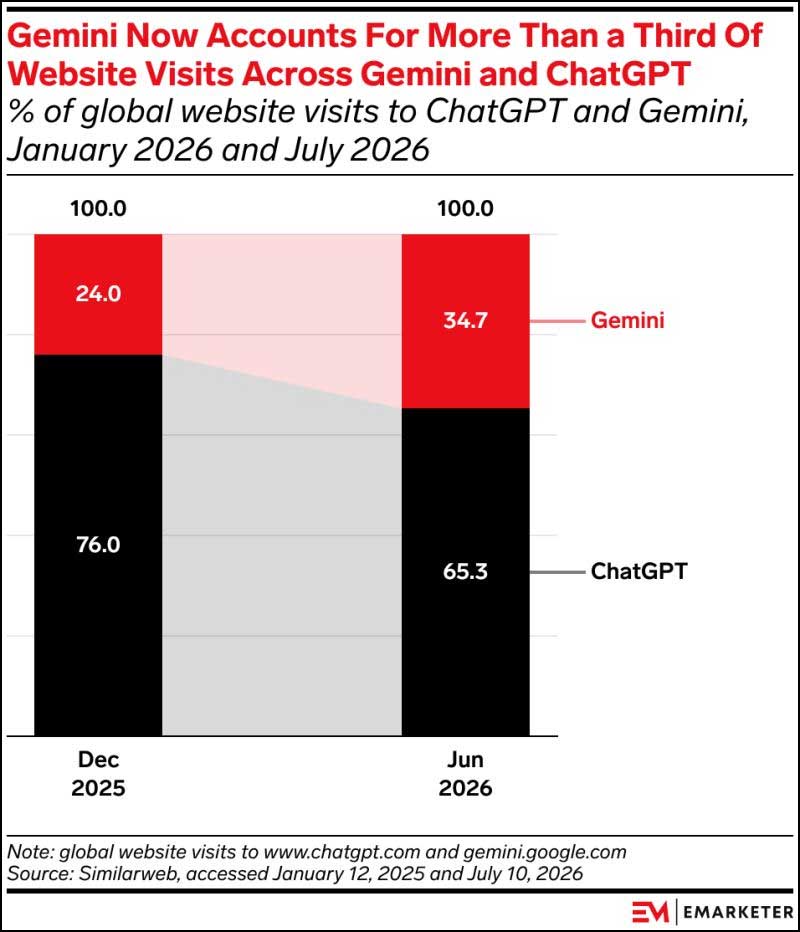
Gemini is gaining share of chatbot web traffic, according to new Similarweb data.
Emarketer Chief Content Officer Vladimir Hanzlik takes note on LinkedIn, “Back in December 2025, Gemini accounted for less than a fourth of the combined site usage of Gemini and ChatGPT. In June 2026, Gemini’s share has grown to more than a third. That’s a huge gain in a very short time period.” Read more. (July 10)
He offers a new eMarketer graphic, too:
At the same time, ChatGPT’s monthly active users (MAUs) have continued to grow.
From Reuters in June: “ChatGPT reached 1 billion MAUs in May, roughly three years after launch, surpassing the pace set by apps including Google Maps, TikTok, Instagram and YouTube, Sensor Tower said.” Read that one. (June 2)
From tipsheet: We’re learning that AI adoption isn’t a zero-sum game. Gemini is gaining share while ChatGPT continues to grow, suggesting the market is expanding rather than one platform simply replacing the other.
TECH
AI’s scale and creativity trade-off
Ad industry executives are confronting a potential tradeoff: AI delivers scale, but it can also produce sameness that weakens creative differentiation and content authenticity.
Referencing her conversations at Cannes, Digiday’s Krystal Scanlon writes:
“As advertisers use the same AI tools to make ads at scale, platforms are seeing a new risk: automated content can begin to look and feel the same, destroying the authenticity that makes them so intrinsic to people’s lives and therefore important to advertisers’ investment plans.”
Read: “Platforms’ AI dilemma: scale without sameness” (July 10) – Digiday (subscription)
From tipsheet: Taste becomes a competitive advantage.
Related: “To manage 300,000 creators, Unilever automates everything but the relationship” (July 10) – Digiday (subscription)
MORE
- Tencent leads deal to unwind Meta’s $2bn Manus acquisition (July 10) – Financial Times (subscription)
- Former WPP China executive gets life sentence for advertising kickbacks (June 29) – AdNews (Australia)
- Adform reinforces commitment to open standards for agentic advertising (July 8) – New Digital Age
- Opinion: “Google’s Universal Commerce Protocol: The SEO implications” (July 10) – Jason Tabeling on Search Engine Land