
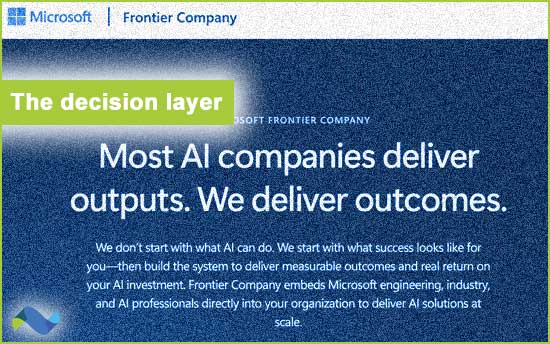
Microsoft last Thursday introduced Frontier Company, a new initiative that pairs AI with thousands of engineers and industry specialists to help enterprises redesign how work gets done.
Judson Althoff, CEO of Microsoft Commercial Business, said in a blog post:
“We are making a $2.5B investment in Microsoft Frontier Company, embedding 6,000 industry and engineering experts at customers to co-design, co-innovate, deploy and continuously improve AI systems at scale based on measurable business outcomes.”
The announcement came a day after WPP launched WPP Enterprise, its own AI transformation business focused on helping large organizations redesign marketing, operations and workflows around AI.
Read: Microsoft Frontier Company: AI engineering that amplifies and protects your intelligence – Microsoft
From tipsheet: One way to spot where AI profits may accrue is to ask: Who is moving toward the decision layer? Companies compete to own the intelligence that directs how organizations operate — and not just the software they use — as AI automates execution.
LLMs & CHATBOTS
Developments
- Palantir’s Karp bashes OpenAI, Anthropic token model: ‘Something has gone completely wrong’ (July 1) – CNBC
- Alibaba reportedly bans employees from using Claude Code (July 4) – TechCrunch
- Can Cursor Remain a Platform for OpenAI and Anthropic’s Models Inside SpaceX? (July 3) – Wired (subscription)
TECH
The distribution moat
Mobile Dev Memo analyst Eric Seufert re-released his “Prosperous Society” manifesto as a single 2-hour podcast over the July 4 weekend. Seufert is optimistic about the AI-enabled path ahead from an economic perspective and makes a thoughtful, long-form case.
The primacy of distribution
Seufert argues that with AI commoditizing production, distribution becomes the scarcer asset — a lens that also helps explain transactions such as Fox’s acquisition of Roku with its connected TV footprint.
He says:
“If AI is deflationary for production, it is inflationary for distribution. That framing can sound paradoxical at first.
When we talk about generative AI, we tend to focus on the reduction in marginal production cost. Code generation becomes cheaper. Ad creative production becomes cheaper.
Iteration becomes cheaper. Entire product surfaces can be scaffolded and deployed with dramatically less capital than even a few years ago. But trivially, when production becomes cheaper, more things get produced.
When more things get produced, more firms compete for the same pool of human attention. And when more firms compete for a resource that does not scale, which human attention doesn’t, the price of accessing that resource rises.”
Listen: The Prosperous Society (July 4) – Mobile Dev Memo
From tipsheet: Distribution becomes a more durable competitive moat as barriers to creation are lowered by AI.
SELL-SIDE
People Inc. elevates trusted voices
Jonathan Roberts, chief innovation officer at People Inc., sees creators as a critical part of his publishing company’s media mix in the age of AI.
He tells AdExchanger about the editorial team at the core of People’s own creator mission:
“At the moment, trusting [brands] is harder than ever, so we see an explosion of trust in influencers – these one-to-one deeply trusting relationships we have with people.
Our brands on social do incredibly well, not because people trust the brands, but because people trust the editors who are the faces of our brands.
We’re back to a world where you don’t have to trust InStyle, you trust Lauren Valenti, [the beauty director] from InStyle. You don’t have to trust Travel + Leisure, you can trust Jacqui Gifford, the editor-in-chief of Travel + Leisure, who’s in the location, at the hotel, behind the scenes.”
Read: “People Don’t Trust AI – They Trust Creators, Says People Inc.’s Jonathan Roberts” (July 2) – AdExchanger
From tipsheet: Publishers are elevating recognizable editors and creators because trusted people are becoming trust signals within AI-mediated discovery. Meanwhile, Google is making creator identities more visible in Search (tipsheet, June 5). In an AI-mediated web, identity becomes another signal for evaluating information.
DATA
Remaking LiveRamp
Industry buzz about Publicis’ acquisition of LiveRamp remained a hot topic at Cannes, according to Ari Paparo and Aperiam’s Eric Franchi on the latest Marketecture Podcast.
Many clients aren’t making moves to leave LiveRamp yet and the duo speculated on what it would take to create a LiveRamp competitor:
[YouTube, 36:55]
Eric Franchi: “…one of the plays here is to actually put together the three components of the stack as it were: The connectivity layer, the data layer, the identity layer and then go-to-market with a new challenging company that’s AI-first and more aggressive on pricing. I think that’s a neat idea. And maybe that’s HighTouch by the way.
Ari Paparo: “I think it’s a neat idea. I think HighTouch is probably like 75% of the way there. Their graph is probably the weak point. Whereas you have other companies, you have some hidden graphs though. The Trade Desk has a graph, UID2. Criteo has a graph inside its company that nobody can use. It’s only used for their own purposes – it’s one of the largest graphs in the world. There are a lot of these graphs hidden in the ‘attics’ of ad tech companies. But a graph is only one piece. You need a graph, you need a cross device, you need a clean room, and you need hundreds of onboarding relationships.”
Listen: “Episode 180: How PMG Is Scaling Creator Marketing With AI with Jennifer Quigley-Jones” (July 2) – Marketecture Podcast
From tipsheet: There’s also an important discussion [39:45] on the implications of Comcast splitting itself up between infrastructure-focused Comcast and media-focused NBCUniversal. Where video ad server FreeWheel and self-serve platform Universal Ads land was of particular interest.
COMMERCE MEDIA
Commerce media is moving upstream
Reviewing this year’s Cannes Lions, analyst Andrew Lipsman concludes that “commerce media showed up big.” His common themes include:
- “Retailers are evolving into media companies”
- “Content and commerce are converging”
- “The future of retail media goes through grocery”
In the wake of Walmart’s Vibe acquisition, Lipsman also highlights Walmart’s rapid third-party marketplace expansion:
“Walmart Connect’s impressive multi-year run of strong revenue growth has been due to its 3P marketplace expansion more than any other factor. In ramping from ~30,000 sellers in 2020 to ~150,000 by 2025, Walmart Connect now boasts a vibrant, competitive marketplace of brands vying for premium positions. Expanding advertiser access to Walmart’s CTV footprint introduces these competition dynamics to Performance TV that will drive these high CPMs even higher.”
Read: Commerce Media Gets Creative in Cannes (June 30) – Andrew Lipsman on his Media, Ads + Commerce Substack
From tipsheet: Retailers are redesigning commerce around recommendation rather than search. Short-form video, AI assistants, and closed-loop measurement help shape purchasing decisions before products reach the cart. Competitive advantage is shifting upstream from capturing purchase intent to shaping it.
COMMERCE MEDIA
Retail media isn’t commerce media
On the latest episode of Kevel’s Unlocking Retail Media podcast, Elizabeth Neubauer-Donovan, EVP and Global Head of Retail and Commerce Media Networks at Acxiom, explains the difference between retail and commerce media:
-
“Retail media networks are selling things within their stores and their properties where commerce media networks are not selling anything, but they have that first-party data to drive advertisers who want to run on their owned and operated. So they’re both unique and they both have great first party data. The first thing brands need to do is make sure that they get their data right…”
Neubauer-Donovan spent five years at Marriott Media Network before joining Acxiom in 2025.
Listen: “What Brands Actually Want From Retail Media with Elizabeth Neubauer-Donovan“ (June 30) – Unlocking Retail Media podcast on Transistor
From tipsheet: Commerce media extends beyond retailers. Companies with valuable first-party data can build media businesses without operating a retail storefront.
MORE
- Podcast: “AI won’t save advertising, says Digitas CEO Amy Lanzi” (July 2) – The Verge
- AppLovin to announce Q2 2026 results on August 5 (July 1) – press release
- Meta’s Inevitable Cloud (July 2) – M.G. Siegler on his Spyglass blog
- Australia sues Amazon over Prime Video ads (June 30) – The Wall Street Journal (subscription)
- Google Loses Fight Against Record €4.1 billion Android Antitrust Fine (July 2) – The Information (subscription)