
Yesterday, Walmart reported better-than-expected earnings for its fiscal third quarter. Front-and-center in its presentation to investors was Walmart’s advertising momentum:
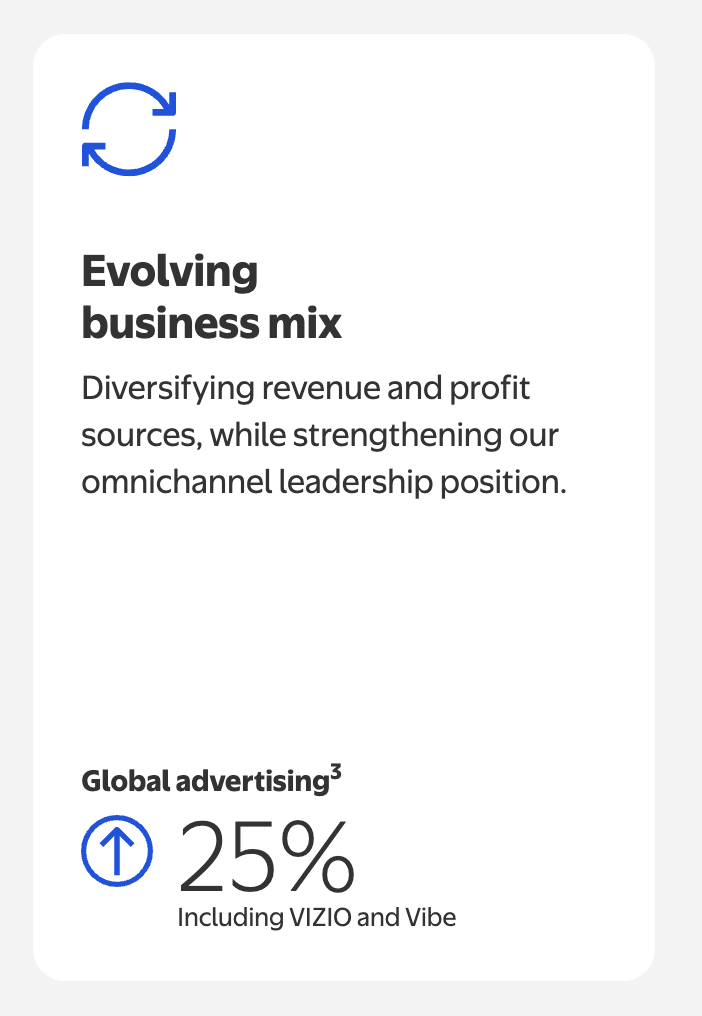
More earnings highlights:
-
- “Sales grew across categories, supported by share gains and eCommerce growth of 23%, including nearly 50% growth in marketplace sales. Walmart Connect advertising grew 36% (ex-VIZIO and Vibe).”
- Walmart didn’t give a dollar figure for quarterly ad revenue. But Adweek noted that the most recent quarter’s 25% global ad growth was the slowest since Q1 2024. Read that one.
More: Walmart Releases Q3 FY27 Earnings (Nov. 19) – Walmart
With VIZIO and Vibe
In the U.S., Walmart’s overall advertising business grew 37% year over year, including TV maker VIZIO and self-serve streaming ad platform Vibe. Excluding both acquisitions, Walmart Connect grew 36%.
So what do VIZIO and Vibe bring to Walmart’s ad business?
Walmart didn’t break out sales for either acquisition, but executives offered a clearer picture of its connected TV strategy: more VIZIO-powered screens, Vibe’s ad-buying tools and sales attribution linking TV ads to purchases.
A few nuggets from the earnings call:
-
- “As a reminder, we also expect cost related to the acquisition and integration of Vibe to be an approximate 20 basis point headwind to full-year operating income growth.” – Walmart CFO John David Rainey
- “The TVs that are powered by VIZIO OS have been the number one sellers in the U.S., and our unit volume for those TVs is up nearly 150% year over year. So that unit volume, the installation base as that continues to grow, allows advertisers more opportunity to speak with the owners of those TVs, our customers and members.” – Walmart Chief Growth Officer Seth Dallaire
- The 50-inch VIZIO TV was the top-selling item for Walmart’s Early Black Friday event from Nov. 12-15 – Walmart U.S. President and CEO David Guggina
- Dallaire said Vibe’s integration with VIZIO happened only a few weeks ago and now enables sales attribution through those TVs. He called its contribution encouraging, but gave no sales figure.
- Asked how shopping agents might affect ad earnings, Dallaire said Walmart is still learning how people search and discover products in conversations. He described experiments with discovery on VIZIO TVs and agentic tools inside Vibe for smaller advertisers, rather than claiming the ad model is settled.
In a followup article on Walmart’s results, The Wall Street Journal noted the retailer’s impressive digital sales: “More Americans now shop online. Walmart has been among the legacy bricks-and-mortar retailers most aggressively ramping up their online operations to get ahead of the shoppers’ shift and fend off Amazon[dot]com.”
Read: “Walmart’s Digital Sales Are Now Driving Its Growth, Not Stores” (Nov. 19) – The Wall Street Journal (subscription)
From tipsheet: Fend off? That ship sailed a long time ago. Walmart is using its stores to challenge Amazon on delivery. In the latest quarter, those stores handled the last mile for more than 80% of Walmart’s U.S. e-commerce orders.
High-margin advertising revenue helps power both companies’ efforts:
-
- Walmart’s global ad business reached nearly $6.4 billion (Feb. 2026) in its last fiscal year and grew 25% year over year in the latest quarter.
- Amazon reported $19.6 billion (Oct. 29) in advertising services for its latest quarter, up 11% year over year.
Walmart vs. Amazon ad revenues
Our estimate:
-
- Walmart’s global ad business grew 37%, 38% and 25% in its first three fiscal quarters. If full-year growth comes in around one-third, that puts Walmart at roughly $8.5 billion for the year. Amazon generated about $78 billion in ad revenue over its latest four quarters. That’s roughly 9x our Walmart estimate, a gap of about $70 billion.
DATA
Databricks wants to steer ad bidding
Databricks, the enterprise data platform, is making a bigger push into advertising with its CustomerLake agentic customer data platform (CDP).
On Thursday, it announced CustomerLake Conversions, a feature of the CDP that will let brands tell ad platforms which conversions their own models predict will be most valuable.
Take a retailer trying to acquire customers likely to buy again…
Today, it might send an ad platform a purchase event and an order value. With CustomerLake Conversions, it could send a more specific signal through a platform’s Conversions API (CAPI) — a first purchase from someone the retailer predicts will buy again. Campaign results would flow back into Databricks, where the retailer and its agency could see whether those customers did come back.
Launch partners include:
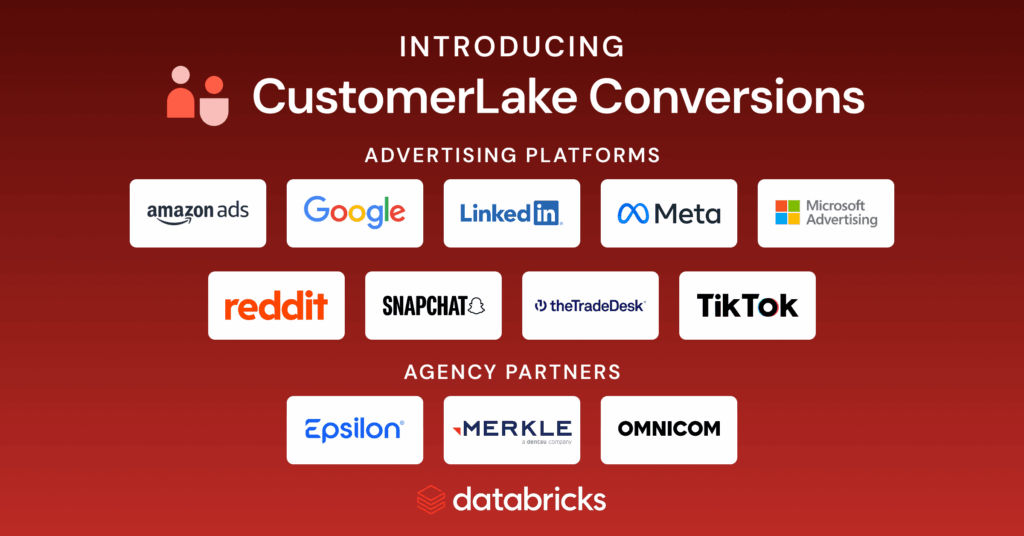
Databricks said the feature will be available to customers using CustomerLake Campaign Agents but didn’t give a date.
Read “Introducing CustomerLake Conversions” (Nov. 19) – Databricks
From tipsheet: Databricks wants to help a brand
-
- decide what a valuable customer looks like,
- send that signal to competing ad platforms and
- bring the results back to judge each platform against the same yardstick.
AGENCIES
How Canvas builds agents for advertisers
-
- “Canvas Worldwide’s Agentic Layer Helps Zillow Distinguish Real Renters From Dreamers” (Nov. 18) – AdExchanger
- On Unharnessed, Britain Eriksen explains how Canvas turns its traders’ expertise into advertiser-specific skills that guide how its agents evaluate media. The agents draw on the agency’s data warehouse and can take action across multiple DSPs. (Nov. 19) – Jonathan Moffie, VP, Agentic at Magnite on LinkedIn. Listen on Spotify.
AGENTS
Who gets the order when Claude fills the cart?
Block shopping agents — or not?
Stratechery analyst Ben Thompson wanted to stock 96 bins with bolts for his workshop. On his podcast with MDM analyst Eric Seufert, Thompson said Anthropic’s Claude Code helped him figure out which sizes he needed, then filled a retailer’s shopping cart. Thompson completed the purchase himself on the retailer’s site.
How did he pick the merchant?
“My LLM goes and actually fills in the cart and by the way, who got all these purchases? The first seller that we found that would allow an agent to actually go on the site and do it.”
Amazon has taken a different approach. It sued Perplexity over its Comet shopping agent and blocked Meta’s Muse from shopping on its site. For a retailer with an ad business to protect, Seufert sees a reason to keep its own agent involved even when the shopper starts somewhere else.
Take Walmart. Under its rules, an outside agent that wants to check out autonomously must go through Walmart’s Agent Gateway, which connects it to the retailer’s AI assistant, Sparky. As Seufert put it, “no matter what agent you’re using, you’re using Sparky, Sparky’s behind the curtain.” That gives Walmart a way to include ads in the response, he argued.
Read or listen: “An Interview With Eric Seufert About Agentic Commerce” (Nov. 19) – Stratechery (subscription)
From tipsheet: Amazon and Walmart already have shoppers, and advertisers pay to reach them. The bolt seller had a different calculation. By the time Claude reached its site, Thompson knew which bolts he wanted. Letting Claude fill the cart helped decide who got the order.
MEASUREMENT
Trade Desk slow-rolls Open Measurement
A feedback loop for the open internet?
The Trade Desk already has two data partners and a Hershey case study for a measurement product it still plans to formally launch this quarter.
Yesterday, TTD said Hershey and MiltonOne, the agency Publicis created for Hershey in 2024, were the first to test Open Measurement. They used Hershey’s own sales data to compare CTV publishers, then shifted spend based on the results.
The rollout has come in pieces:
-
- CEO Jeff Green previewed Open Measurement on TTD’s Nov. 9 earnings call.
- On Nov. 11, Green made the case that last-click attribution gives too little credit to the ads that create demand.
- On Nov. 17, Attain announced it would supply purchase data. Its CEO Brian Mandelbaum explained why in The Current, TTD’s publication.
- Yesterday (Nov. 19), the same day TTD shared Hershey’s beta results, Circana announced its own data partnership. The release still put the formal launch in Q4. TTD Chief Commercial Officer Kristi Argyilan said adding purchase data “lets advertisers see how each touchpoint contributed to sales and gives publishers credit for the demand their media helps create.”
Hershey Chief Growth and Marketing Officer Stacy Taffet described the problem Open Measurement is trying to solve in TTD’s LinkedIn post.
“Every media partner defines success a little differently, which makes them hard to compare. Open Measurement gave us one consistent view, built on our own sales data, and a way to act on it. We could see how our partners stacked up and adjust spend with more confidence.”
See the results on LinkedIn. (Nov. 19)
From tipsheet: For CTV publishers, there’s money riding on how TTD assigns credit. In Hershey’s test, the scorecard helped decide where the next ad dollar went.
LLMs & CHATBOTS
What happened to Reddit’s AI citations?
“Inbox: Reddit went from as much as 8% of ChatGPT citations in Q2 to nearly zero in October for the shopping-related prompts Tinuiti tracked. As Reddit fell out of the results, Walmart, Ulta, and Target gained citation share from Q3 to early Q4.” (Nov. 19) – Trishla Ostwal, reporter, Adweek on X
More from Ostwal: “LinkedIn Taps Former Trade Desk Exec to Lead Global Ad Sales” (Nov. 19) – Adweek
PLATFORMS
NYT: AI hurts Google’s ads
“The Silicon Valley giant’s search advertising has long fueled the company. But its search ad growth is slowing as A.I. becomes more prevalent…”
Read: “Google Leaned Into A.I., Hurting Its Core Business” (Nov. 19) – The New York Times (subscription)
Meanwhile, yesterday: “New on the Google desktop homepage globally: we’re rolling out a collapsible sidebar to easily find & jump back into your recent AI searches.” (Nov. 19) – Google VP Product, Search, Robby Stein on X
LLMs & CHATBOTS
Developments
-
- ICYMI: “Anthropic IPO live updates: AI lab tops $2 trillion market cap in debut” (Nov. 19) – CNBC
- Agentverse: “Google Built a Giant ‘Mirror Dimension’ Internet to Test Its Chrome AI Agents” (Nov. 19) – Wired (subscription)
- Agent Gemini: “Let Gemini tackle repetitive chores on your Mac” (Nov. 19) – Google
MORE
-
- AI and ads: “Satya Nadella predicts AI agents will reshuffle the economics of the web” (Nov. 18) – TechCrunch
- More inventory? “Meta Launches (Another) Messaging App” (Nov. 18) – MediaPost
- M&A in review: Why Adobe bought AEO/SEO firm Semrush: “Former president reveals new details” (Nov. 19) – Search Engine Land
- Standards: “Building a More Connected CTV Ecosystem with OpenRTB 2.6” (Nov. 19) – Magnite
- Holiday agents: “In Graphic Detail: Welcome to the agentic commerce quarter” (Nov. 19) – Digiday (subscription)