
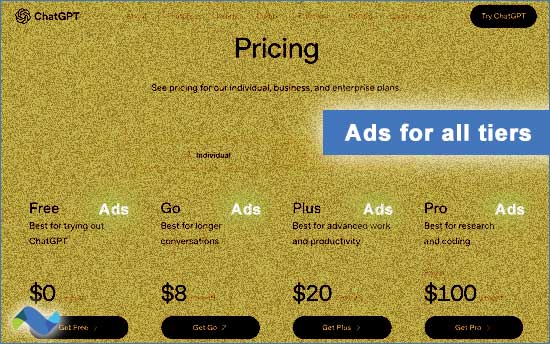
Higher-priced individual subscriptions offer another source of advertising revenue. And business plans could open a more valuable ad market around the decisions companies make in a conversational context.
ChatGPT’s next advertising opportunity may be sitting inside the subscriptions it currently sells as ad-free.
On August 31, OpenAI announced that ChatGPT Ads had reached a $1 billion annualized revenue run rate in less than 200 days. In April, Axios reported a $100 billion annual advertising revenue projection for 2030.
ChatGPT Ads progress to date is impressive, but the road to $100 billion remains long and ambitious.
Despite OpenAI’s current policy — which keeps Plus, Pro, Business, Enterprise and Edu subscriptions ad-free — tipsheet expects ChatGPT Ads surfaces to expand in two directions:
- Higher-priced individual subscriptions.
- Sponsored commercial discovery inside Business and Enterprise.
Thus far, the company has provided no indication that it plans to expand ads into those tiers. But the argument for changing that boundary starts with the cost of providing AI and becomes more interesting when considering what people use AI to decide.
The argument:
- The $100 billion math
- Go provides the test
- Plus and Pro come into focus
- Business could be the bigger unlock
- Buy shelf space, not the recommendation
- Trust makes it possible
The $100 billion math
Reaching the reported target would require annual advertising revenue roughly 100 times this past August’s run rate.
OpenAI can pursue that growth through more users, international expansion, additional formats and better advertising performance. Opening more subscriptions to advertising would provide another source of inventory, too.
The costs create an incentive to consider it.
Reuters reported in February that OpenAI was targeting approximately $600 billion in compute spending through 2030. That encompasses a much broader investment than the expense of answering an individual prompt, but serving users is part of the bill.
OpenAI already uses infrastructure costs to explain advertising, saying ads help fund reliable access and continued product investment for Free and Go. That rationale could eventually extend to subscribers receiving more capabilities or higher usage allowances — the “ads subsidize inference” business model continues to thrive.
An eventual IPO could sharpen the pressure to improve revenue growth, margins and cash flow. Advertising offers an additional return on an audience OpenAI has already acquired, which could make expanding ad eligibility for its products an increasingly valuable revenue lever.
Additionally, OpenAI’s commercial organization is taking shape.
Tipsheet has tracked plans for direct, reseller and outsourced sales. A current advertising product marketing role connects advertiser needs with product priorities and adoption. Those postings establish the structure of the commercial buildout without identifying any change in subscriber eligibility.
Go provides the test
Go, priced at $8 a month in the U.S., already combines a paid subscription with advertising eligibility. That gives OpenAI a way to study the two revenue streams together.
For OpenAI, the useful questions about ads extend beyond whether subscribers click an ad:
- How do different formats affect engagement and renewals?
- Does advertising encourage an upgrade to an ad-free plan?
- Can ad revenue support more model access at the same subscription price?
- What happens to the combined revenue and cost of serving a customer over time?
OpenAI has not described Go as a test bed for higher-tier advertising. It nevertheless provides a population in which to investigate those questions.
The findings would need validation elsewhere — and a Go subscriber’s expectations may differ substantially from those of a Pro subscriber or an employer buying hundreds of seats.
Go establishes that subscriptions and advertising can coexist. The next question is where that combination creates enough value to expand.
Plus and Pro come into focus
Higher-priced individual plans are the more straightforward extension for ChatGPT Ads. They include professional users such as entrepreneurs, consultants or marketers who use a personally purchased subscription to conduct consequential business research while using the same account for ordinary personal tasks.
The distinction between OpenAI’s individual and organizational ChatGPT accounts tells us how the product is purchased and administered, but it tells us much less about the value of a particular decision.
Ad-free subscriptions create a tradeoff: OpenAI collects subscription revenue while forgoing the opportunity to show ads during those sessions.
Is the subscription juice worth the squeeze?
OpenAI could offer more capabilities or usage in exchange for advertising.
The company’s advertising principles promise an ad-free paid option, leaving room for different combinations of price, capability and advertising. Changing an existing plan would still mean changing a benefit customers were sold.
The test would be whether advertising improves the overall economics after accounting for cancellations, reduced engagement and the cost of delivering it.
Ultimately, Plus and Pro present a pricing decision.
Business could be the bigger unlock
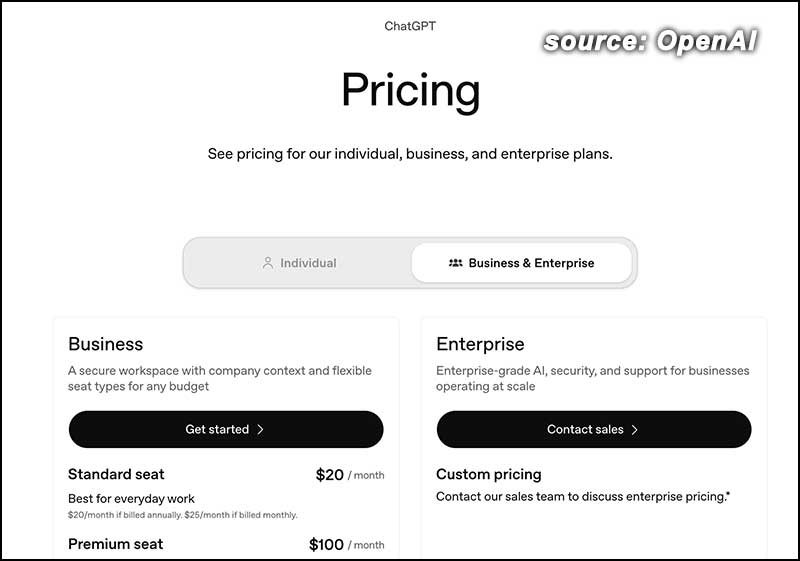
Business and Enterprise offer something potentially more valuable than another place to display ads: access to purchasing decisions happening through the software itself.
Consider the difference between updating a sales record and asking an assistant which supplier the company should hire.
The first task manages an existing process and the second can assemble a market.
ChatGPT brings vendor discovery and evaluation into the same conversational workspace employees use for everyday work.
SaaS with a purchase funnel
That gives OpenAI a potential second revenue stream inside the same product: subscription revenue for doing the work and advertising revenue around some of the commercial decisions flowing through it.
An employee might ask ChatGPT to establish requirements, identify vendors, compare proposals, investigate compatibility and prepare a recommendation. Suppliers have an economic reason to participate in that process.
OpenAI itself describes ChatGPT as a place where people frame decisions, establish criteria and understand alternatives, including choosing software for a business.
The model builds on the commercial intent that makes search advertising valuable. Search has always prized the buyer whose query reveals exactly what they want at exactly the moment they want it. But a conversation can reveal far more than a query: requirements, constraints and follow-up questions that carry the interaction deeper into evaluation.
So, imagine a supplier pursuing a $500,000 contract.
An introduction to someone actively evaluating suitable products could be valuable even if the audience is small. What matters is the quality of the opportunity and whether the introduction produces a measurable result.
That suggests a business built around a limited number of purposeful commercial interactions. The potential compensation could be tied to an engagement, a qualified introduction or another disclosed advertising objective.
Some revenue could subsidize the customer’s AI usage. Some could improve OpenAI’s margins. Neither outcome requires assuming every workplace conversation becomes advertising inventory.
Buy shelf space, not the recommendation
Here is how that opportunity could work.
A marketing team asks ChatGPT Business to find a measurement provider that integrates with Snowflake, covers streaming TV and operates in the U.S. and Europe.
ChatGPT produces an independent shortlist.
Below it, a clearly labeled sponsored placement introduces another supplier whose product appears to meet those requirements. The team can inspect the claim, ask questions and decide whether to include that supplier in its evaluation.
The advertiser gets an opportunity to compete. The buyer discovers another potentially relevant solution.
AI advertising can buy shelf space. It cannot buy the recommendation.
That distinction matters when an assistant compresses a complicated market into a few options. Sponsored placements can create another entry point for new or lesser-known suppliers. Independent research must continue to surface suitable products regardless of their advertising budgets.
A sponsored supplier could ultimately earn a recommendation if the user chooses to evaluate it and the evidence supports that conclusion. Payment should never determine the evaluation criteria or the result.
There is already a relevant format precedent. On September 16, OpenAI announced testing of Sponsored Agents, allowing users who click an ad to start a separate, labeled conversation with a business-sponsored agent. OpenAI says that interaction is distinct from ChatGPT’s independent answers and the original conversation.
A future workplace version could let an employee investigate a supplier’s capabilities or request a demonstration, subject to the organization’s permissions.
Calling the feature “commercial discovery” would not change the need to disclose paid participation as advertising.
Trust makes it possible
The value of this opportunity rises with the importance of the decision. So does the cost of compromising it.
An employee delegating part of a vendor assessment to ChatGPT needs confidence that its judgment serves the company. A sponsored placement is visible. A hidden change to the shortlist, the weighting of evidence or the questions the assistant asks would be much harder to detect.
OpenAI currently says its ad system operates separately from the chat model, with advertisers unable to shape, rank or alter ChatGPT’s responses. Business advertising would need to preserve that separation as the interaction becomes more elaborate.
Organizational accounts would require their own product design. A company might enable sponsored supplier discovery only for approved teams or purchasing tasks. It would need control over which information could be used and explicit permission before anything was shared with a vendor.
Those safeguards would have to fit OpenAI’s existing business data commitments, including confidentiality, organizational ownership and administrative controls. Permission to operate a company workspace should never be treated as blanket permission to turn its contents into advertising signals.
Authorized interactions and outcomes could also provide useful feedback for improving ad relevance and measurement. That learning would require defined data permissions, retention rules and a clear boundary around confidential company material.
The economic test therefore includes the relationship OpenAI is protecting. An advertising product that undermines confidence in the assistant could damage the subscription business that makes those interactions possible.
Trust isn’t merely a constraint on the advertising opportunity. It’s what makes the opportunity valuable. The more buyers trust ChatGPT’s independent judgment, the more valuable adjacent sponsored shelf space can become.
Tipsheet expects OpenAI to explore advertising in higher individual tiers as well as commercial discovery inside its business products. The workplace opportunity could prove especially valuable because the product sits so close to the buyer’s reasoning.
OpenAI could sell access to the consideration process while continuing to work for the buyer. Preserving that independence will be key to unlocking the opportunity.