
OpenAI has introduced conversion-optimized campaigns with impression billing, allowing ChatGPT advertisers to optimize toward purchases, sign-ups or leads while paying for impressions. Known as oCPM, the model uses eligible conversions following ad views and clicks to guide delivery.
Issy Evans, a member of OpenAI’s Global Ads Solutions team, wrote on LinkedIn: “People don’t always click and buy straight away, so this helps account for those who discover something, think about it and come back later.” (Sept. 16)
Advertisers can still choose oCPC, which charges for clicks and optimizes toward post-click conversions. With oCPM, advertisers pay for impressions while bids reflect predicted conversion likelihood.
Read: Conversion-optimized Campaigns – OpenAI
More: “A few updates I thought helpful to call out…” (Sept. 17) – Mitch Pilar, GTM, Ads Solutions on LinkedIn
From tipsheet: OpenAI is moving beyond the click as the primary signal of advertising value. With oCPM, an ad seen during a ChatGPT conversation can influence subsequent delivery and receive conversion credit even when the user never clicks it. The conversation may create the consideration even when the conversion happens later.
LLMs & CHATBOTS
Talking OpenAI ad strategy with ‘the axe’
With an OpenAI IPO looming, although it may not occur until next year, New Street analyst Dan Salmon has produced extensive research on the company and is rapidly establishing himself as the Wall Street “axe” on OpenAI’s advertising plans.
Garett Sloane speaks with Salmon for a new article in Ad Age. He previews their discussion on LinkedIn:
“From the start, there was a lot of skepticism about OpenAI’s commitment to advertising for the long haul. There was a sense a new channel might not work, that AI chats are not the place for ads, that ChatGPT needed to compete for enterprise contracts not ad dollars. New Street’s Daniel Salmon said that’s a misread of the competitive landscape.
‘We’re seeing an ad platform roll out more aggressively than I’ve ever seen an ad platform roll out before,’ he tells Ad Age. The enterprise push and the ad business feed into each other.”
Read more. (Sept. 17)
Read: “How OpenAI is connecting ChatGPT ads to its enterprise business—and what it means for brands” (Sept. 17) – Ad Age (subscription)
PROTOCOLS
This week in MCP
- Business messaging: “Announcing WhatsApp Business Tools MCP: Set up and manage WhatsApp business from your AI agent” (Sept. 15) – Meta
- Connected home: “Introducing Home MCP: enabling your agent to interact with your home” (Sept. 16) – Google
- Enterprise security: “Implementing defense-in-depth authorization for MCP tools on Amazon Quick” (Sept. 17) – Amazon Web Services
From tipsheet: MCP is moving from a developer protocol to an operating layer.
AGENTS
Salesforce touts Campaign Agent
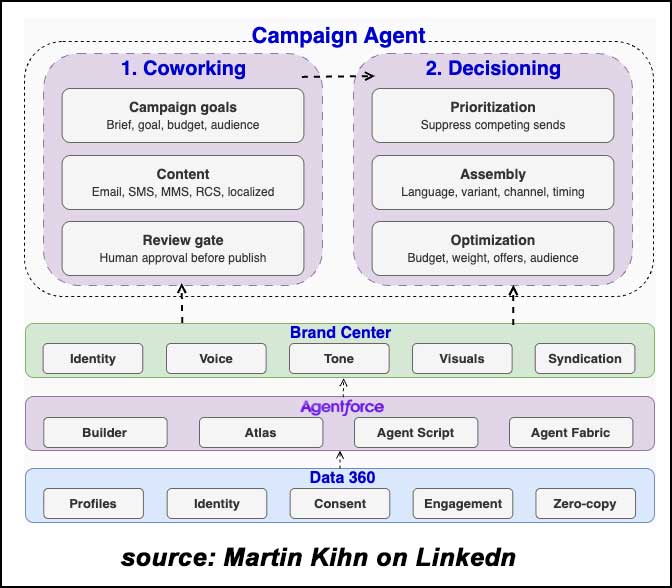
Coming out of this week’s Dreamforce event in San Francisco, Salesforce introduced Campaign Agent, which turns a marketer’s goals, audience parameters, brand guidelines and approved assets into a campaign, then continuously decides which campaign, content, channel and send time are best suited to each customer.
Salesforce SVP of Strategy Martin Kihn described it as a “campaign coworker” rather than a self-driving marketing operation:
“There are 2 PHASES:
1 – Coworking – which is the very human-mediated process of defining a campaign, pulling together the right audience, elements and assets, setting up the right channels …
2 – Decisioning – where machines take the lead – the mathematical and iterative exercises of prioritizing different campaigns for the individual, pulling the right elements together in real-time …”
Read more on LinkedIn. (Sept. 17)
More:
- Introducing The Campaign Agent That Turns Goals Into Growth (Sept. 14) – Salesforce 360 blog
- Agentforce Marketing Innovations: Dreamforce 2026 and What’s New – Salesforce
From tipsheet: Campaign Agent positions Salesforce upstream of execution, where goals, audiences, creative and channel choices are set. Salesforce, like everyone, wants to be closer to the decision.
AGENCIES
Dentsu sees the stack compressing
Writing from ATS London, Louis Naghten, group partner at Dentsu, says:
“The industry is beginning to reimagine where decisions happen, how they happen and, perhaps most importantly, how many layers are actually required to make them happen…
The emergence of agentic systems, containerisation and SSP-side decisioning creates a future where much of today’s fragmented stack could effectively collapse into a far smaller number of connected intelligence layers.”
Read more on LinkedIn. (Sept. 15)
Dentsu has pursued a containerization strategy for at least a year through its partnership with Chalice and Index Exchange. Naghten says the agency now incorporates SSP-side containers into campaign architecture for all its clients.
From tipsheet: The DSP remains involved, but some of the intelligence and differentiation that once resided there is moving closer to supply and under greater agency control.
Related: “Inside the complex anatomy of agency AI bills” (Sept. 17) – Digiday (subscription)
DATA
Case study: Databricks + The Trade Desk
A Databricks case study offers another clue about the expanding relationship between the data platform and The Trade Desk.
The Trade Desk uses Databricks to apply natural language processing to millions of web pages each day, turning their content into signals advertisers can use to optimize global marketing spend.
That is only one layer of the relationship.
- Last November, the companies integrated Unified ID 2.0 into Databricks Data Clean Rooms, allowing advertisers to resolve identities, build audiences, measure campaigns and activate their first-party data through The Trade Desk without moving raw customer information outside their Databricks environment.
- In June, The Trade Desk became a launch partner for CustomerLake, Databricks’ agentic customer data platform. CustomerLake is designed to let agents continuously analyze customer behavior, make marketing decisions and activate them across platforms including The Trade Desk.
Taken together, the pieces point toward a closed loop: Databricks holds the customer data, models and agents; UID2 connects that intelligence to audiences; and The Trade Desk executes across the open internet. Campaign and conversion signals could then return to Databricks to inform the next decision.
Read: The Trade Desk leverages the power of NLP with Databricks – Databricks
From tipsheet: Databricks could emerge as the intelligence and control layer above The Trade Desk, with TTD serving as the execution engine for the open internet. That could make TTD easier to activate from enterprise data while putting Databricks in a position to influence where advertising dollars go. TTD is also an important example of Databricks pursuing the data-intensive ad tech market that helped Snowflake establish itself as an enterprise data platform.
GOVERNANCE
Provenance: Retail chatbot answers get scrutiny
Sens. Tammy Baldwin (D., Wis.) and Rick Scott (R., Fla.) asked the Federal Trade Commission to investigate whether shopping assistants from Amazon (Alexa) and Walmart (Sparky) “obscure and suppress” information about products made in the U.S.
The Wall Street Journal reported yesterday that Amazon denied intentionally withholding country-of-origin information, saying it displays the data on product pages when available and is improving Alexa for Shopping’s ability to surface it. Walmart declined to comment.
Read: Retail Chatbots Draw Lawmaker Pushback Over Product Origins (Sept. 17) – The Wall Street Journal (subscription)
More: Baldwin, Scott: Lead bipartisan call for investigation into Amazon and Walmart for hiding Made in America goods (Sept. 17) – WisPolitics-State Affairs
From tipsheet: As shopping agents mediate discovery, the product data they surface, omit or prioritize could face the same scrutiny as conventional product claims and rankings. Where did that answer come from?
CREATIVE
Provenance: Apple authenticates images at capture
Last week, Apple introduced Reference Image, an opt-in iPhone 18 Pro system that authenticates photographs beginning at the camera sensor rather than attaching provenance only after capture. Earlier this week, the company went much deeper to explain how the system works.
Read: Apple Reference Image: A New Approach for Verified Photography (Sept. 15) – Apple
Dentsu global chief product officer Matthew Schultz took note and highlighted its combination of authenticity, resilience and photographer privacy. Read more from Schultz on LinkedIn. (Sept. 15)
Rembrand CEO Omar Tawakol described it as a potential “root of trust” that could complement CAI and C2PA as provenance information moves through editing and distribution. Read Tawakol on LinkedIn. (Sept. 13)
Meta, Google and Microsoft have all made moves in this area in recent weeks.
From tipsheet: Advertising’s provenance challenge begins before an asset enters the creative supply chain and Apple is attempting to authenticate its origin. Platforms and standards still need to preserve that evidence downstream.
MEASUREMENT
Follow-up: Chrome’s new CrUX ad metrics
Following Tuesday’s news about Chrome’s new CrUX metrics for measuring ad load, U of Digital’s Myles Younger engaged in a short but noteworthy Q&A on LinkedIn with the Google Chrome product manager leading the initiative, Alex Cone.
Myles Younger: “How do you see these new CrUX metrics (great acronym!) getting priced into CPMs? Ad count and density seem like relatively easy inputs into any ‘inventory valuation’ models since you’re directly measuring the level of competition for viewer attention.”
Alex Cone: “Advertisers may decide to point ad spending toward the sites that fall in some sort of range… publishers might decide to adapt ad experiences accordingly.”
Read more. (Sept. 16)
From tipsheet: Google wants advertiser demand to reward less cluttered inventory and, potentially, produce higher CPMs for publishers that provide better experiences. Less clutter may also make publisher content easier for AI systems to parse.
RESEARCH
Analysis
- Hybrid channel: “What Kind of Media Channel Is AI, Anyway?” with Criteo CEO Michael Komasinski (Sept. 17) – Debra Aho Williamson on The AI Ad Economy Substack
- Overcoming superstition: “ChatGPT introduces conversational ads and a Shopify integration” (Sept. 17) – Eric Seufert on Mobile Dev Memo (subscription)
- Retail reckoning: “The Knives are Out for Retail Media: How Will RMNs Respond to this Fork in the Road?” (Sept. 16) – Andrew Lipsman on Media, Ads + Commerce Substack
LLMs & CHATBOTS
Developments
- Emerald AI, Google and Nvidia Launch Alliance to Advance Flexible AI Data Centers (Sept. 17) – Nvidia
- Europe’s new AI edge? The emerging application layer opportunity (Sept. 17) – McKinsey & Co.
- “Sources: Manus is set to soon close a $500M round at a $4B valuation, signaling growing confidence after Beijing unwound Manus’ short-lived $2B buyout by Meta” (Sept. 17) – Bloomberg (subscription)
PEOPLE MOVES
Now hiring
- “I promised to share what comes next and here it is: I’m joining Prodege as CEO on October 1, and excited about what we can build together… Across seven consumer brands, Prodege serves 125 million users that provide deep, trusted feedback… an extraordinary business in consumer research and commerce, connecting human perspective and participation to real business outcomes.” (Sept. 17) – Former Criteo CPO Todd Parsons on LinkedIn
MORE
- Anthropic making moves: “Claude now speaks commerce, too. It is the last chatbot to add product cards – I started seeing them today.” (Sept. 17) – Entrepreneur Joe Kaziukėnas on LinkedIn
- Incremental RMN: “Albertsons Media Collective Now Offers Incremental Multi-Touch Attribution” (Sept. 17) – Progressive Grocer
- Predictive retail: “Sam’s Club Debuts Ad Targeting Products That Confidently Assert Future Buyers” (Sept. 17) – AdExchanger
- Performance+ addition: “Pinterest unveils Visual Search Ads, bringing new performance advertising to visual discovery” (Sept. 17) – Pinterest
- Commerce intelligence: Walmart evolves Scintilla with AI-powered analysis and activation across media, inventory and in-store execution (Sept. 17) – Mass Market Retailers