
Palantir’s appeal to media and marketing companies (1, 2) goes beyond AI tools: It connects fragmented data to the workflows where people and models can act on it. Adweek’s Mark Stenberg examines that role at Zeta Global, Stagwell, USA Today Co. and Fox News Digital.
Zeta rebuilt its data cloud on Palantir’s Foundry platform and signed a seven-year partnership that also gives it access to Palantir’s commercial customers. Stagwell uses Foundry between its data and AI models.
Stagwell chief AI officer John Kahan said:
“We want to be agnostic to the LLM. That is what the ontology gives us: the ability to take that data, integrate it, and reason over it. If someone comes out with a new model, we switch the model.”
Palantir’s engineers also helped Fox build a platform that assists with production tasks for 95% of its digital articles, although nothing reader-facing is AI-generated.
Read: Palantir’s Quiet Takeover of Media’s Data Stack (Sept. 23) – Adweek
From tipsheet: AI models may become interchangeable, but the infrastructure connecting company data to everyday decisions is harder to swap out. Palantir is positioning itself in that layer. There’s a parallel with SSPs’ orchestration ambitions: The strategic value lies in coordinating data, models and actions, even as the models themselves change.
Who will own the layer connecting company data to AI-driven action? Palantir’s push raises different questions for many data-related companies. A few thoughts:
- LiveRamp: Its Sept. 16 preview of LAB Demo Day highlights third-party agents built on its identity, activation and measurement infrastructure. Does that network position LiveRamp to orchestrate marketing, or supply the platform that does?
- Hightouch: Its Sept. 18 introduction of content review agents puts brand checks, product accuracy and human approvals inside its marketing platform. Can that depth in marketing workflows give it an edge over Palantir and its partners?
- Snowflake: Its September AI updates emphasize model routing, agent governance and automated workflows. Will companies run agents where their data already lives, or put a platform like Palantir above it?
- Databricks: Its June expansion of Agent Bricks combines model choice, business context and governance in a platform for building agents. Can it turn its data foundation into the operational layer Palantir is pursuing, or will customers use both?
MARKETING
OpenAI sets out to build its own marketing stack
OpenAI is hiring a Head of Marketing Technology to build what it calls “the most AI-enabled marketing operations organization in the world.” The role will oversee OpenAI’s internal marketing systems, data and workflows, with authority to decide what to build, buy, integrate, consolidate or retire.
One responsibility makes the ambition explicit: “Build AI-enabled workflows and agents that connect research, strategy, creative development, campaign execution, optimization, and learning.”
The position sits within Business Marketing, helping drive adoption of OpenAI’s products. Its remit includes connecting product usage, customer engagement and enterprise buying signals so Marketing and Sales can identify and respond to demand.
From tipsheet: Should MarTech providers be looking over their shoulders?
OpenAI could become its own test case for replacing purchased marketing software with capabilities it builds using AI. If it can connect research, creative, execution and learning through its own agents, how much of the traditional martech stack will it still need? The listing describes an internal effort, but the broader question is whether what OpenAI builds for itself could eventually become something it sells to others.
AGENTS
ChatGPT’s Sponsored Agents test brand control
ChatGPT’s Sponsored Agents (announced Sept. 16) let advertisers conduct AI-generated sales conversations, but brands cannot approve every answer. Instead, they supply information, instructions and boundaries for the agent to follow, Ad Age’s Garett Sloane reports.
Previewing his article on LinkedIn, Sloane frames the questions: “What does the agent say on the brand’s behalf? What information do brands receive about those conversations? How do you measure them?”
Sloane says OpenAI is still working out which parts of those conversations it will share with advertisers. The format asks brands to move from approving ad copy to setting rules for a sales conversation that unfolds on its own.
Michael Cohen, EVP of performance media at Horizon Media, describes the format to Sloane as an ad that conducts the sales conversation.
Read more on LinkedIn. (Sept. 23)
And read: “How ChatGPT Sponsored Agents work—and what brands can and can’t control” (Sept. 23) – Ad Age (subscription)
From tipsheet: If an agent speaks for the brand, advertisers need enough visibility to judge whether it represents them well.
Related: ChatGPT ads at DMEXCO (Sept. 24) – David Dugan, Head of Global Ad Solutions, OpenAI on LinkedIn
COMMERCE MEDIA
Advertising + retail momentum
- New Bank RMN: “Excited to finally share Citi Commerce Media, our new platform helping brands reach Citi customers. This is what my amazing leaders Dezeree, Clara, and I have worked on for the past few months.” (Sept. 24) – Joseph Almonte, VP, Citi on Linkedin
- New QSR RMN: “Why McDonald’s is following Walmart and Amazon into the advertising business” (Sept. 23) – CNBC
PROTOCOLS
Meta expands MCP beyond advertising
At its Connect conference this week, Meta’s announcements included:
- Meta AI connectors, letting developers connect services through APIs or MCP so people can use them within an AI conversation. Early access starts with glasses and Meta AI on web and mobile.
- Expanded retail connections for AI assistant Muse, including Walmart, Best Buy, Sephora, Wayfair and others, plus Shop Pay and PayPal for payments.
- Muse is also coming to Meta’s AI glasses in the coming months. Separately, planned shopping features for the glasses will identify products, surface prices and reviews, set alerts and support purchases by voice.
Read: “Everything We Announced at Meta Connect 2026” (Sept. 23) – Meta
From tipsheet: In April and May, we covered Meta opening its ad tools to outside agents through its Ads MCP server. Now, Meta is bringing outside businesses into its own AI interface. These distinct integrations position agents on both sides of commerce: helping advertisers run campaigns and consumers act on purchase intent.
In our Connect preview, we asked whether glasses could become a new interface for product discovery. These announcements take that question further: Can the agent access your products and complete a purchase?
Related: Meta brings Ads MCP controls to Business Suite (July 27) – tipsheet
AGENTS
Agentic updates
- Apostra has 40 media partners: “The Ad Gateway: Connect Once, Advertise Everywhere” (Sept. 24) – Apostra co-founders Brian O’Kelley and Anne Coghlan on their blog
- Europe: “Agentic Ad Buying Gains Ground in IAB Europe’s 2026 AI Report” (Sept. 24) – IAB Europe
- Muse and the ad funnel: Viant CEO Tim Vanderhook argues that Meta’s agent could eventually take consumers from ad-driven interest through checkout. Read LinkedIn. (Sept. 24)
LLMs & CHATBOTS
When GEO moves beyond GEO
Profound CEO James Cadwallader on LinkedIn:
“In case you missed it on TBPN: your AI Marketer can now generate, launch, and optimize campaigns across your paid channels with Profound Ads Studio, currently in beta.”
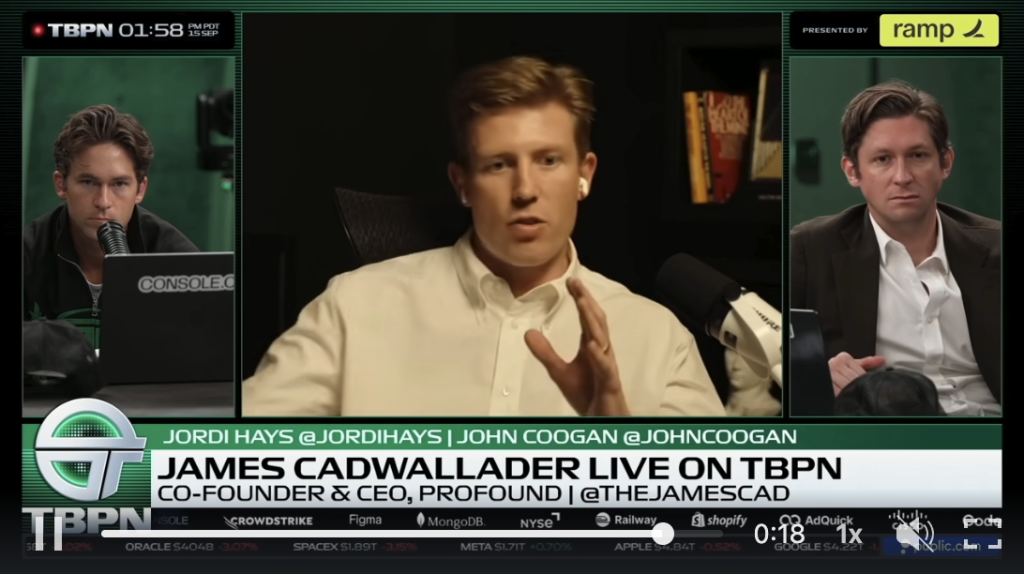
Read and hear more. (Sept. 24)
LLMs & CHATBOTS
Developments
- Meta Debuts Dedicated ‘Charm’ Device for Using Muse AI (Sept. 23) – Bloomberg (subscription)
- Behind Project Suncatcher, our moonshot to put AI in space (Sept. 24) – Google
- Jev developer TypeSafe is in talks to raise $1B+ at a $10B+ valuation; last week the startup announced a $40M seed, PitchBook says at a $200M valuation (Sept. 24) – The Information (subscription)
PEOPLE MOVES
Now hiring
- SQREEM Technologies: “I’ve had the privilege of building alongside some of the sharpest minds in tech in pursuit of this belief. That is why I am thrilled to announce that I will begin my next chapter as Chief Executive Officer of SQREEM Technologies.” (Sept. 23) – Former Googler and Perion CRO Stephen Yap on LinkedIn
- Scowtt: Predictive AI platform Scowtt announced the appointment of Ben Trenda as Chief Revenue Officer (Sept. 23) – press release
- Conductor: Chief Product Officer Wei Zheng takes over from co-founder and long-time chief executive Seth Besmertnik as CEO of Conductor as answer engine optimization becomes a bigger focus of its business (Sept. 24) – Search Engine Land
MORE
- ChatGPT Ads in 60+ countries: “Our global expansion continues: ChatGPT Ads are rolling out in Indonesia, Malaysia, the Philippines, Singapore, Thailand, Vietnam and Taiwan.” (Sept. 23) – Benji Shomair, VP Monetization, OpenAI on LinkedIn
- Opinion: “ChatGPT ads glass ceiling for growth” – Bostjan Spetic, CVP Product, Teads on his personal blog
- The CTV side of the SSP: “PubMatic Jumps On The Show-Level CTV Targeting Bandwagon” (Sept. 24) – AdExchanger
- Restructuring incentives: “The Trade Desk wants to reprice over 15 million stock options on the heels of a substantial round of layoffs.” (Sept. 24) – Adweek
- Fewer visits, more value: Publishers are shifting their focus from traffic growth to revenue per remaining human visit, GrowthCode’s Trip Foster writes on LinkedIn (Sept. 23)