

Magnite is finding an early use case for agentic advertising in CTV direct deals, where buyer and seller agents can negotiate and launch campaigns without a traditional DSP.
Magnite Head of Agentic Jonathan Moffie tells the Open Market podcast that direct IOs have become the main use case so far for its agentic products, which are live but not yet operating at Magnite scale.
[7:13]
“We are live. It’s not the Magnite scale but we’re ramping up pretty significantly and the real major use case to start are CTV direct IOs where you really can bypass the DSP, go direct to the publisher and handle that negotiation. It’s normally extremely manual, taking weeks of emailing back and forth, negotiating the rates.”
Agencies can use Magnite’s buyer agent, private-label it or connect a third-party buyer agent through Magnite Orchestration to its seller agent. Moffie says the agentic products have generated “the fastest growing pipeline in the history of Magnite,” with real campaigns now launching.
The approach has similarities to Google’s Buyer Direct (tipsheet July 14, August 3), which also creates a path for agencies to transact direct deals with publishers without using a DSP. Magnite is approaching the opportunity through buyer and seller agents connected by its infrastructure.
Magnite CEO Michael Barrett has been more cautious about how quickly agentic advertising will become meaningful financially.
On the company’s Q2 earnings call, he said customer estimates for industrywide agentic spending in 2027 range from zero to $1 billion and characterized the opportunity as a mid-to-long-term growth driver. At the same time, Barrett called Magnite Orchestration a potential “critical infrastructure layer” for agentic advertising.
Watch: Episode 110: Agentic Advertising Is Already Here with Magnite’s Jonathan Moffie (August 12) – Marketecture’s Open Market podcast on YouTube
From tipsheet: Magnite and Google are approaching the same opportunity from different directions: make direct deals easier to buy without requiring a traditional DSP. Google is building the workflow into Ad Manager. Magnite is betting buyer and seller agents can do the work.
Also in the interview: Why CTV may be an early proving ground for agentic advertising, how agents are already recommending campaign optimizations and why Moffie thinks human approval will remain important for large campaigns.
COMMERCE MEDIA
When retail media becomes ‘investment-grade’
Retail media networks want access to more than the money brands have already committed to retailers. To get it, they need to prove their media can compete for the same dollars as other advertising channels.
David Glaza, CEO of retail media agency DIGITS, calls that standard “investment-grade media.”
Speaking with Kevel CEO James Avery on his company’s Unlocking Retail Media podcast, Glaza says the concept grew out of conversations with sales leaders who believed they weren’t getting a fair share of their companies’ media budgets. A brand might spend $5 million with Target when the retailer believes it should spend $8 million, leaving the sales team to make the case internally for the additional money.
[14:28]
“We know brands spend a ton of media money. It’s not all dedicated to retail media. And so the retail media bubble keeps getting bigger and bigger every year, I think, soaking up more of it. And we wanted to arm our clients with, well, how do you fight for your share of your internal budget?”
Beyond the JBP
Winning those dollars requires more than fulfilling a joint business plan (JBP). Avery frames the pitch to retailers this way: you’re going to get what you’re owed through the JBP, but is this media better than what the brand can get on Meta? That’s the standard retail media has to meet if it wants to compete for broader media budgets.
Glaza says the larger retail media networks are getting better at providing the evidence required to make that case.
[15:27]
“Being able to give you the metrics and the KPIs that your head of media as a brand wants to see and your CFO wants to see to feel good about their spend. And so I think that that’s something the big RMNs are really focused on…to try to unlock and get a bigger share of the total media budgets.”
Watch: “Why Not Spending Is the Costliest Mistake in Retail Media | David Glaza, DIGITS Agency” (August 12) – Unlocking Retail Media podcast
From tipsheet: AI pushes the investment-grade threshold higher, but it can also make more retail media qualify (as in meet the standard required to compete for those broader, non-JBP media dollars).
If AI systems decide where the advertiser’s next dollar should go, retail media will be compared more continuously with search, social, CTV and other channels. That raises the burden of proof, while giving RMNs an advantage if their commerce data and closed-loop outcomes can feed quickly back into decisioning. AI could ultimately make media dollars more fungible, with investment-grade media becoming media that can earn the next dollar from the machine.
MEASUREMENT
AI influence hides from attribution
New data from AI search optimization company Scrunch says AI may be influencing considerably more web traffic than referral data suggests.
Scrunch analyzed millions of search events from February through June, linking people’s AI conversations with their subsequent searches and visits to news publishers.
After a news-related AI conversation, readers were 20.5 percentage points more likely to visit a news site during the following week than after a non-news conversation. But only 1.1% of those visits carried a direct AI referral.
“A referral dashboard can tell you when an AI link was the click right before a visit. It can’t tell you whether an answer shaped a later search, put a publisher back into consideration, or influenced a direct visit.”
Scrunch cautions that the data doesn’t prove AI created the additional demand.
Read: Surviving the clickpocalypse: What millions of search events say about AI eating the news (August 13) – Scrunch
LLMs & CHATBOTS
ChatGPT ads: The integrated performance stack
New Street Research principal analyst Dan Salmon updated investors on his research into ChatGPT ads yesterday.
Salmon sees the addition of MMPs AppsFlyer and AppLovin’s Adjust as a critical attribution element and wonders aloud about who else could help ChatGPT advertising.
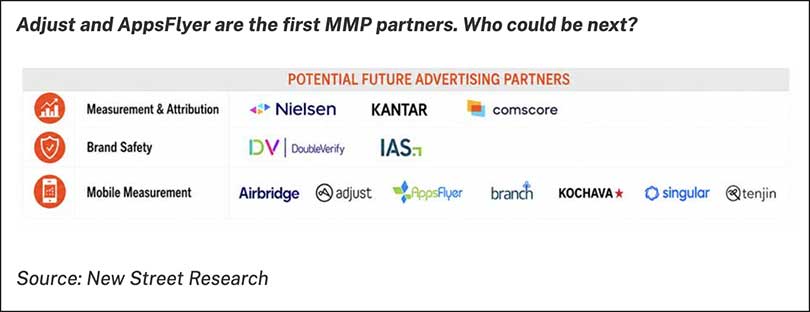
Salmon writes:
- “We view the launch as an important step toward expanding ChatGPT beyond web-based advertisers and into the sizable mobile user-acquisition market. More complete install and post-install data should also provide OpenAI with better conversion signals for campaign optimization, which could improve advertiser ROAS and support greater budget allocation over time.”
He adds that the MMP partners and other enhancements “build on the Pixel and server-side Conversions API” already in place, “bringing targeting, measurement and optimization into a more integrated performance-advertising stack.”
OpenAI has also rolled out optimized cost-per-click bidding (oCPC) for its Conversions objective. Advertisers still pay on a CPC basis, but OpenAI optimizes delivery for clicks expected to generate a specified conversion, such as a purchase or add-to-cart.
Taken together, the additions give OpenAI more of the measurement and optimization infrastructure needed to compete for performance advertising budgets.
Of interest (last updated August 12):
- Measure Results – OpenAI Help
- Ads Manager Availability – OpenAI Help
- Create Campaigns for ChatGPT Ads – OpenAI Help
TECH
Opinion: More data doesn’t fix pooled architecture
As we noted in Part 4 of his “Two Architectures” series, Chalice CEO Adam Heimlich argued that a pooled advertising system can optimize toward a different objective than an individual advertiser.
For Part 5, Heimlich asks whether giving the pooled system better data solves the problem. He turns to retail media, where networks can have purchase records, loyalty files, basket histories and point-of-sale data, along with closed-loop attribution.
He writes, “The network’s data advantage makes it superb at recognizing the customer the brand already has. That is the harvest, executed at the highest resolution available.”
Find me new customers
Heimlich argues that a system optimized for attributed sales can become good at finding people already likely to buy, while an enterprise advertiser may instead want to find genuinely new customers. Even defining “new” can depend on the advertiser, its products and purchase cycle.
His conclusion: “The constraint was never the quantity of data. The distinction is structural, not informational.”
Read: The Two Architectures, Part 5: The Indistinguishable Customer (August 13) – Adam Loves Adtech
LLMs & CHATBOTS
Developments
- Anthropic could be worth $2 trillion when it goes public (August 13) – Ars Technica
- OpenAI hires Dali Rajic, COO of Alphabet’s Wiz, as chief revenue officer, replacing ex-Slack CEO Denise Dresser, who was hired in December 2025 and will leave (August 13) – Bloomberg (subscription)
- Introducing Gemini 3.7 Flash (August 13) – Google
PEOPLE MOVES
Pinterest takes its intent off Pinterest
- “Today I’m excited to announce that I’ve taken on an additional role as GM, Programmatic & Affiliate at Pinterest, alongside continuing as CEO of tvScientific by Pinterest.” (August 13) – Jason Fairchild on LinkedIn
MORE
- Nielsen’s $2.15B DoubleVerify Bet Could Make it a Player, Not Just a Referee (August 13) – Adweek (subscription)
- Moloco launches an agency partner program, in part to expand beyond mobile programmatic (August 13) – Digiday (subscription)
- Luma and Dumbstruck Launch Creative Intelligence for Advertising (August 13) – Luma
- DoubleVerify Expands Measurement Coverage on TikTok Pangle (TikTok’s ad network) In the United States and International Markets (August 13) – press release
- Agentic AI’s biggest obstacle in APAC isn’t the technology (August 13) – The Trade Desk’s The Current