
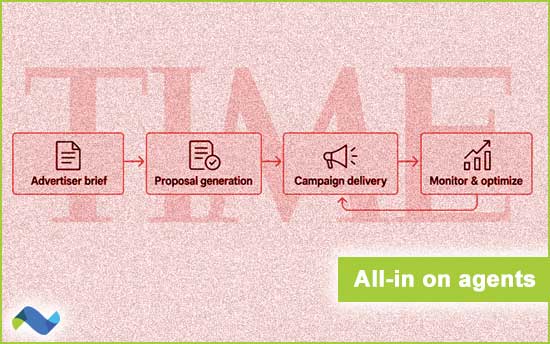
Time has deployed Kana AI agents across its advertising business, connecting proposal generation with ongoing campaign monitoring.
According to a press release yesterday, Kana’s Media Proposal Generator converts inbound RFPs into inventory-aware proposals using Time’s pricing and packaging guidance, reducing a process that previously took days to minutes. Its Campaign Orchestrator continuously monitors live campaigns for pacing, underdelivery and optimization opportunities.
The agents operate within controls established by Time, including budget limits, pricing guidance and approval thresholds that determine when they can act independently and when human sign-off is required.
Read: Time Turns to Kana’s Agentic AI to Power the Next Era of Ad Sales and Campaign Delivery (Sept. 22) – press release
From tipsheet: Tipsheet readers will recall that Mobian is helping Time develop ads intended for AI agents. Kana’s newly announced tools address a separate part of the business: proposal generation and campaign monitoring. The announcement doesn’t say the systems are connected, but Time is pursuing agentic advertising on two fronts: new ad experiences and the workflows used to sell and deliver campaigns.
Related: Kana CEO Tom Chavez on what comes after the martech stack (Aug. 20) – tipsheet
PROTOCOLS
AAMP 3.0 maps agentic media-buying workflow
Industry standards body IAB Tech Lab has introduced AAMP 3.0, expanding its agentic advertising framework to cover the process from inventory discovery and proposal evaluation through negotiation, execution and reporting.
IAB Tech Lab CEO Anthony Katsur wrote on LinkedIn, “For publishers, that creates the opportunity to reach more buyers with more ad products or custom ad solutions that demonstrate why their audiences and inventory fit the brief, and to earn a place on more media plans.” Read more. (Sept. 22)
Once an agreement is reached, the transaction can run through existing buying and reporting infrastructure, including OpenDirect, the Deals API and AdCOM. OpenProposal is available for public comment through Oct. 22.
Read:
- “IAB Tech Lab Introduces AAMP 3.0 to Standardize the RFP-to-Buy Process for Agentic Advertising” (Sept. 22) – IAB Tech Lab
- OpenProposal – GitHub
From tipsheet: If adopted, AAMP 3.0 could move media discovery and selection into an agent layer above the buying platforms. DSPs, SSPs and existing deal infrastructure would still execute campaigns, but agents would help determine which publishers and packages make the plan. Because it works with existing pipes, the industry can adopt agentic planning without rebuilding the transaction stack.
Also yesterday: “IAB Releases Measurement Services Addendum v1.0 for Public Comment” (Sept. 22) – IAB
LLMs & CHATBOTS
OpenAI builds an SMB growth machine
OpenAI is staffing a dedicated “SMB Ads” marketing team as it works to expand ChatGPT Ads beyond major brands and reach hundreds of thousands of advertisers.
New Street Research analyst Dan Salmon identified five openings spanning growth marketing, lifecycle marketing, content, international expansion and scaled programs. The SMB group now represents 19% of OpenAI’s open advertising-related positions, according to his analysis.
Salmon writes, “Getting its self-service platform in front of every single advertiser on [Google] and [Meta] will be vital to that goal.”
The hiring coincides with a much faster international rollout. Salmon notes that OpenAI Ads Manager has expanded from nine countries on Aug. 18 to 56 as of yesterday. In newer markets, OpenAI is also opening its self-service platform when ads launch rather than waiting two to four months.
From tipsheet: The Shopify and HubSpot integrations announced last week give OpenAI distribution through systems small businesses already use. The strategy is becoming clearer: reduce the expertise required to create a campaign, connect product and customer data and scale the advertiser base much faster than a traditional enterprise sales operation could.
LLMs & CHATBOTS
tipsheet: ChatGPT Ads’ next ad inventory
ChatGPT Ads has reached a $1 billion annualized revenue run rate in less than 200 days. And yet OpenAI reportedly projects $100 billion in annual ad revenue by 2030.
How could OpenAI reach $100 billion in annual ad revenue by 2030?
Tipsheet expects advertising to eventually expand beyond Free and Go and into:
- Higher-priced individual subscriptions.
- Sponsored commercial discovery inside Business and Enterprise.
To be clear, OpenAI has announced no such expansion to date.
Go shows subscriptions and advertising can coexist. Business could be the bigger unlock because ChatGPT can help employees decide which products and services to buy, creating valuable commercial intent inside the software itself.
The trust requirement: Advertisers may be able to buy shelf space, but they cannot buy a favorable recommendation from ChatGPT.
Read: “Why ChatGPT ads will move beyond Free and Go” (Sept. 22) – tipsheet
AGENTS
Seufert on Amazon’s gift to Meta
Following Monday’s news about the Amazon–Muse dispute, analyst Eric Seufert argues that Amazon’s decision to block Meta’s shopping agent could lead to an advertising deal. He predicts Amazon may let its merchants buy ads in Muse, giving Meta a way to monetize shopping activity while Amazon keeps control of its customer relationships.
Seufert writes:
“Meta doesn’t currently support advertising in Muse. But I’d argue that Amazon blocking Muse opens exactly that door. In that way, I view it as a gift: it provides Meta the air cover to adopt the advertising model.
Not that it needs it…”
Read: “Amazon blocking Muse is a gift to Meta” (Sept. 22) – Eric Seufert on Mobile Dev Memo (subscription)
COMMERCE MEDIA
Instacart ad net taps Gopuff’s last mile
“Instant commerce” company Gopuff will adopt Instacart’s Carrot Ads technology to power advertising across its U.S. digital storefront, giving more than 9,000 brands using Instacart Ads access to customers across Gopuff and Gopuff-owned BevMo!
Advertisers will be able to manage and measure campaigns across the connected properties through Instacart. Gopuff will continue offering bespoke, full-funnel campaigns directly to brands. The partnership also adds Gopuff to the Instacart Marketplace. Orders will be fulfilled through Gopuff’s micro-fulfillment network in as little as 15 minutes.
Read: “Instacart and Gopuff Announce New, First-of-Its-Kind Partnership in the U.S.” (Sept. 22) – press release
From tipsheet: AI may mediate discovery and purchasing, but last-mile fulfillment remains a source of leverage. Gopuff controls the physical network and inventory while Instacart contributes marketplace distribution, advertising technology and aggregated brand demand. The partnership lets Instacart extend its commerce media infrastructure across assets it does not own.
VIDEO
Sir Martin’s fund backs Higgsfield
On S4S Ventures’ investment in AI video startup Higgsfield, S4 Capital executive chairman Sir Martin Sorrell said on LinkedIn yesterday:
“While early consumer-grade AI sparked valid questions around creative quality, the technology is evolving at extraordinary speed. High-calibre, photorealistic generation is rapidly becoming the enterprise baseline.”
Read more. (Sept. 22)
Higgsfield’s $400 million funding round was announced in August.
Read: Martin Sorrell’s Venture Fund Backs AI Video Startup Higgsfield (Sept. 22) – Adweek (subscription)
LLMs & CHATBOTS
Developments
- “Introducing Claude Opus 5.5, the first model in our new Claude 5.5 family.” (Sept. 22) – Anthropic’s Claude on X
- “Introducing GPT‑6 Sol and Luna” (Sept. 22) – OpenAI
- Ande, which creates AI agents for booking entertainment, raises $52 million (Sept. 22) – The Information (subscription)
LLMs & CHATBOTS
Opinion: Skepticism about AI visibility metrics
Search industry veteran and SparkToro co-founder Rand Fishkin is questioning whether the emerging AI tracking industry can reliably measure brand visibility across chatbots.
He argues that answers vary across repeated prompts, while conversation history and personalization affect what each user sees. More fundamentally, the industry has no authoritative measure of what people are asking:
“We know there’s no source of truth about prompt volume. Clickstream panel data is the closest thing, but it can only see the first prompt, can’t see inside any app behavior, can’t see API-sent prompts, and can’t see any prompts inside many signed-in/paid accounts.”
Citation tracking is also suspect, Fishkin argues, because it remains unclear whether cited sources influenced an answer or were attached afterward. His larger objection is attribution: visibility scores alone cannot establish that a recommendation produced incremental sales.
Read: “5 reasons why I’m so skeptical of the entire AI tracking industry” (Sept. 22) – LinkedIn
From tipsheet: Prompt-based AI visibility scores are best understood as synthetic benchmarks, not measurements of the market. A consistent prompt panel can reveal directional movement, but its percentages should not be mistaken for audience reach or causal business impact.
Related: “Comscore data shows how AI discovery is splintering beyond ChatGPT” (Sept. 22) – Digiday
MORE
- Seller agent: “From Supply Discovery to Activation: Inside Magnite Showcase” (Sept. 16) – Magnite
- Creative agent: “Picsart Partners with Zappi to Unveil Vera,” bringing consumer insights into creative development (Sept. 22) – press release
- Performance identity: Taboola launches Realize ID to identify consumers during active purchase consideration (Sept. 22) – Taboola CEO Adam Singolda on LinkedIn
- Recommendation trust: “Shoppers think that AI’s answers are for sale” (Sept. 22) – Analyst Kiri Masters on LinkedIn
- B2B creative: “Smartly Collaborates with LinkedIn to Bring Intelligent Creative and Video at Scale to B2B Marketers” (Sept. 22) – press release